


AI Multimodal Domain Knowledge Engine
Built for Enterprise Agents · Powered by the Dual Engines of Jonex Wiki and Graph Ontology
English | 中文
Overview | Quick Start | Local Development | API Quickstart | Integration profile | Document and video parsing | Runtime requirements | Community & Security | License
If you find value in Jonex, please ⭐ Star the project to support us.
Overview
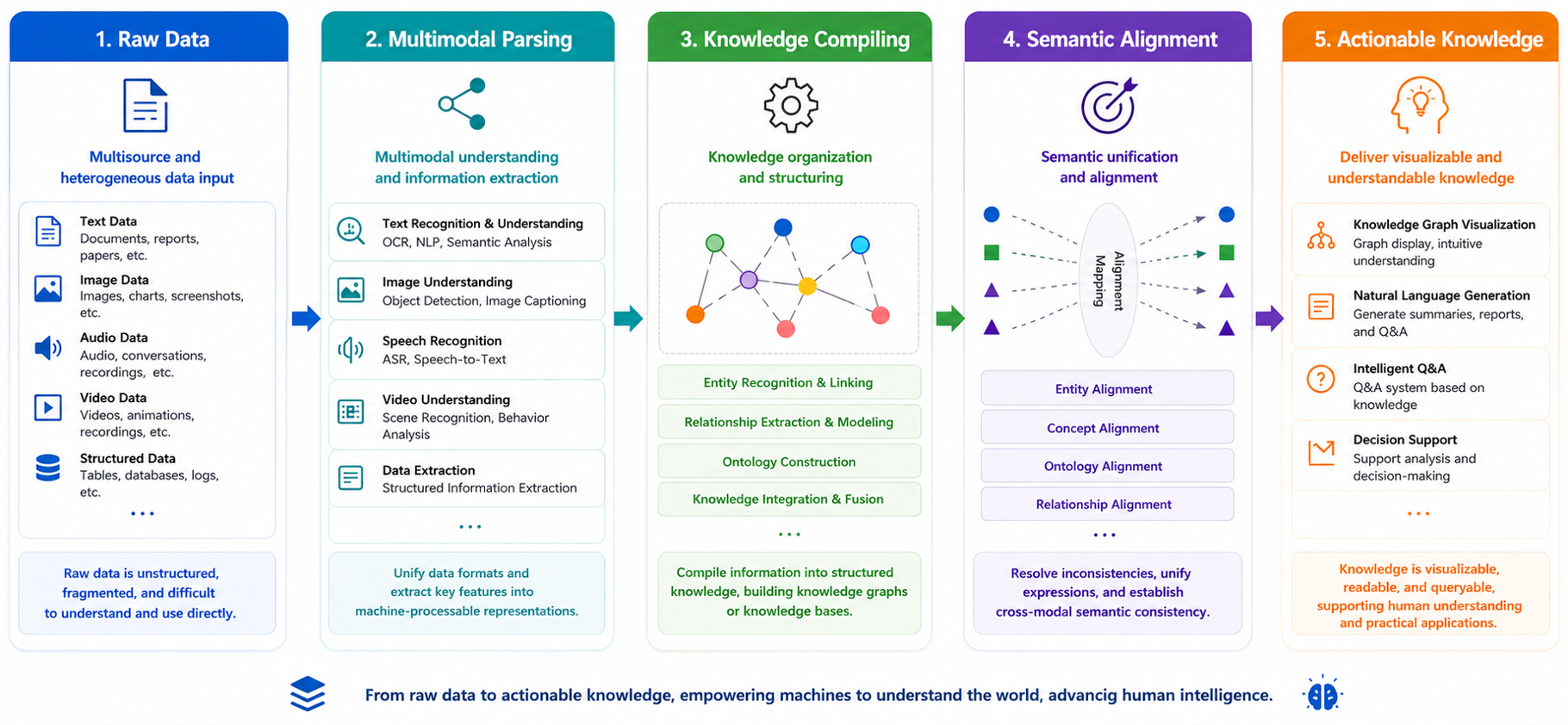
Jonex unifies an all-in-one multimodal parsing engine with an AI-ready knowledge engine. Ontology compiles domain reasoning into the knowledge layer before retrieval begins.
It is an end-to-end enterprise AI knowledge platform that turns raw content into reusable knowledge services. Jonex connects data ingestion, multimodal parsing, domain knowledge compilation, vector and graph indexing, source-grounded retrieval, feedback loops, and business applications in one governed system.
Quick Start
Docker Compose is the fastest way to run the complete platform.
Docker requirements
- Docker Engine or Docker Desktop
- Docker Compose v2 with Buildx
makeon macOS or Linux- Sufficient disk space and time for the first build, which downloads container images, Python dependencies, and RAG models
1. Clone the repository
git clone https://github.com/yuezhiai/jonex.git
cd jonex
2. Initialize configuration
make init
This creates:
deploy/.envfor the platform, database, object storage, and LLM Gatewaydeploy/.env.ragfor LightRAG, embeddings, and parsingdeploy/.env.mcpfor the MCP server- Frontend
.envfiles for Shell, Core Business, Ecosystem Management, Platform Management, and Dev Gateway
3. Configure model connections
Configure at least one OpenAI-compatible LLM and embedding provider in deploy/.env:
LLMGW_UPSTREAM_LLM_HOST=https://your-openai-compatible-host/v1
LLMGW_UPSTREAM_LLM_API_KEY=your_llm_api_key

LLMGW_UPSTREAM_EMBED_HOST=https://your-embedding-host/v1
LLMGW_UPSTREAM_EMBED_API_KEY=your_embedding_api_key
If your model names differ from the defaults, update the matching LLM_MODEL / EMBEDDING_MODEL keys — they are defined in both deploy/.env and deploy/.env.rag, and EMBEDDING_MODEL must be kept identical in the two files (it is used to build the vector index).
Keep LIGHTRAG_API_KEY identical in deploy/.env and deploy/.env.rag. For audio, video, or advanced image processing, also configure the VLM and ASR connections in deploy/.env.
4. Build and start
make build
make up
make ps
The first build creates the shared jonex/python-base:local image before Compose builds the platform services in parallel.
Use make logs to follow service logs when troubleshooting; press Ctrl+C to stop following them without stopping the platform.
5. Open Jonex
Visit:
http://localhost/
Local demo credentials:
Username: admin
Password: admin123
Tenant: tenant_jonex_demo
Security warning: These credentials are for local evaluation only. Change or remove the default administrator account before binding Jonex to a non-loopback interface, sharing the deployment, or exposing it to any network. Complete the production checklist in SECURITY.md before deployment.
Windows PowerShell
.\jonex.ps1 init
.\jonex.ps1 build
.\jonex.ps1 up
.\jonex.ps1 ps
Use .\jonex.ps1 logs when you need to follow service logs.
If script execution is restricted:
powershell -ExecutionPolicy Bypass -File .\jonex.ps1 help
Stop the platform
make down
On Windows:
.\jonex.ps1 down
Local Development
Local development uses root-level environment files and VSCode Debug. It is separate from the Docker deployment configuration under deploy/.
Toolchain requirements
- Python
>=3.12.13 - Node.js
>=20.18.0(Node.js 22 LTS recommended) - pnpm
>=9.0.0 - A current stable version of uv
Initialize the local environment
cp .env.local.example .env.local
cp .env.rag.local.example .env.rag.local
mkdir -p .vscode
cp docs/examples/launch.json.example .vscode/launch.json
make frontends-install
Set local middleware addresses in .env.local to 127.0.0.1, or replace SERVER_IP with a remote infrastructure host. Backend processes are started from VSCode Run and Debug; the Makefile no longer starts host backend processes.
Start the required local dependencies:
make dev-infra-up  # PostgreSQL, Redis, etcd, MinIO, and Milvus
# Or, when running the complete RAG stack locally:
make dev-deps-up   # Middleware plus LightRAG and Atomic RAG
Start the frontend gateway and applications in separate terminals:
make dev-gateway
make dev-frontend
Open http://localhost:8080.
Your First Knowledge Search in Five Minutes
- Sign in with the local demo credentials
admin / admin123in the demo tenanttenant_jonex_demo. - Open Core Business and create or select a domain space.
- Create a knowledge base and organize it with folders or tags.
- Select a parser profile or preset for the content you plan to ingest.
- Upload files, or configure a REST API or S3-compatible data source.
- Wait for multimodal parsing and knowledge compilation to finish.
- Inspect the parsing results, compiled ontology, relationships, and knowledge graph.
- Open Knowledge Search, ask a question, verify its references, and submit feedback.
API Quickstart
All external APIs are exposed through the unified Gateway.
Sign in
curl -X POST "http://localhost/api/v1/auth/login" \
  -H "Content-Type: application/json" \
  -H "X-Tenant-ID: tenant_jonex_demo" \
  -d '{"username":"admin","password":"admin123"}'
Use the returned access_token to call ontology-first search:
curl -X POST "http://localhost/api/v1/knowledge-base/search/ontology" \
  -H "Authorization: Bearer <access_token>" \
  -H "Content-Type: application/json" \
  -d '{
    "query": "What are the key risks described in these documents?",
    "knowledge_base_ids": ["<knowledge-base-id>"],
    "mode": "hybrid",
    "top_k": 5,
    "with_reasoning": true
  }'
The response includes the answer, matched knowledge bases, ontology instances, RAG usage, structured source references, and an optional reasoning trace.
In production, the browser communicates only with Frontend Gateway. Business APIs, capability services, and infrastructure components are not directly exposed to frontend applications.
Integration profile
- RAG-Anything and MinerU can be connected for multimodal content processing and document parsing
- LightRAG can be connected through the graph-enhanced retrieval adapter
- Neo4j and Milvus are packaged graph and vector persistence integrations
- OpenAI-compatible endpoints provide replaceable LLM, embedding, reranking, VLM, and ASR services
Document and video parsing
- Deploy the Atomic RAG parser with Docker Compose, run it as an independently scaled capability, or register a compatible parser service through a parser profile
- Process video locally with ASR, keyframes, and vision-language models, or route media analysis to a configured cloud service
- Scale parsing workers independently from the core platform; GPU acceleration is optional for model-heavy workloads
Runtime requirements
| Deployment profile | Requirements |
|---|---|
| Core platform | Docker Engine or Docker Desktop, Docker Compose v2 with Buildx, PostgreSQL 15, Redis 7, and object storage |
| Vector retrieval | Milvus, etcd, and MinIO or compatible equivalents |
| Ontology graph | A supported graph database service; Neo4j is the packaged integration |
| CPU parsing | Suitable for evaluation and light workloads; capacity scales with file size and concurrency |
| Accelerated parsing | Optional NVIDIA GPU and Container Toolkit for faster OCR, ASR, and vision-language processing; VRAM depends on the selected models |
| Cloud parsing | A compatible parsing or media-analysis endpoint, credentials, object storage, and outbound network access |
Community and Security
- Read CONTRIBUTING.md before opening an issue or pull request.
- Participation is governed by CODE_OF_CONDUCT.md.
- Report vulnerabilities privately according to SECURITY.md; do not include vulnerability details in a public issue.
- See CHANGELOG.md for release notes and compatibility changes.
License
This repository is licensed under the Jonex Open Source License, based on Apache License 2.0 with additional conditions. Third-party components remain under their respective licenses; see NOTICE and THIRD_PARTY_NOTICES.md.
Jonex — AI Multimodal Domain Knowledge Engine
Providing enterprise Agents with ontology-powered knowledge services that are reasoning-ready, traceable, and callable.
Enjoying Jonex?
Click ⭐ Star to support us, thank you!
© 2026 JONEX