

design-taste
Agent skills that make AI-generated interfaces look designed, not generated.
Every AI coding agent — Claude Code, Codex, Cursor, opencode — defaults to the same look: indigo-purple gradients, a centered hero, three feature cards, Inter, slate-900, rounded-2xl. Open any AI-built landing page and you can name the template in one glance.
It's not the model's fault. It's taste — and taste isn't in the training data.
This repo puts it back: 24 skills (and counting) that teach your agent to read the brief, pick a design direction deliberately, and avoid the patterns that scream "AI-generated."
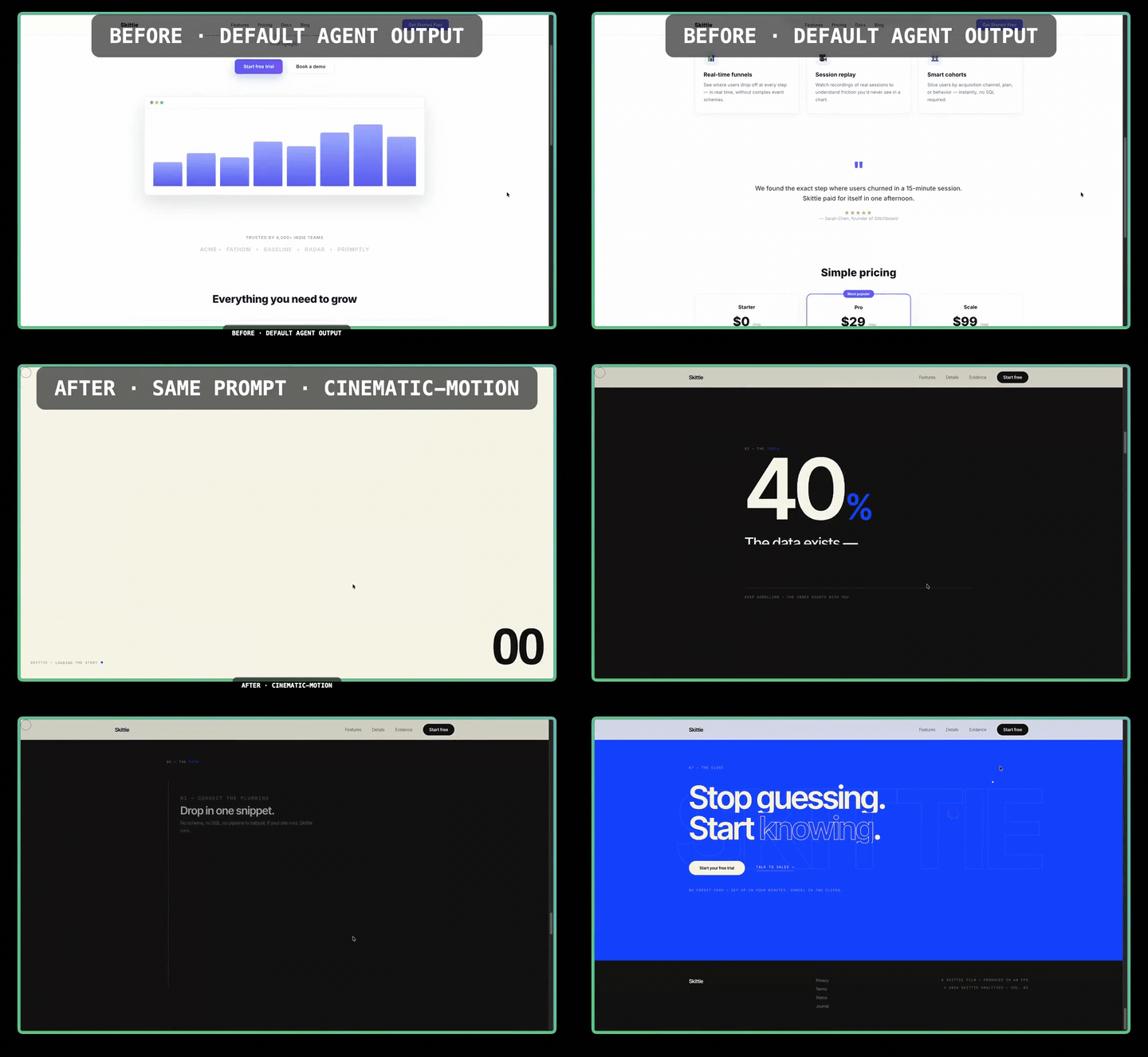
Same brief, twice: a default agent — then the cinematic-motion skill. 39 seconds, one cut. ▶ Full film
Don't take our word for it
Open these side by side in a browser. Same product, same copy, same sections — one built by a default agent, one built with design-taste loaded:
| Default agent output | With design-taste |
|---|---|
examples/before.html |
examples/after.html |
Five seconds, no tutorial needed. That's the whole pitch.
The catalog
Core
| Skill | What it does |
|---|---|
design-taste |
The core anti-slop skill: read the brief → declare a design read → ban the LLM defaults → craft the details → pre-flight checklist. Applies to any UI generation. |
Genre packs (opinionated identities — pick one per project)
| Skill | Identity | Demo |
|---|---|---|
editorial-minimal |
Swiss print: warm paper, ink, vermillion, serif + mono, hairline grids, indexed sections | after.html |
brutalist-industrial |
Declassified blueprint: visible grid rules, heavy caps, one signal color, mono coordinates | brutalist-industrial.html |
quiet-luxury |
Private bank annual report: ivory, deep ink, brass/oxblood accent, serif with italic flourishes | quiet-luxury.html |
dark-tech |
Linear/Vercel school: near-black, hairline borders, mono metadata, one restrained accent | dark-tech.html |
playful-color |
Sticker-poster energy: giant heavy type, thick ink outlines, two saturated inks, hard offset shadows | playful-color.html |
retro-print |
Riso/70s–80s print revival: warm stock, pigment inks, halftone dots, misregistered ink offsets, rubber stamps, poster type | retro-print.html |
japanese-minimal |
Wabi-sabi: rice paper, sumi ink, one seal-red hanko, mincho serif, negative space as the layout, one vertical text element | japanese-minimal.html |
neo-brutalism |
Loud consumer web: every element ink-bordered, 6px hard shadows, one hot + one cool accent, chunky pills, confident copy | neo-brutalism.html |
corporate-trust |
Trust-first enterprise: white, one deep-blue accent, system type, evidence tables, compliance chips, restraint as the brand | corporate-trust.html |
cinematic-motion |
Site-of-the-day: the page as a film on studio print — paper canvas, ink type, one electric blue, alternating scene canvases, live product screen, scrubbed index counter, drag carousel, roadmap pin | cinematic-motion.html |
Craft skills (reference-grade rules, stack on any pack)
| Skill | What it does |
|---|---|
taste-design-system |
Three-tier tokens (primitive → semantic → component), DTCG format, spacing/type scales, component anatomy, inventory audits, governance, adoption metrics |
taste-typography |
Pairing tables, fluid scales, line lengths, baseline rhythm, weight discipline, legibility minimums |
taste-color |
60-30-10 palette architecture, OKLCH ramps, WCAG 2.2 contrast math, semantic tokens, color-blind-safe pairs, dark mode |
taste-motion |
Duration/easing tokens, choreography, micro-interactions, reduced-motion compliance, what never to animate |
taste-gsap |
GSAP implementation craft: context/matchMedia gating, timeline architecture, pin & scrub hygiene, transform-only animation, refresh-after-fonts, reduced-motion fallbacks |
taste-accessibility |
WCAG 2.2 AA built into generation: semantics, keyboard, focus, labels, targets, errors, testing ritual |
taste-design-review |
Structured audit: capture → taste pass → Nielsen heuristics → a11y pass → severity-ranked findings → verify |
taste-landing-page |
Landing-page structure & conversion: 8-second rule, audience hero patterns, the selling sequence, CTA discipline, proof placement, pricing psychology, mobile behavior |
taste-ux-copy |
UX writing: voice/tone, headline formulas, button labels, error→fix triads, empty states, status/loading text, before/after pairs |
taste-brand-identity |
Logo/identity generation: concepting in two words, wordmark typography, lockups, clear space, favicon + og-image, one-page brand sheet |
Code skills (the engineering half of taste)
| Skill | What it does |
|---|---|
taste-code-craft |
Code-level craft for agent-built UI: semantic HTML, token-driven CSS (zero hardcoded values), specificity discipline, no inline styles, no dead code |
taste-web-performance |
Core Web Vitals budgets: LCP/CLS/INP targets, font loading without layout shift, image discipline, CSS/JS delivery, verify ritual |
taste-code-review |
Six-pass review order (behavior → structure → taste → security → performance → a11y), severity-ranked findings, diff discipline |
How they compose: genre packs decide the identity; craft skills police the details; code skills police the delivery. The core skill runs on everything. Install all and your agent picks what it needs from the description.
Install (5 seconds)
git clone https://github.com/madebymustafa/design-taste.git
cd design-taste
./scripts/install.sh              # installs all 24 skills to every agent it finds
Or manually — copy the skills/* folders into your agent's skills directory:
| Agent | Path |
|---|---|
| Claude Code | ~/.claude/skills/ |
| Cursor | ~/.cursor/skills/ |
| Codex | ~/.codex/skills/ |
| opencode | ~/.config/opencode/skills/ |
| Cline / Roo | ~/.cline/skills/, ~/.roo/skills/ |
See docs/INSTALL.md for details. To check your install: ./scripts/validate.sh — every skill must pass before a release.
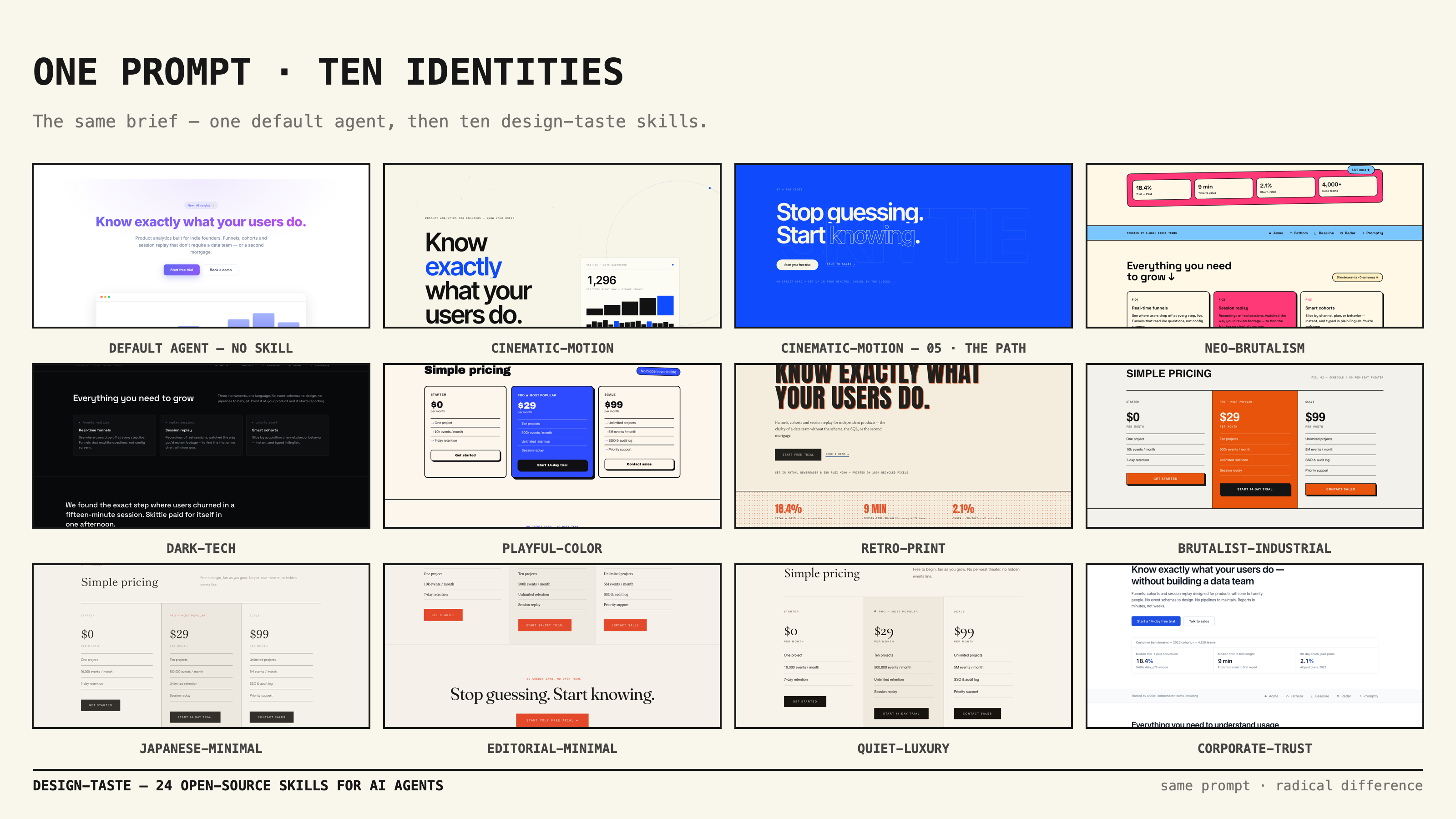
The whole argument is ten takes on one brief — gallery/README.md. Taste is instructions, and instructions ship.
Repo layout
design-taste/
├── skills/             # 24 skills — one folder per skill, SKILL.md inside
├── examples/           # before/after demo pair + one demo per genre pack
├── gallery/            # screenshot gallery (community before/afters)
├── docs/               # INSTALL, CONTRIBUTING
└── scripts/            # install.sh, validate.sh
Roadmap
- core
design-taste+ 10 genre packs + 13 craft/code skills - before/after demo for every genre pack
-
taste-figma-tokens— Figma ↔ code token sync workflow - CI: render-to-screenshot pipeline that diffs pages with/without skills
- community gallery & pack marketplace
Gallery
Before/after pairs from real agent runs — gallery/. Add your own; it's the best PR you can make.
And the whole family on one board — same brief, ten identities:
License
MIT — use it, fork it, ship it.
Made by a designer who doesn't think AI has to be boring. The skills are free; so is the opinion.