

Not every app needs a full node. Sync (and archive) only what you need.
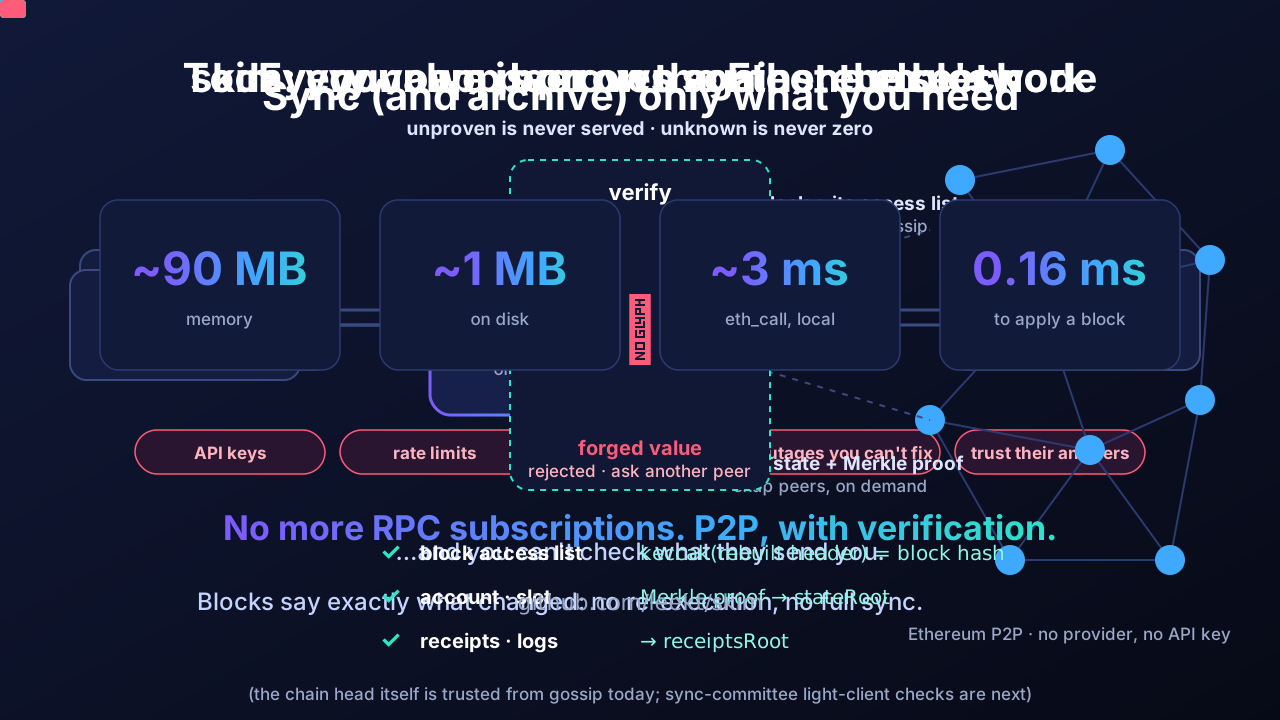

Real recording, real Sepolia: skim follows the chain from P2P gossip, and unmodified viem gets Uniswap V3/V4 state, quotes and logs from it. (MP4 · how it was recorded)
skim is an application-specific Ethereum state client. You declare the state your app cares about: accounts, storage slots, or whole simulations. skim keeps exactly that state current, straight from the Ethereum P2P network, and runs your eth_calls locally against it in milliseconds. Anything else is fetched on demand, with Merkle proofs verified, only when a request needs it.
There is no full node, no RPC provider, and no block re-execution. The state follows the chain through Glamsterdam's block-level access lists (BALs).
$ skim run --config skim.yaml          # follows Sepolia, serves JSON-RPC on :8545
$ cast call 0xfFf9…6B14 "balanceOf(address)(uint256)" 0x3289…EfF1 --rpc-url http://127.0.0.1:8545
101838818991837710804 [1.018e20]       # unmodified Foundry, viem, ethers
Why this is possible now
Until Glamsterdam, knowing the latest state meant executing every block, or asking a node that did. EIP-7928 changes that. Every block now commits to a block access list: every account and slot it touched, with the post-values it wrote. With ePBS, that list travels in the execution payload gossiped on the consensus layer.
skim builds on that:
| How skim gets it | |
|---|---|
| New blocks + their state diffs | CL execution_payload gossip. The EL header is rebuilt from the payload, so the BAL is bound to the block hash. eth/71 BAL requests fill gaps. |
| State it has never seen | snap/1 + snap/2 point lookups at the parent root, verified against the state root with Merkle proofs, then brought to the head by replaying the BAL |
| Execution | revm with Amsterdam rules over a per-key MVCC store |
The model: subscribed state, on-demand everything else
| Subscribed (your state watchlist) | On demand | |
|---|---|---|
| What | Accounts, slots and simulations you declare | Everything else |
| Freshness | Applied from every block's BAL | Fetched for the requested block; cached for a TTL |
| Hot path | No network. Target: a few ms | One verified fetch wave, then local |
| Guarantee | Ready = head BAL applied and every required key known. Otherwise reported as not ready. | Best effort, and never wrong: unknown state is never treated as zero |
# skim.yaml (see skim.example.yaml)
state:
  subscriptions:
    - name: weth-usdc-0.3%
      address: "0x6Ce0896eAE6D4BD668fDe41BB784548fb8F59b50"
      account: true
      storage: ["0x0", "0x4"]            # slot0, liquidity
    - name: my-quoter                     # a simulation you run every block
      calls:
        - to: "0xEd1f6473345F45b75F8179591dd5bA1888cf2FB3"
          data: "0xc6a5026a…"
      on_block: true                      # re-run each block; read via skim_subscriptionStatus
      retention: { mode: archive }        # keep every version on disk (skim run --archive <path>)
  on_demand: { enabled: true, cache_ttl_blocks: 4 }
  limits:    { max_subscribed_keys: 100000 }
Simulation subscriptions don't need you to know storage layouts. skim learns each call's access set, and protocol-aware predictors cover it too: for Uniswap V3, the tick range a swap of a given size can reach. Those keys stay warm.
What we measured
All numbers are from Sepolia, measured from one home connection over public peers. Details and caveats are in the experiment logs.
| Result | |
|---|---|
| Correctness | Every completed run matched a reference archive node byte for byte at the same block hash. Totals: 1,753 calls in a 1-hour soak; 2,700 calls with randomized, never-seen Uniswap V3 quotes; 866 with proof verification on; 36/36 JSON-RPC requests (P0, verified state). |
| State ready after a new block | BAL applied 0.16 ms after the payload arrives. State ready at about 880 ms P50 after slot start, bounded by gossip arrival (M1). |
| Warm simulation | Uniswap V3 quote over JSON-RPC: 0.25 ms P50, 0.56 ms P99; ~8,500 calls/s at 50 in flight |
| Fetch reliability | 298,084 SNAP jobs over public peers, 0 failed, 126 disconnects absorbed (soak) |
| Unseen inputs | Background prefetch had 99.9% of predicted keys ready at call time. Worst on-path fetch: 1.6 s (P1). |
| Footprint | ~120 MB RSS, ~0.25 CPU core. On disk: a restart snapshot of subscribed state (~1 MB for 2,400 keys; --ephemeral for none) |
What skim is not: faster than an in-process full node on raw execution, or a trustless light client (yet). It saves resources while keeping simulation quality close to a node's. Part of the saving is work that public SNAP peers do on skim's behalf.
Architecture
flowchart LR
  subgraph P2P["Ethereum P2P (Sepolia)"]
    CL["CL gossip<br/>execution_payload + BAL"]
    EL["EL peers<br/>eth/71 BALs · snap/1 · snap/2"]
  end
  CL -->|verify: rebuilt header hash matches block_hash| CHAIN[Chain placer<br/>reorgs · gaps]
  EL -->|gap fill| CHAIN
  CHAIN -->|BAL writes for tracked keys| MVCC[(Per-key MVCC store<br/>subscribed · on-demand TTL)]
  SUB[Subscriptions<br/>accounts · slots · simulations] --> PRED[State access predictor<br/>learned sets · V3 ticks]
  PRED -->|prefetch, low priority| SCHED
  SIM[revm simulator] -->|miss| SCHED[Adaptive SNAP scheduler<br/>AIMD · hedging · priorities]
  SCHED -->|Merkle-verified values| MVCC
  EL --- SCHED
  MVCC --> SIM
  SIM --> RPC[JSON-RPC :8545<br/>eth_call · estimateGas · getStorageAt …]
  SIM --> API[Rust API]
| Crate | Role |
|---|---|
skim-bal |
EIP-7928 decoding, commitment checks, per-key normalization |
skim-cl |
Minimal Gloas gossip listener: discv5, libp2p, envelope parsing, payload verification |
skim-el |
EL networking on reth: eth/71 BALs, snap/2 and a snap/1 client, head following |
skim-snap |
Adaptive request scheduler and SNAP Merkle-proof verification |
skim-state |
Per-key MVCC store (BAL application, base inserts with replay, reorg rollback, retention) and the selective on-disk archive |
skim-sim |
revm over snapshots, state access predictor, subscriptions |
skim-cli |
skim run (JSON-RPC), skim follow, probes and benchmarks |
Quick start
git clone https://github.com/leekt/skim && cd skim
cargo build --release                     # Rust 1.97 (pinned in rust-toolchain.toml)
./target/release/skim run --config examples/uniswap-v3/skim.yaml
Wait for state ready in the log. Then point any Ethereum tooling at http://127.0.0.1:8545:
import { createPublicClient, http, parseAbi, parseEther } from 'viem'
import { sepolia } from 'viem/chains'

const client = createPublicClient({ chain: sepolia, transport: http('http://127.0.0.1:8545') })
const { result } = await client.simulateContract({
  address: '0xEd1f6473345F45b75F8179591dd5bA1888cf2FB3',          // Uniswap V3 QuoterV2
  abi: parseAbi(['function quoteExactInputSingle((address,address,uint256,uint24,uint160)) returns (uint256,uint160,uint32,uint256)']),
  functionName: 'quoteExactInputSingle',
  args: [['0xfFf9976782d46CC05630D1f6eBAb18b2324d6B14', '0x1c7D4B196Cb0C7B01d743Fbc6116a902379C7238', parseEther('1'), 3000, 0n]],
})
// answered locally in a few ms
Next steps:
- Examples: Uniswap V3, Uniswap V4 and sending transactions, all with viem.
- Docs: getting started, how it works, configuration, JSON-RPC, archive, trust, troubleshooting.
Supported methods:
- State and simulation:
eth_call(with state overrides),eth_simulateV1,debug_traceCall(default,callTracer,prestateTracer),eth_estimateGas,eth_getBalance,eth_getCode,eth_getStorageAt,eth_getTransactionCount(includingpending) - Transactions:
eth_sendRawTransaction(gossiped straight to EL peers),eth_getTransactionByHash,eth_getTransactionReceipt - Logs:
eth_getLogs. Receipts are fetched only for blocks whose bloom and BAL match, and checked againstreceiptsRoot. - Blocks and chain:
eth_getBlockByNumber/eth_getBlockByHash,eth_blockNumber,eth_chainId,net_version,eth_syncing,eth_gasPrice,eth_maxPriorityFeePerGas,web3_clientVersion skim_subscriptionStatus,skim_status- WebSocket on the same port:
eth_subscribefornewHeads,logsandskim_subscriptions
Errors:
- Out-of-scope methods (
eth_sendTransaction, since skim holds no keys, and filters and subscriptions) return-32004. - State or blocks skim can't serve return
-32002. skim never returns a fabricated value.
Correctness rules skim lives by
- Unknown is never zero. A value is used only if it was written by a BAL, or fetched and verified.
- A SNAP answer must prove itself. Accounts are checked against the state root, slots against the verified storage root. A slot is zero only when proven: absent account, empty trie, or an exclusion proof. Anything else is "unavailable" and gets retried elsewhere.
- Fetch at the parent, replay to the head. At gossip time peers usually haven't executed the new block yet. skim reads at root(H−1) and applies BAL(H) itself.
- Reorgs roll back only to the common ancestor, using the EL chain, and replay from there.
Trust model
| Checked | Not (yet) checked |
|---|---|
| BAL ↔ block hash (header rebuilt from the payload), block hash ↔ builder bid | Proof-of-stake fork choice and finality, BLS signatures |
| Every SNAP value ↔ the block's state root (Merkle proofs) | Execution correctness of the block itself |
| Header parent links, code hashes |
Consensus light-client verification is on the roadmap. Until then, skim trusts the gossiped head the way an optimistic client does.
Status and roadmap
- M0: P2P feasibility (CL payload gossip, eth/71, snap/1+2, adaptive scheduler)
- M1: BAL state follower with MVCC store
- M2: simulator, JSON-RPC adapter, verified state, state access predictor
- M3: subscriptions (subscribed vs on-demand state)
- Resource benchmark vs a Nethermind full node (same workload, same block hashes)
- M4: selective state archiving.
retention: archivekeeps every BAL-written version of subscribed state on disk.eth_getStorageAtandeth_callthen work at historical blocks for what you subscribed to, from the block each key became known (90/90 and 51/51 historical reads matched a reference archive node, restart gaps healed from eth/71; see M4). Sync and archive only what you need. - M4.2: backfill from retained BALs.
--archive-backfill Nextends archived history up to about 2 weeks before a subscription existed. Unchanged keys are covered for the whole range; written keys are covered from their first write. Live: 102 historical reads matched a reference archive node, 3 were correctly refused, 0 were wrong. - M5: generalized learned patterns (exact args + amount buckets) with key/byte bounds. The V3 predictor is configurable in
skim run: calls that needed the network fell from 51 to 19 out of 400. Addedeth_sendRawTransaction, receipts andeth_getLogs, all identical to a reference node in every check (M5). -
storage: all: a contract's whole storage, downloaded and verified against its storage root, then kept current from BALs (Uniswap V3 pool: 3,677 slots; 29/29 sampled slots identical to a reference node). WebSocket JSON-RPC:newHeads,logs, andskim_subscriptionspushes with every block'son_blockresults - M6: correctness and bounds. Review fixes with regression tests. 2 h chaos soak (kills, restarts, key-set switches): 3,465 matches, 23 refusals, 0 wrong. Verified restart snapshots, warm
eth_call3× faster (M6) - Consensus light-client verification: implemented and unit-tested, waiting on consensus clients to serve Gloas light-client data
- Mainnet once Glamsterdam ships there
Design: PROJECT.md. Guides and experiment logs: docs/.
License
Licensed under either of Apache License 2.0 or MIT, at your option.