



Our survey
From Existing Methods to New Research Ideas: Two Perspectives on Recursive Self-Improvement
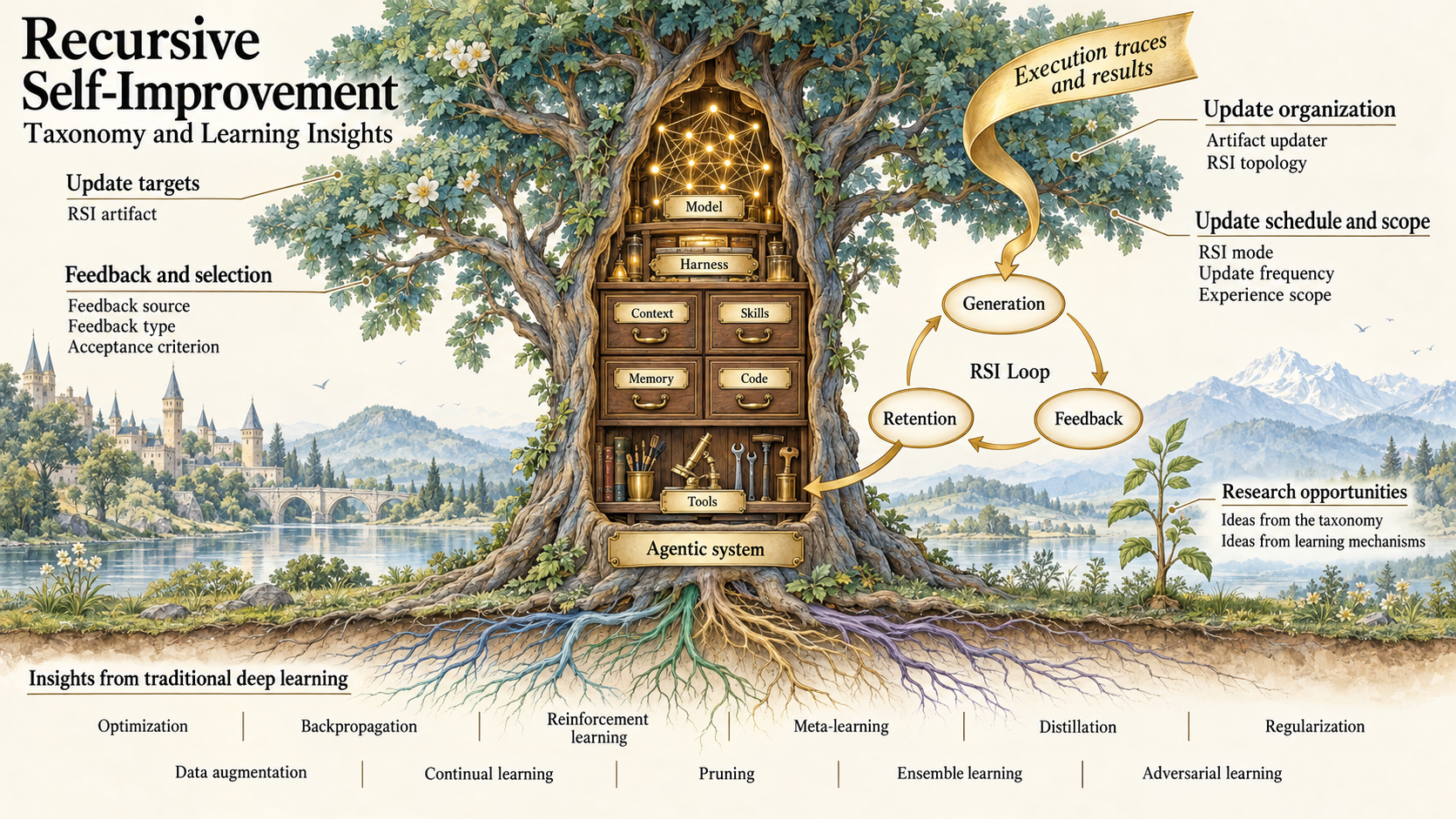
A nine-dimension taxonomy of RSI methods and insights from traditional deep learning to inspire new research.
Watch the walkthrough · 1 min
awesome-rsi-walkthrough.mp4
Start here
Awesome RSI collects benchmarks, methods, and systems for Recursive Self-Improvement. We follow the loop: an agent performs tasks, learns from trajectories and feedback, updates its own state, and uses that updated state in later work. That state can be model parameters, harness code, context, memory, or skills.
107 method papers · 33 benchmark papers · 3 systems
| Looking for… | Start with… |
|---|---|
| An introduction to RSI | Understanding RSI — an illustrated guide, available in English and Chinese. |
| A method to build on | Methods & Systems — filter by artifacts, topology, feedback, and more. |
| A way to measure improvement | Benchmarks — compare artifacts and online, offline, or hybrid protocols. |
| Connections between papers | Citation graphs — switch between methods and benchmarks, search for a node, zoom, and pan. |
| More background | Books, courses, and learning materials. |
Paper map
Each list in this README is organized along one dimension: RSI artifact for methods and systems, and RSI mode for benchmarks. For more ways to explore the collection, visit the Awesome RSI website, where you can compare additional dimensions and combine filters to find work that matches your interests.
What does the agent improve? The tree below follows the RSI artifact dimension.
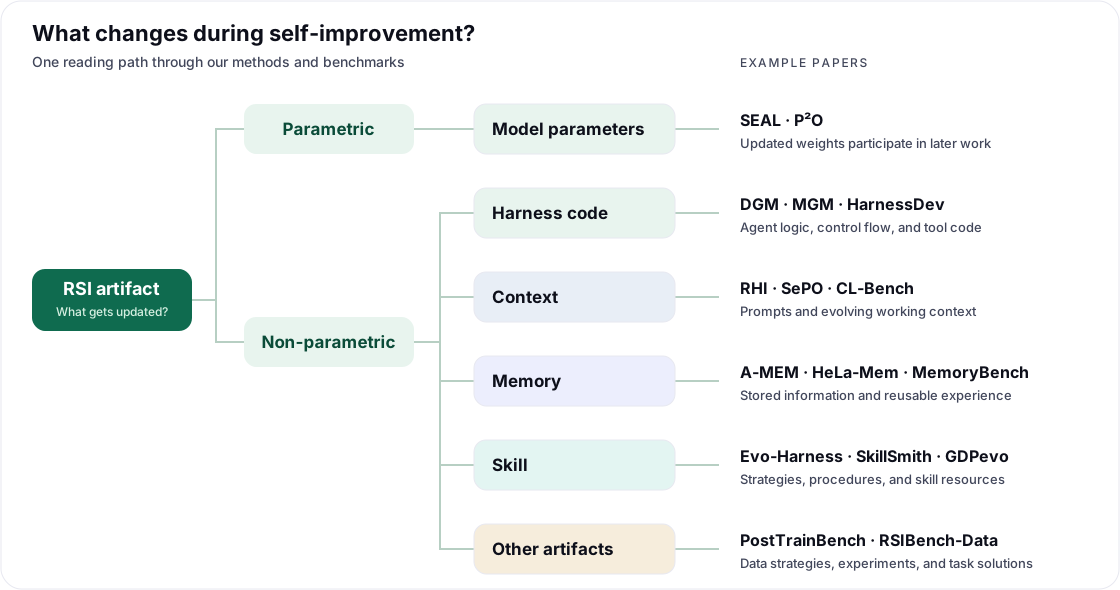
Model parameters · Harness code · Context · Memory · Skill · Other artifacts · Benchmarks
The tree shows examples from the collection. The lists below use the website's existing labels; a work can appear under multiple artifacts. Inclusion covers both explicit self-modification and experience-driven improvement during long-running tasks.
Methods & Systems
Compare all dimensions on the website →
Grouped by RSI artifact and ordered by first publication or project release date, newest first. Conference labels reflect the venue recorded in the collection; projects link to their repositories.
Model parameters
The student's model parameters are updated to improve task performance. This includes a teacher using student performance feedback to refine successive training rounds, even when each round restarts from the initial model, as well as the updated student continuing to learn from later tasks.
Harness code
Executable agent, harness, control-flow, self-improvement, or tool code is modified.
Context
Prompts or working context are updated. Observations, feedback, and experience can accumulate or be reorganized during a continuous run to guide later actions or tasks.
Memory
Information or experience is stored, updated, and retrieved across steps, trajectories, or tasks.
Skill
Reusable strategies, procedures, workflows, or skill resources are created and revised.
Other artifacts
Other artifacts evolve, such as data strategies, experiment configurations, or task solutions.
| Paper or project | Publication |
|---|---|
| Harness-of-Harness: Multi-Day Autonomous Software Development with Continual Improvement | arXiv preprint |
| EnvHarness: Awakening Static Worlds for Agent Learning | arXiv preprint |
Benchmarks
Compare benchmark dimensions on the website →
Grouped by RSI mode, newest first. Benchmarks that support multiple protocols appear in each relevant group. Artifact labels describe what evolves in the evaluated workflow.
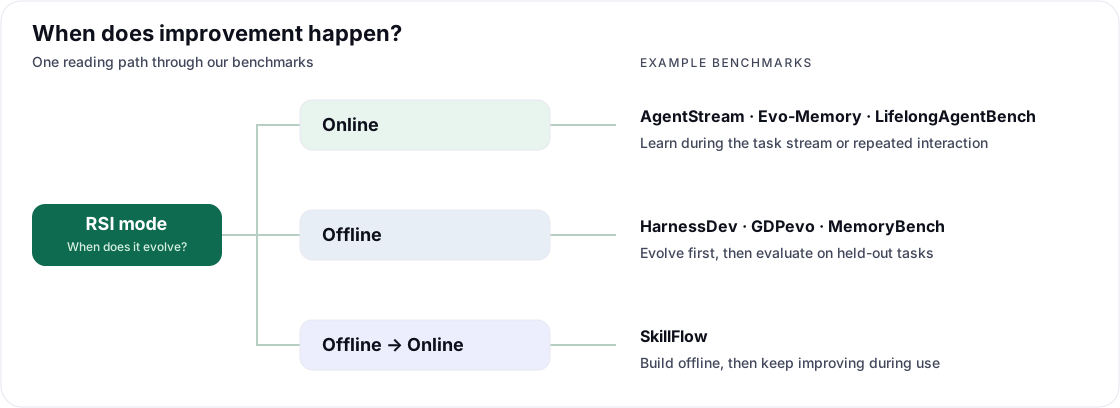
Online · Offline · Offline → Online
Online
Experience accumulates during the task stream or repeated interaction, and later work can use it.
Offline
Evolution precedes a separate held-out evaluation.
Offline to online
An artifact is built offline and continues to evolve during online use.
| Benchmark paper | Year | RSI artifact |
|---|---|---|
| SkillFlow: Benchmarking Lifelong Skill Discovery and Evolution for Autonomous Agents | 2026 | Context · Skill |
Use the explorer
- Choose a collection: Benchmark papers or Methods & Systems.
- Narrow the question: select multiple tags within a row, then combine dimensions across rows. For example, look for methods that update Skill, run Online, and use Environment feedback.
- Read and compare: search titles, sort by recency or citations, and expand abstracts and taxonomy profiles.
- Follow the connections: open Citation graph, choose methods or benchmarks, and search for a paper. Drag and zoom to explore its neighborhood.
The site supports English and Chinese, with the language switch in the upper-right corner.
Citation
If this collection is useful in your work, please cite it:
@misc{awesomersi2026,
  title        = {Awesome RSI: A Curated Collection of Recursive Self-Improvement Benchmarks and Methods},
  author       = {Prism-Shadow},
  year         = {2026},
  howpublished = {\url{https://github.com/Prism-Shadow/awesome-rsi}},
}
WeChat Group
Scan the QR code to join the Awesome RSI discussion group.

Back to top ↑