

RAC-Hide
Robust Attribute Coding for images — hide one image inside another so it survives JPEG re-compression and proportional rescaling.

RAC-Hide is a dependency-free JavaScript implementation of robust image steganography. A secret image is compressed to JPEG and embedded into the relationships between low-frequency DCT coefficients of a cover image. The result is visually indistinguishable from the cover and can be recovered after the cover has passed through the lossy re-encoding pipelines used by messaging apps and social platforms.
Everything runs locally: the library never uploads an image anywhere.
Dual use. Steganography is a general information-hiding technique. This project is released for research, digital watermarking / copyright protection and lawful covert communication. Do not use it to distribute illegal content or to evade lawful moderation. See Security and ethics.
Live demo
Try the full tool in your browser — nothing to install:
https://tuoPzf.github.io/rac-hide/demo/
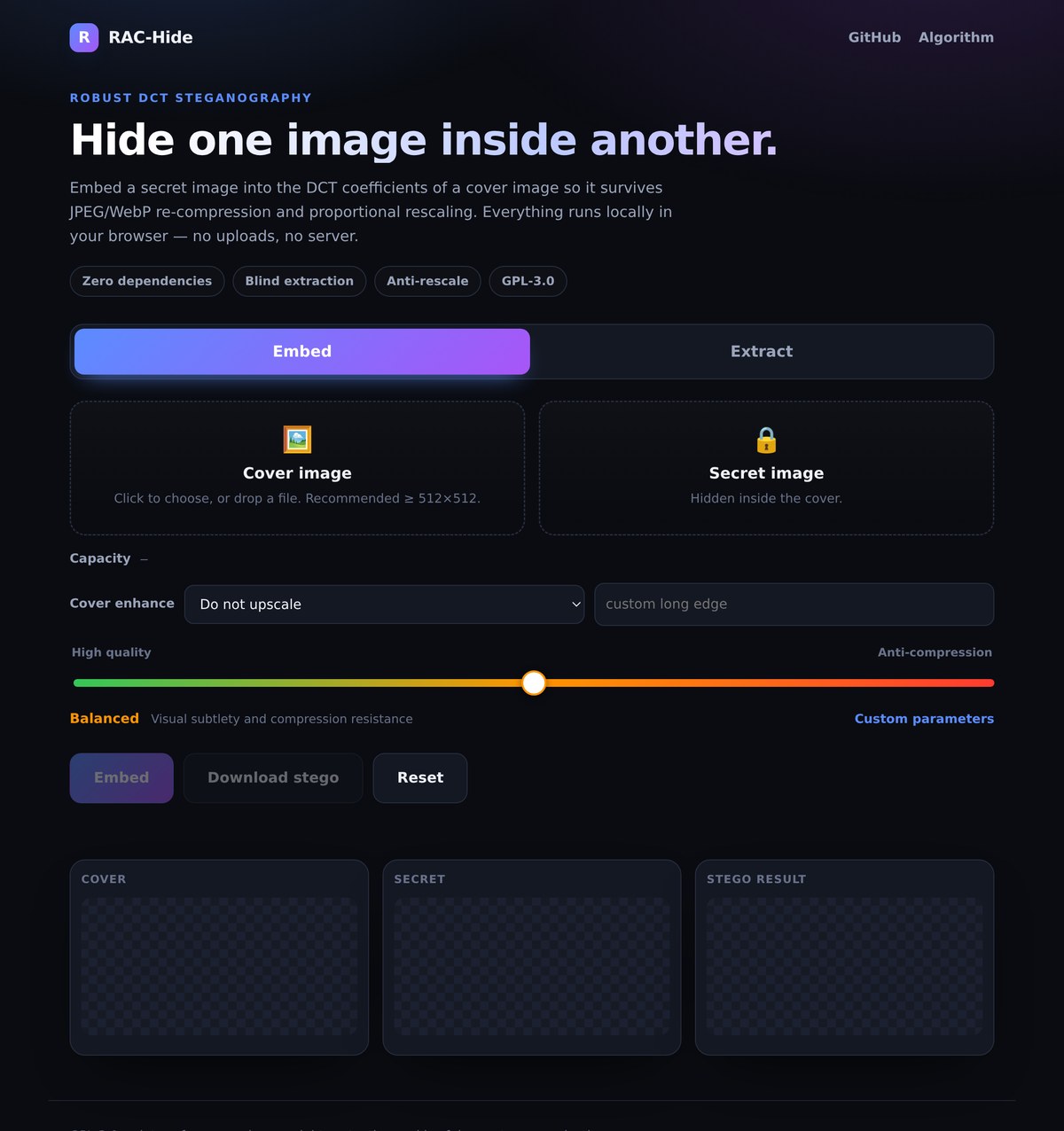
The demo exposes every knob: capacity read-out, cover enhancement, the quality ↔ anti-compression slider, custom embedding parameters, progress feedback and previews. All computation stays on your device.
Why coefficient relationships?
JPEG quantises every DCT coefficient independently, so absolute coefficient
values are not stable under re-compression. But if two coefficients receive
almost the same quantisation step, their difference is stable — quantisation
shifts both members in nearly the same direction. RAC-Hide therefore encodes one
bit as the sign of C1 - C2 for a carefully chosen coefficient pair, and
actively pushes that difference away from zero by an adaptive margin.
That single idea, plus error-correction and interleaving, is what makes the payload survive the channel.
Pipeline
EMBED
  secret image ─▶ JPEG ─▶ 11-byte header ─▶ Reed–Solomon ─▶ bit repeat ─▶ interleave
                                                                              │
  cover image ─▶ YCbCr ─▶ Cb + spatial ruler ─▶ luma ─▶ 8×8 DCT ─▶ pair modulation
                                                                              │
                                                             IDCT ─▶ RGB ─▶ stego PNG

EXTRACT
  stego image ─▶ read ruler from Cb ─▶ normalise scale ─▶ 8×8 DCT ─▶ pair differences
                                                                          │
        search (ppb, repeat, nsym) ─▶ RS decode ─▶ header check ─▶ JPEG ─▶ secret image
See docs/algorithm.md for the full design, or the
src/ modules — each one is self-contained and documented.
Features
- Anti-JPEG. Payload lives in quantisation-robust coefficient differences.
- Anti-rescale. A resolution-independent spatial ruler in the chroma channel lets the decoder recover the original dimensions at any scale.
- Blind extraction. The payload is self-describing; no original cover and no side channel are needed.
- Zero dependencies. Pure ES modules, no build step.
- Isomorphic core. The
src/core.jscodec runs in Node, a Web Worker or a browser; onlysrc/browser.jstouches the DOM.
Quick start
Node
import { buildPayload, embed, extract, capacityBytes } from 'rac-hide';
import { readFile, writeFile } from 'node:fs/promises';

// `imageData` is any { data, width, height } with RGBA bytes
const cover = await loadImage('cover.png');
const secretJpeg = await readFile('secret.jpg');

const options = { ppb: 2, repeat: 1, nsym: 48 };
console.log(capacityBytes(cover.width, cover.height, options), 'bytes available');

const payload = buildPayload(secretJpeg, options);
const stego = embed(cover, payload, options);      // -> { data, width, height }
const result = extract(stego);                     // -> { jpeg, ppb, repeat, nsym }
await writeFile('recovered.jpg', result.jpeg);
Browser
import { embedImage, extractImage, decodeImageFile, imageDataToBlob } from 'rac-hide/browser';

const cover = await decodeImageFile(coverFile);
const secret = await decodeImageFile(secretFile);

const { stego, secretSize } = await embedImage(cover, secret, { ppb: 2, repeat: 1, nsym: 48 });
const blob = await imageDataToBlob(stego, 'image/png');

const recovered = await extractImage(await decodeImageFile(blob));
Run the demo locally
The hosted demo is at https://tuoPzf.github.io/rac-hide/demo/ (the site root
redirects there). To run it from a checkout, serve the repository over HTTP
(ES modules do not load from file://):
python3 -m http.server 8000
# then open http://localhost:8000/demo/
Operating points
| Preset | ppb |
repeat |
nsym |
Trade-off |
|---|---|---|---|---|
capacity |
6 | 1 | 32 | Largest, sharpest secret; weakest against attacks |
balanced |
2 | 1 | 48 | Recommended default |
robust |
1 | 3 | 48 | Strongest against compression/rescaling; smallest |
| Parameter | Effect when increased |
|---|---|
ppb |
Capacity rises linearly; per-bit margin is spread thinner |
repeat |
Random-error resilience rises; capacity falls by the same factor |
nsym |
Corrects more errors; payload shrinks (RS rate (255-nsym)/255) |
marginMin |
Robustness rises, visibility rises |
marginGain |
Textured blocks get larger margins (more robust, less invisible) |
marginMax |
Caps the distortion in high-energy blocks |
Capacity in bytes:
total slots   = (W/8) · (H/8) · ppb
codewords     = floor(total slots / 2040)
capacity      = floor(codewords / repeat) · (255 - nsym) - 11
Robustness
Measured with the bundled test-suite and manual platform round-trips:
- Lossless for a clean embed → extract cycle, and for mild additive noise.
- The spatial ruler is recovered after proportional rescaling and JPEG/WebP re-compression.
- Survives aggressive JPEG quality reduction and rescaling on the
robustoperating point.
Known limits:
- Cropping breaks the lattice alignment and is not recoverable.
- Watermarks / redrawing destroy the signal.
- Heavily rescaled and heavily re-compressed images can exceed the error
budget, especially on the
capacitypreset. Robustness is content-dependent: flat covers are harder than textured ones.
If the spatial ruler cannot be read, the extractor accepts the original cover dimensions manually as a fallback.
Project structure
src/
  constants.js      coefficient pairs, magic, defaults
  dct.js            orthonormal 8x8 DCT-II / inverse
  color.js          BT.601 helpers and chroma-preserving luma reconstruction
  reed-solomon.js   GF(256) RS codec
  interleave.js     global bit scattering
  ruler.js          spatial ruler (anti-rescale metadata)
  core.js           the codec: embed() / extract() / capacityBytes()
  browser.js        DOM helpers and high-level embedImage() / extractImage()
  index.js          public entry point
demo/               standalone browser demo
test/               node:test suite
docs/algorithm.md   detailed design notes
Testing
npm testThe suite covers the RS codec, the DCT round-trip, interleaving, the spatial ruler (including a simulated rescale) and full embed/extract round-trips across several operating points.
Security and ethics
- All computation is local. No network requests, no telemetry.
- This is a steganography, not an encryption, tool: the embedded payload is obfuscated, not cryptographically protected. Encrypt sensitive data first.
- Do not use this software to hide illegal content or to circumvent lawful content moderation. You are responsible for how you use it.
- The authors provide no warranty and accept no liability; see LICENSE.
Citation
If you use RAC-Hide in academic work, please cite it via
CITATION.cff.
Contributing
Contributions are welcome. Please read CONTRIBUTING.md and
CODE_OF_CONDUCT.md first, and report security issues
privately as described in SECURITY.md.