
Aseprite AI Artist
Your coding agent, painting in the Aseprite window you already have open.
Not a generated PNG. Not a file changed behind your back. The document on your screen, one pixel at a time — and every step is one Ctrl+Z.

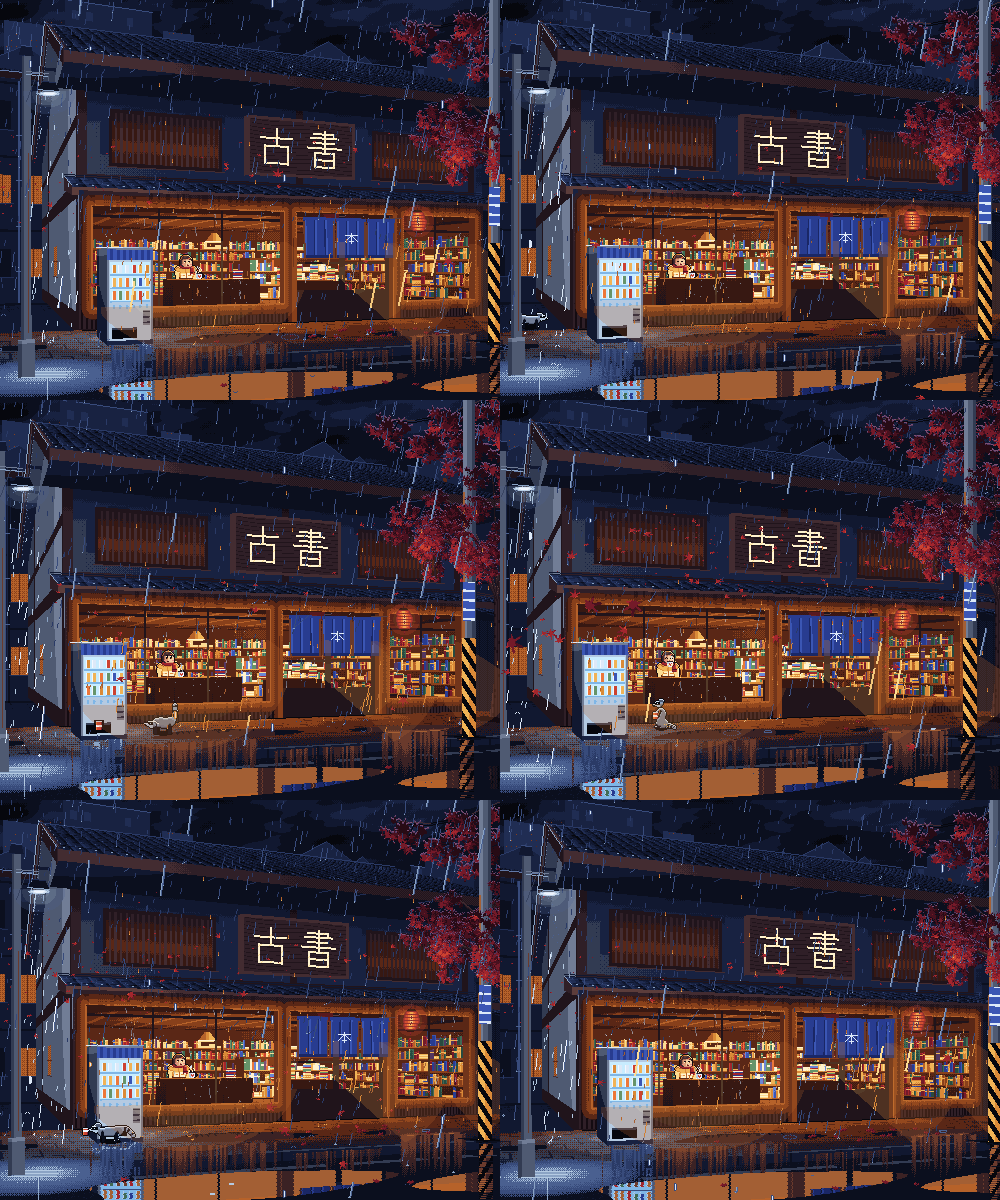
☔ 500×400 · 384 frames at 24 fps · 16 s · 24 layers — drawn by Claude Opus 5.5 through this server.
Install · How it draws · Skills · Gallery
✨ What it feels like
"Draw me a 32×32 knight in the PICO-8 palette, then give him a 4-frame idle."
You type that, and watch it happen in Aseprite: a palette, a silhouette, shading, layers, a breathing idle, a tagged cycle. The agent looks at its own work after every step, and at the end tells you what it compromised on.
You stay in charge. Don't like the helmet? Ctrl+Z, or just say so.
Works with Claude Code, omp, OpenCode, Codex CLI, Gemini CLI, Cursor, VS Code and Windsurf. Best results so far: Claude Opus 5.5.
🚀 Install
You need Aseprite 1.3+ and Node 22.6+ (macOS, Linux or Windows).
1. The Aseprite extension — then quit and reopen Aseprite:
npx @pebbly/aseprite-ai-artist install-extension
2. Your agent:
Claude Code
/plugin marketplace add with-pebbly/aseprite-ai-artist
/plugin install aseprite@aseprite-ai-artist
omp
omp plugin marketplace add with-pebbly/aseprite-ai-artist
omp plugin install aseprite@aseprite-ai-artist
OpenCode 2.x
npx @pebbly/aseprite-ai-artist install opencode
opencode plugin add github:with-pebbly/aseprite-ai-artist#main::path:opencode
Codex, Gemini, Cursor, VS Code, Windsurf
npx @pebbly/aseprite-ai-artist install codex # or gemini, cursor, --allYour config is backed up first; --dry-run shows the change.
3. Check it — restart your agent, then:
npx @pebbly/aseprite-ai-artist doctor
All ticks means you're ready. Updating? Run step 1 again. Odd setups (Steam, custom folders, Windows paths) are in docs/INSTALL.md.
No window? Headless mode
For CI or a batch of assets, the server can run Aseprite itself with no window:
npx @pebbly/aseprite-ai-artist serve --headless --aseprite /path/to/aseprite
Nothing is on disk until the agent saves, and it never touches a file your editor has open. It is never a fallback: if your window isn't attached, the agent asks instead of quietly switching.
🎨 How it draws
Ask /aseprite:studio for anything and it runs the whole job:
| Stage | What happens | |
|---|---|---|
| 1 | Connect | Checks Aseprite is attached and reads what's open. If it isn't, it stops — it never edits files behind your back. |
| 2 | Brief | Only for open-ended requests: size, palette, view, light — one message, one answer. |
| 3 | Concept | For anything new: writes the design down and gives you a prompt for an image model. Send back a concept sheet, or say "continue without". |
| 4 | Draw | Silhouette first, written as a text grid (below), then shading. |
| 5 | Animate | Splits limbs onto layers, plans key poses and timing, draws each frame, tags the cycles. |
| 6 | Review | A separate critic who didn't draw it judges the result cold — what does it look like to someone never told? Blockers get fixed one at a time; a fix is kept only if the critic, shown both versions blind, prefers it. |
| 7 | Export | Spritesheet + atlas, GIF or PNGs for your engine. |
After every step that changed pixels, it looks at the result before moving on.
🔤 The grid loop
New in 0.5.0. The agent doesn't draw with circles and rectangles — it types the frame out, one character per pixel, and draws that text in one call. To fix something, it reads the canvas back in the same format and changes only the characters that are wrong.
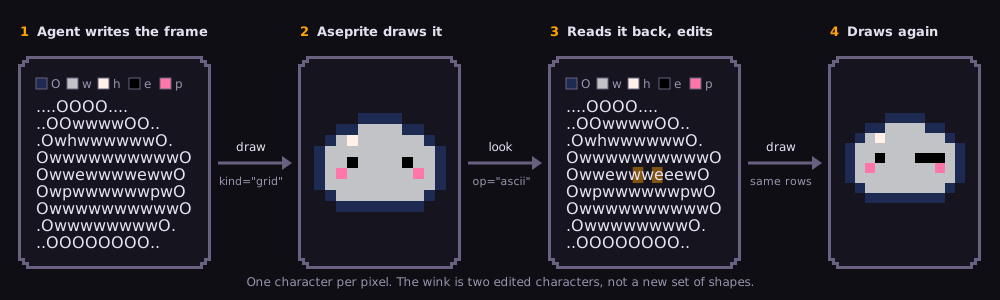
It sees the whole shape while writing it, so silhouettes stay even, limbs keep their length between frames, and an edit never spills into its neighbours. Animation is the same trick: copy the last frame's rows, move the arm, draw.
Since 0.6.0 every character stands for one palette entry, the same on every read, so a big canvas can be read and edited in pieces without the letters changing meaning between them. A grid can be as large as the canvas.
Early signal, not a measurement: with the same model and prompts, the mage benchmark went 3 → 4/10 and the road 1 → 3/10; the tree stayed at 2 (compare them).
📚 The pixel-art knowledge base
The agent doesn't improvise a hand at 16 px or a horse's walk — it looks them up.
62 rules · ~400 pixel templates · 2006 palettes — browse them at pixeli.pebbly.space/knowledge 👀
| 🧍 Craft | 🌍 World |
|---|---|
0x Core — loop, palette, shading, outlines |
5x Creatures — quadrupeds, birds, monsters |
1x Technique — lines, anti-aliasing, dithering |
6x Environments — skies, water, tiles, buildings |
2x Colour — hue-shifted ramps, materials, light |
7x Objects & 3D — perspective, isometric, props |
3x Characters — anatomy, faces, hands, clothing |
8x Effects & UI — fire, magic, particles, fonts |
4x Animation — idle, walk, jumps, attacks |
9x Style — console eras, tells of generated art |
Every rule gives size budgets, a procedure, common mistakes and grid templates
the agent pastes straight onto the canvas. Any MCP client reads them as
rules:// resources from rules/.
🎨 Palettes: the console classics plus Lospec's 2000 most-downloaded, each
credited — preset: "endesga-32", or just a word of the name.
👀 Review by fresh eyes
New in 0.8.0. The agent that drew a sprite is the worst judge of it — it
knows what it meant, so it sees it. studio hands the result to
pixel-critic, which first writes a cold read (what the picture shows to
someone who was never told), then a scored critique. A draft ships at 7/10
with nothing blocking; below that the agent fixes the one thing named,
snapshotting first. Each fix goes back to the critic as a blind A/B — old and
new under neutral names — and stays only if it wins, so a round can't quietly
make good art worse.
It costs time (roughly one more critique per round) and its effect on quality is not yet measured — the thirteen experiment runs behind it are in the gallery, next to the benchmark rows.
🧰 Skills
studio picks these for you. Call one directly when you know the step you want
— as /aseprite:<name> in Claude Code and omp, or just ask elsewhere.
| Skill | For | Try |
|---|---|---|
🎬 studio |
anything — it plans and runs the rest | /aseprite:studio a fox, 32×32, sleeping loop |
📝 brief |
a vague idea | /aseprite:brief a cosy tavern keeper |
🖼️ concept |
a design or storyboard before drawing | /aseprite:concept a fire mage, 4-frame walk |
📄 new |
a fresh document set up right | /aseprite:new 64×64, PICO-8 |
🎨 palette |
colour: a retro look, ramps, cleanup | /aseprite:palette give this a Game Boy look |
✏️ draw |
making the thing, text included | /aseprite:draw a fox curled up asleep |
🌗 shade |
flat art that needs light | /aseprite:shade light from the upper left |
🦴 rig |
splitting a character for animation | /aseprite:rig split the knight |
🏃 animate |
walk, idle, attack cycles | /aseprite:animate 8-frame walk cycle |
🧱 tileset |
terrain and autotiles | /aseprite:tileset grass-to-dirt, 16px |
🔍 review |
an honest critique | /aseprite:review why does this look off? |
🩹 fix |
changing art without wrecking it | /aseprite:fix make him more menacing |
📦 export |
files for your engine | /aseprite:export spritesheet for Godot |
🗂️ submit |
sharing it in the gallery | /aseprite:submit |
In Claude Code and omp, four specialists take stages off the main agent: palette-smith, rig-builder, animation-director and the read-only pixel-critic.
🏆 Which model?
Live from the benchmark: every model draws the same fixed prompts and is scored against written criteria. Your model is not on it? Send us a sprite!
🗂️ Gallery and benchmark
Everything drawn with the plugin — with its prompts, models and .aseprite
source — is at pixeli.pebbly.space. The
benchmark puts every model and plugin version through the same three fixed
prompts and scores them against written criteria, and the
knowledge base shows the rulebook
the agents draw by.
Made something? Ask your agent for /aseprite:submit — it packages the files
and opens the pull request.
🔧 Under the hood
your agent ──MCP──▶ server ──▶ bridge ──▶ Aseprite extension
- 18 tools, grouped by noun (
draw,look,layer,frame,export…) instead of ninety — every tool costs context on every turn. Reference. - A knowledge base in
rules/— 62 files from line craft to walk cycles, with pixel templates — served over MCP, so every client gets the same craft knowledge. - Safe by default. Every action is one undo step. With Aseprite detached,
tools refuse instead of editing files on disk. Everything binds to
127.0.0.1. Details · security.
🛠️ Development
pnpm install && pnpm run build
pnpm test                 # TypeScript
pnpm run test:extension   # the Lua handlers, inside a real Aseprite
pnpm gallery:check        # gallery and benchmark data
pnpm web:dev              # the site, locally
Read AGENTS.md before changing anything — it lists the rules that aren't negotiable and the Lua gotchas that already cost someone a day.
📜 Licence
MIT — see LICENSE. Aseprite is a trademark of Igara Studio S.A.; this project isn't affiliated with them.