

Speech synthesis, speech recognition and voice activity detection for voice conversation, in C++ on ggml
Models · Install · Quick start · Documentation · C API
English · 日本語
speech.cpp is one command, speech, and one shared library, libspeech, behind one C API, on the CPU, Metal and
Vulkan through ggml. The command speaks text, writes the text of recordings, finds
where someone speaks in them, transcribes the microphone as someone speaks (speech asr --live), serves OpenAI's audio
API and its Realtime transcription over HTTP, and runs a worker process for any program that keeps models loaded between
requests, ASIST among them.
A time to first audio of a quarter of a second or less. On an Apple M5, Qwen3-TTS 0.6B sends its first audio 0.04 s after the text and Irodori-TTS 0.25 s after it, and the rest follows while it plays.
One executable, nothing else to install. No Python and no CUDA: speech fetches each model by name, one GGUF file
with its codec, and runs it on Metal, Vulkan or the CPU.
OpenAI's API on your own computer. speech serve answers OpenAI's audio API and its Realtime transcription, so an
OpenAI client works by changing its base URL.
Checked against the official implementations. Every stage of every model is compared with the model's official implementation, from the same inputs.
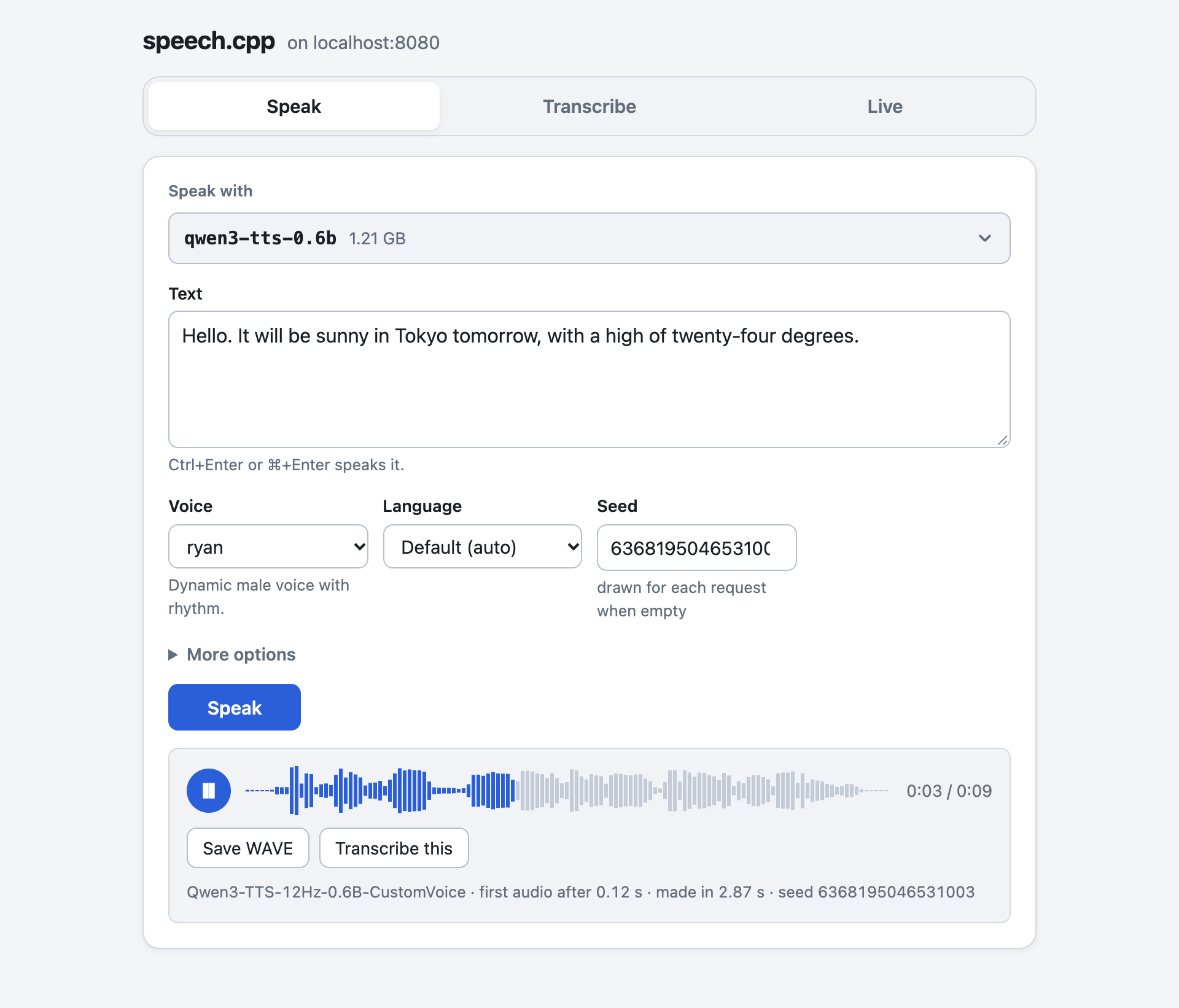
The page of speech serve --open: pick a model of the catalog, fetch it and try it.
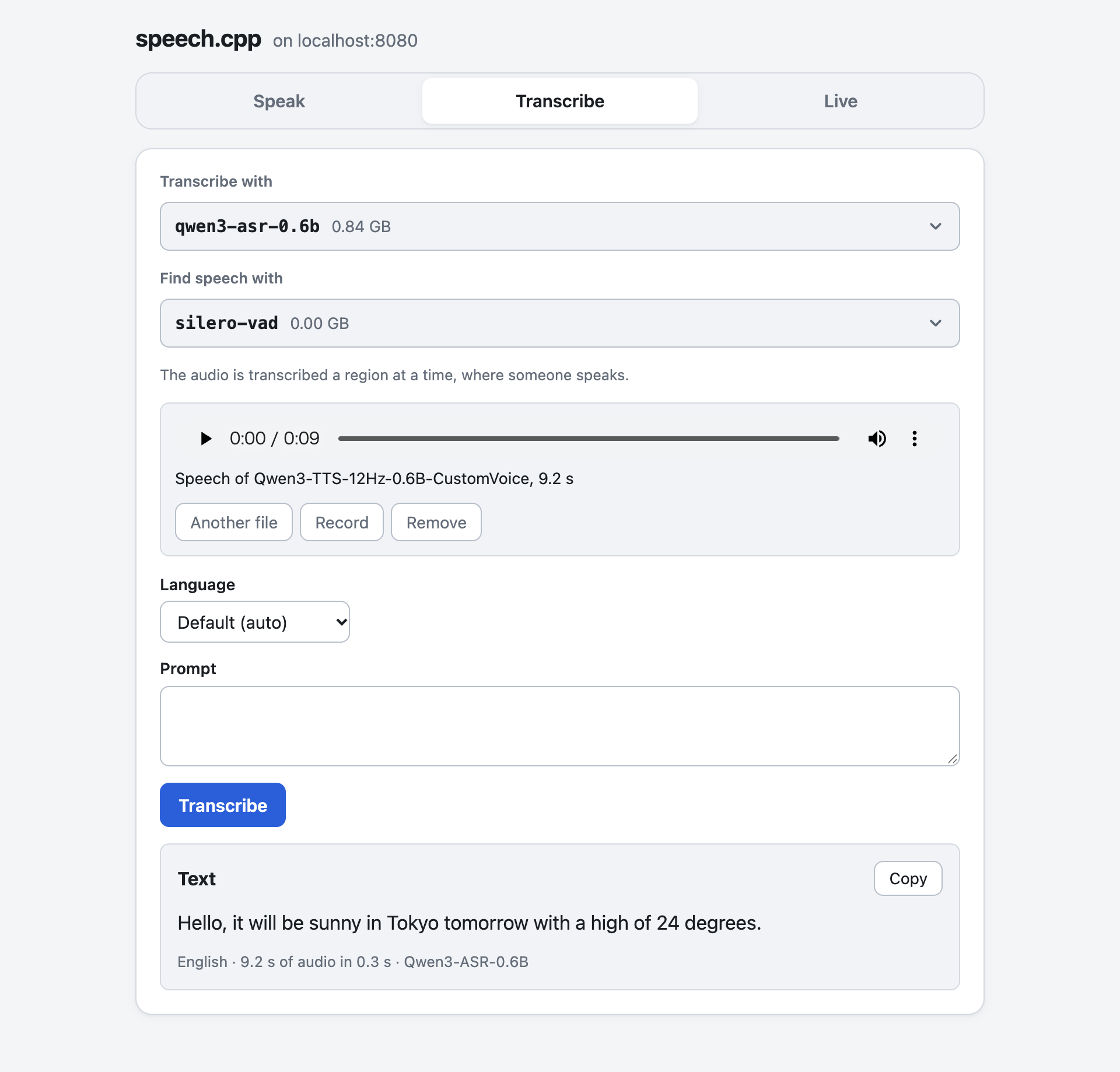 Transcribe writes a file or a recording, a region at a time where someone speaks. |
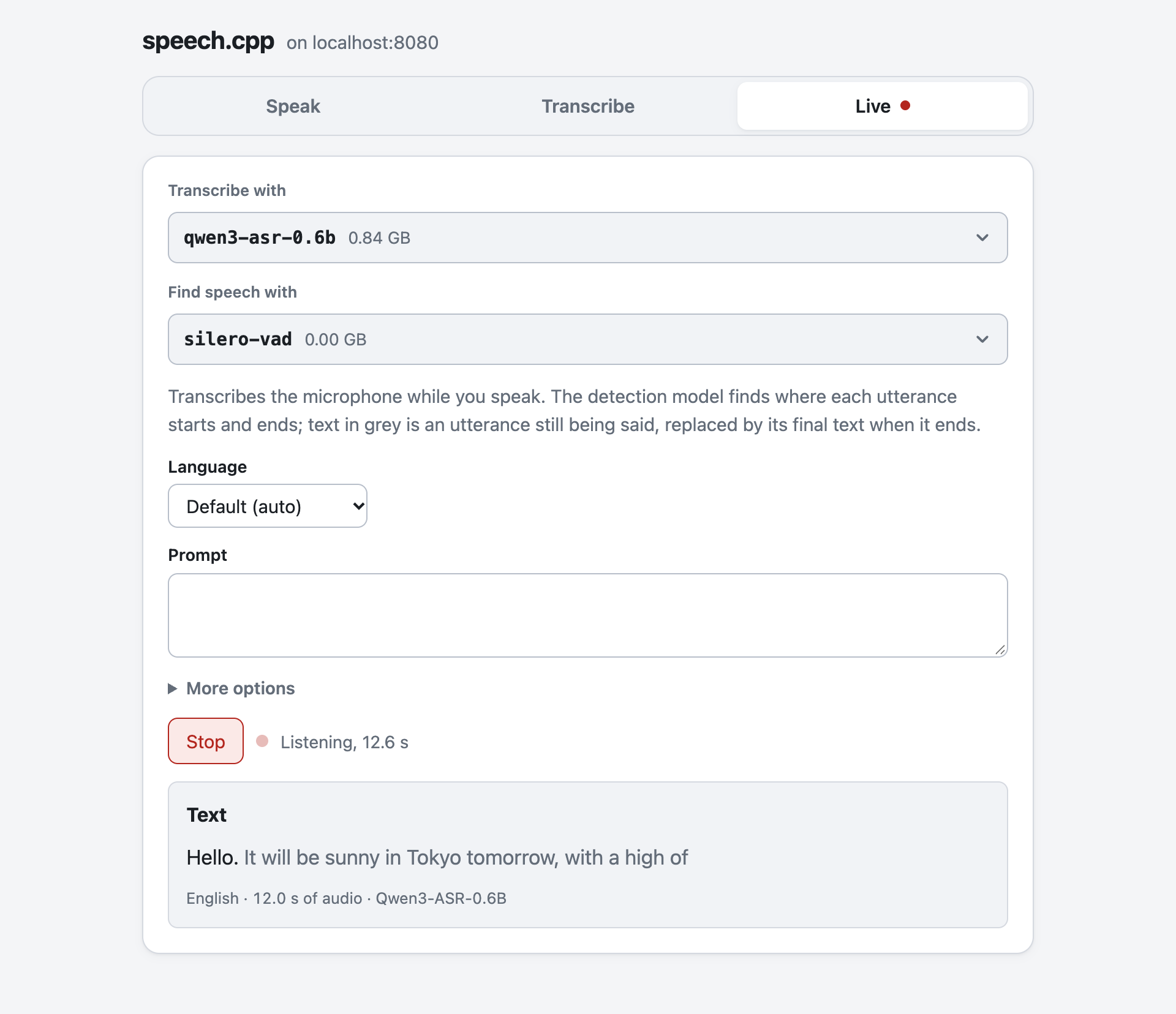 Live writes the microphone as you speak; the grey text is the utterance still being said. |
Models
| Task | Name | Languages | Good at |
|---|---|---|---|
| Synthesis | qwen3-tts-0.6b, qwen3-tts-1.7b |
de en es fr it ja ko pt ru zh | nine named speakers; audio that streams from its first frame of 0.08 s; the 1.7B model follows an instruction of how to speak |
| Synthesis | irodori-tts-mf, irodori-tts |
ja | Japanese in the voice of a reference recording, or in a voice described in words |
| Recognition | qwen3-asr-0.6b, qwen3-asr-1.7b |
30 languages | finds the language itself, takes a prompt of names and terms, and up to 20 minutes at once |
| Recognition | reazonspeech-v2 |
ja | Japanese with punctuation, in recordings of many minutes |
| Recognition | parakeet-tdt_ctc-0.6b-ja |
ja | short Japanese utterances, fast, with times |
| Recognition | parakeet-tdt-0.6b-v3 |
25 European languages | finds the language itself, with punctuation, capitals and times |
| Detection | silero-vad |
any | where someone speaks, to give a recognizer one utterance at a time; 1.2 MB |
A command takes a model by its name and fetches its converted file from Hugging Face, from the repository the name links to, the first time. docs/models.md lists the models with their sizes, voices and languages, and each family has a page: Qwen3-TTS, Irodori-TTS, FastConformer, Qwen3-ASR and Silero VAD.
Install
macOS on Apple silicon and Linux on x86-64:
curl -fsSL https://raw.githubusercontent.com/nyosegawa/speech.cpp/main/install.sh | shWindows x64, in PowerShell:
irm https://raw.githubusercontent.com/nyosegawa/speech.cpp/main/install.ps1 | iex
The installer checks the release's archive against its SHA-256, puts speech under your home folder, and adds it to
PATH. Run it again to update. On Linux it installs the Vulkan build when the Vulkan loader is installed, and the CPU
build otherwise; the Linux builds need glibc 2.34 or later. docs/install.md has the options, how to
uninstall, and what each platform needs. On an Intel Mac or another system, build from source.
Quick start
-
Speak a sentence. The model is fetched the first time (1.21 GB):
speech tts qwen3-tts-0.6b --voice ryan -o hello.wav "Hello. It will be sunny in Tokyo tomorrow." -
Write its text back (0.84 GB the first time):
speech asr qwen3-asr-0.6b hello.wav
Hello, it will be sunny in Tokyo tomorrow. -
Open a page on which to pick models, speak and transcribe:
speech serve --open
speech models lists every model and, for each language, the model to start with.
Command line
| Subcommand | What it does |
|---|---|
speech tts |
speaks text into a WAVE file or to stdout |
speech asr |
writes the text of WAVE files, or of the microphone as someone speaks |
speech vad |
writes where someone speaks in WAVE files |
speech voice |
makes an Irodori-TTS voice file from reference recordings |
speech info |
prints what a model file says of its model |
speech devices |
lists the devices a model can run on |
speech models, pull, rm |
list, fetch and remove models |
speech quantize |
writes a model file of F32 weights in F16, Q8_0 or a smaller type |
speech serve |
serves models over HTTP with OpenAI's audio API, and a page to try them |
speech worker |
serves a model over JSON Lines on stdin and stdout, for programs |
speech voice irodori-tts-mf me.wav me.voice.gguf
speech tts irodori-tts-mf --add-voice me=me.voice.gguf --voice me -o - < story.txt | ffplay -nodisp -autoexit -
speech asr reazonspeech-v2 --timestamps meeting.wav
speech asr qwen3-asr-1.7b --language ja --prompt "Claude Code、渋谷" meeting.wav
speech asr reazonspeech-v2 --vad silero-vad --live
speech vad silero-vad --max-speech-duration-s 10 meeting.wav
Every request option is a flag, and speech info MODEL lists the ones a model takes. docs/cli.md lists
every subcommand and option.
Server and page
speech serve holds a synthesis model, a recognition model and a detection model, and answers
POST /v1/audio/speech and POST /v1/audio/transcriptions as OpenAI's audio API does, for a web app, a script or curl:
speech serve qwen3-tts-0.6b qwen3-asr-0.6b
curl http://127.0.0.1:8080/v1/audio/speech -H 'Content-Type: application/json' \
    -d '{"input": "Hello.", "voice": "ryan"}' -o hello.wav
curl http://127.0.0.1:8080/v1/audio/transcriptions -F file=@hello.wav
It listens on 127.0.0.1 and has no authentication. docs/server.md has the endpoints, the formats, the errors and the page.
Using the library
A program links libspeech and includes speech.h, from a release archive:
speech_model * model = NULL;
speech_request * request = NULL;
speech_model_load("Qwen3-TTS-12Hz-0.6B-CustomVoice-Q8_0.gguf", NULL, &model);
speech_request_new(model, &request);
speech_request_set_text(request, "Hello.");
speech_request_set_string(request, SPEECH_OPT_VOICE, "ryan");
speech_synthesize(request, on_audio, NULL);   /* on_audio receives the samples as they are made */
Each call returns a status whose category says what failed. docs/c-api.md has the whole API.
A program that would rather not link a library starts speech worker MODEL and speaks JSON Lines with it, as ASIST
does: one request per line on stdin, its audio or text and one terminal message on stdout.
docs/worker.md has the protocol.
Accuracy and speed
Every stage of each port is compared with tensors dumped from the official implementation. The recognizers write the official text on every check input in F32 and F16.
Measured with speech-bench on 2026-10-08, on an Apple M5 (Metal) and an RTX 2080 (Vulkan), one request at a time. Speech: 20 Japanese sentences, the p50 time to first audio, the RTFx (the seconds of audio over the seconds they took, so larger is faster), and the CER of the speech as Qwen3-ASR 1.7B hears it.
| Model | Time to first audio, M5 / RTX 2080 | RTFx | CER |
|---|---|---|---|
qwen3-tts-0.6b, Q8_0 |
0.04 s / 0.03 s | 3.2 / 3.7 | 5.8% / 8.0% |
qwen3-tts-1.7b, Q8_0 |
0.06 s / 0.04 s | 2.4 / 3.1 | 3.0% / 2.8% |
irodori-tts-mf, F16 |
0.25 s / 0.12 s | 5.9 / 14 | 6.1% / 7.1% |
irodori-tts, F16, 16 steps |
1.24 s / 0.52 s | 2.9 / 7.7 | 3.2% / 3.2% |
Recognition: the 4,483 utterances of Common Voice 8.0's Japanese test set, trimmed to the voice, with the CER that accepts other spellings of the same words in parentheses, and parakeet-tdt-0.6b-v3 on 300 English utterances of FLEURS. FastConformer's times were measured on 2026-10-12 by speech-bench, one request at a time, on the first 100 Japanese utterances (99 kept by VAD) and the 300 English ones (299 kept); its accuracy and timing use separate sample counts.
| Model | CER on Common Voice ja | p50 latency, M5 / RTX 2080 |
|---|---|---|
parakeet-tdt_ctc-0.6b-ja, Q8_0 |
7.9% (3.0%) | 0.05 s / 0.04 s |
reazonspeech-v2, Q8_0 |
12.1% (7.2%) | 0.08 s / 0.11 s |
qwen3-asr-0.6b, Q8_0 |
11.9% (7.0%) | 0.13 s / 0.09 s |
qwen3-asr-1.7b, Q8_0 |
9.5% (4.7%) | 0.31 s / 0.16 s |
parakeet-tdt-0.6b-v3, F16 |
WER 8.8% on FLEURS en | 0.09 s / 0.10 s |
Each model's page has more.
Documentation
| Page | What it covers |
|---|---|
| Install | installers, updating, uninstalling, requirements, release archives and building from source |
| Command line | every subcommand and option |
| Models | the catalog, names, where models are kept, voices and languages |
| Qwen3-TTS, Irodori-TTS, FastConformer, Qwen3-ASR, Silero VAD | each family: what it does, its options, accuracy and speed |
| Server and page | speech serve and OpenAI's audio API |
| Worker protocol | speech worker for programs |
| C API | speech.h |
License
MIT, see LICENSE. The model weights are their authors':
- Qwen3-TTS and Qwen3-ASR are the Qwen team's, under the Apache License 2.0.
- Irodori-TTS v4.1-Small and v4.1-Small-MF are Aratako's, under the MIT License with the ethical restrictions of their model cards: no voice cloning without consent, no deepfakes or misinformation.
- Semantic-DACVAE-Japanese-32dim, the codec in the Irodori-TTS files, is Aratako's under the MIT License. It derives from Meta's facebook/dacvae-watermarked, under the Apache License 2.0; the SAM License that its card's text also names was corrected to Apache-2.0 in facebookresearch/dacvae on 2025-12-19.
- The parakeet models are NVIDIA's, under CC-BY-4.0, and reazonspeech-nemo-v2 is reazon-research's, under the Apache License 2.0.
- Silero VAD is the Silero Team's, under the MIT License.