
Infinite
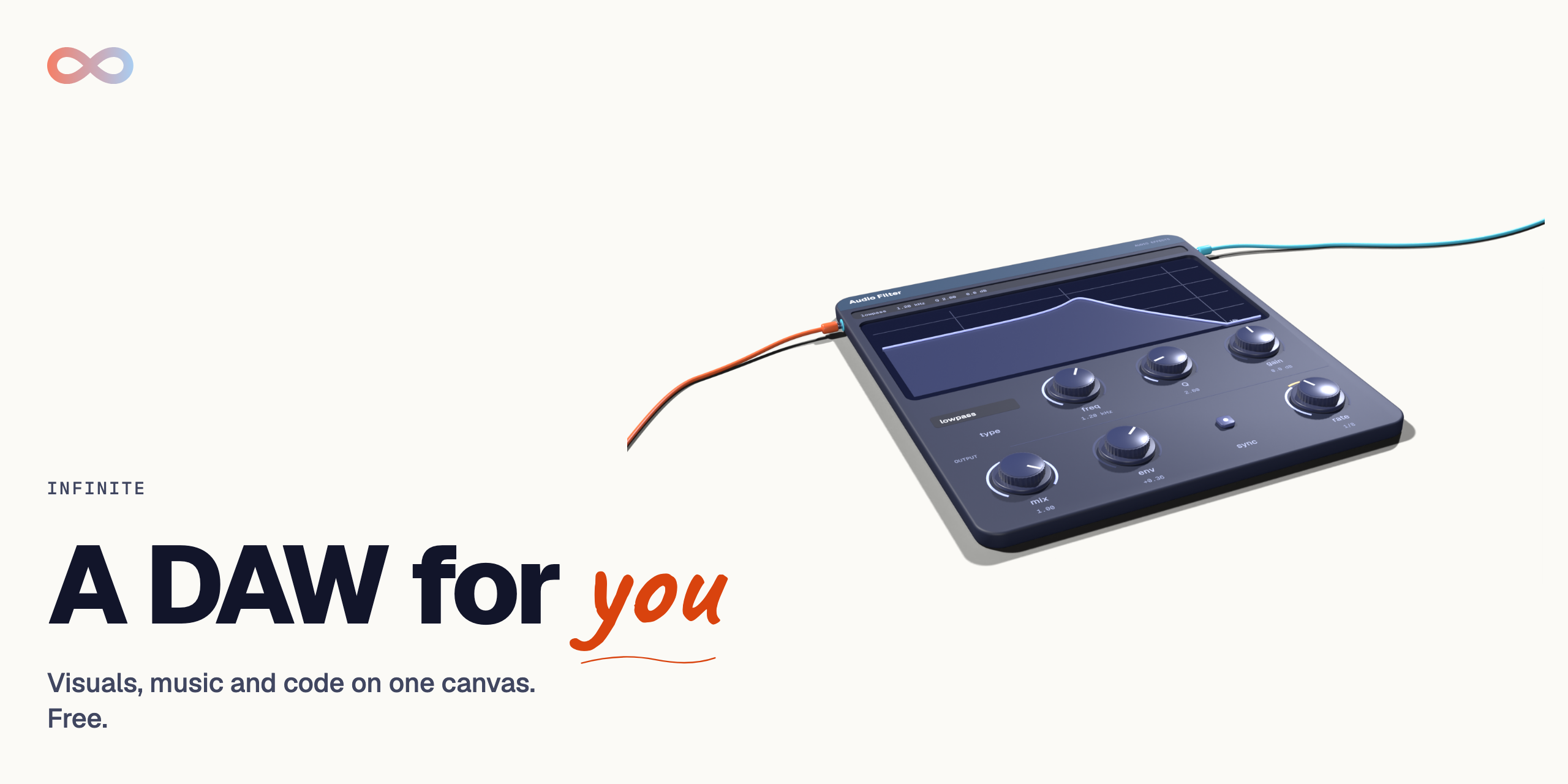
Infinite is a free, open-source audiovisual workstation made by Naman Soni (n1m21n). A unified node-based audiovisual modular workstation for macOS, Windows, and Linux. Real-time GPU image/video compositing, procedural 3D geometry and physics, and a full modular synthesizer rack with native AU and VST3 plugin hosting — all interconnected through a universal modulation graph. Most nodes do one fixed thing; Field, Infinite's embedded programming language, lets you write what a node does instead.

Download
Always the newest release. All files, checksums and release notes are on the Releases page.
Video Tutorial
New to Infinite? Watch the full walkthrough and workflow tutorial on YouTube:
🔗 Infinite Video Walkthrough & Tutorial
Highlights
- Arrangement Timeline: A full clip-based arrangement editor alongside the node canvas — tick-accurate scheduling off the same BPM transport, blade tool, track groups, marquee multi-select, drag-and-drop media import, live waveform/video-thumbnail rendering, and a render/export queue.
- Dual Synchronized DAG Engine: High-throughput GPU texture pipeline (GLSL / OpenGL 3.2 Core) running in lockstep with a sample-accurate, pull-based audio graph tied to a global BPM transport.
- Universal Cross-Domain Modulation: Modulate any shader parameter, 3D transform, audio synth control, or hosted plugin slider via LFOs, CV sequencers, live audio FFT spectrum analysis, or video analysis.
- Audio Synthesis & Physical Modeling: Wavetable oscillator, modal metallic physical resonator, real-time granular engine, PaulStretch spectral stretcher, multi-sample player, and 8-track drum machine.
- AU & VST3 Plugin Hosting: Host third-party Audio Unit (macOS) and VST3 (macOS, Windows, Linux) plugins with native GUI windows and automatable/modulatable parameter controls.
- Procedural 3D & Physics Solvers: Meshes, 3D splines, point scattering, single-draw-call GPU instancing (
Instance on Points), PBD cloth/soft-body physics, particle systems, and PBR rendering (Cook-Torrance GGX + ACES tonemapping + 32-bit HDRI). - 2D Shaders & Generative FX: 32 blend modes, live GLSL editor, video & camera playback, Syphon (macOS) / Spout (Windows) zero-copy video I/O, NDI video in/out over the network (needs the free NDI runtime), reaction-diffusion, and on-device ML subject background removal.
Node Library Overview
Infinite features 300+ modular node types:
| Domain | Key Nodes |
|---|---|
| 2D & Video | Image, folder Slideshow, Video (hardware-accelerated), Syphon In / Spout In, NDI In, Paint/Draw canvas, GLSL Formula editor, Sketch (JavaScript-drawn images, with SVG animation), Shapes (SDF), Noise & Gradient Ramps |
| 2D FX & Grading | Blur, Bloom, Glitch (6 modes), Twirl, Ripple, Displace, Halftone, Curves (RGB/Luma splines), Dither, Color Ramp, .cube LUTs, Gradient Map, Palette extraction |
| Compositing & Masks | Blend (32 modes), Layer Stack, Remove Background (on-device ML segmentation), Chroma/Luma Key, Feedback loop, Reaction-Diffusion, Resynthesize |
| 3D Geometry & FX | Primitives, USD/OBJ/PLY/STL/glTF/GLB import, 3D Text, 3D Curves, Point Distribution, Sketch 3D (JavaScript-built meshes), Mesh Deconstruction, Delaunay Mesh, Voronoi Cells, Decimate, Curve Ops, Taubin Smooth, Array, Instancing, Metaballs |
| 3D Scene & Render | Camera (orbit/perspective/ortho), Lights, 32-bit HDRI Environment, PBR Materials, ACES Tonemapping, Multisampled Antialiasing |
| Synths & Sound | Wavetable synth, Metallic modal resonator, Granular synth, PaulStretch, Molder / Grain Molder (spectral resynthesis), Sampler, Slicer (onset-detecting sample chopper), 8-track Drum Sequencer, 16-pad MPC sampler (polyphonic, per-pad mode / tempo-quantised sync / volume / pitch / pan / speed / fine tune / fades, all modulatable), Looper (record / overdub, tempo-synced, latency-compensated, Sampler-style playback controls), Multi-waveform Oscillator |
| Field Language | Field Modifier, Field Primitive, Field Effect, Field Synth, Field Pixel, Field Graph — see below |
| Notes & MIDI | Live MIDI input/clock, Arpeggiator, Note Sequencer, Chorder, Strum, Bouncing Balls (physics notes), Humanizer, Quantizer, MIDI File player, MIDI Out (hardware and virtual ports, CC and clock), Field Notes (a Field script that plays notes) |
| Audio FX & Plugins | AU / VST3 Plugin Host, Filters, EQ, Dynamics, Lookahead Limiter, Delay, Reverb, Drive/Saturation, Pitch & Frequency Shifters, Chorus, Phaser, Formant |
| Modulators & Analysis | LFO, Random, Pattern CV, Envelope Follower, Math, XY Pad, Audio Analyze (8-band FFT / onset), Image Analyze (luminance / motion), Hand / Face / Pose Track (camera to modulators, via the Tracking pack) |
| Output & I/O | Spatial Mixer (3D headphone mix with head tracking), PNG snapshot, H.264/MOV video recording with synchronized audio, Syphon Out / Spout Out, NDI Out |
The full catalogue, including every node's pins and parameters, is in the Node Reference Manual.
Infinite also renders headless, with no window: pictures, video and sound straight from a .inf text file on the command line. See the Headless User Guide (Markdown).

Field: write what a node does
Every other node in Infinite does one fixed thing — a Blur node blurs, a Delay node delays. Field nodes are different: you write a short kernel, and Field figures out where it runs from what the code touches.
col = vec3(uv.x, uv.y, 0.5)              // once per pixel, on the GPU — a shader
P.y += sin(P.x * 4.0 + t) * 0.2          // once per point in a mesh — a geometry deformer
out = in * gain                          // once per audio sample — a DSP effect
That's the one idea underneath the whole language: a kernel, run once per element of a domain, forever. You never declare where it runs — the domain (and therefore the backend it compiles to) is inferred. Field currently spans five domains and seven node types:
| Node | Domain | What it does |
|---|---|---|
| Field Modifier | element | Per-vertex kernel over existing geometry — modifies P, N, uv, Cd and custom attributes |
| Field Primitive | element | Generates procedural point geometry from scratch (Circle, Spiral, Grid Lattice, Fibonacci Sphere, Helix, Torus Knot) |
| Field Effect | sample | Per-sample audio DSP kernel; in/out, state for per-voice memory, param for knobs |
| Field Synth | sample | Polyphonic note-driven synth voice using the same sample compiler, with freq/gate in place of an audio input |
| Field Pixel | pixel | Per-pixel kernel compiled straight to GLSL; state cells with [wrap] support feedback and stencils |
| Field Notes | sample | Per-sample note kernel: note(pitch, vel, len) sends notes out, and tick(div), deg(d), rand() and beat read the transport |
| Field Graph | graph | Runs once at edit time — emit()/connect()/set()/place() declaratively mount and wire real Infinite nodes into a bundle ("Instrument Mode" collapses it to one box; "Unpack to Canvas" expands it back out) |
Any element/pixel/sample kernel can also declare dynamic pins right in its code, adding real, cable-wireable, save/load-safe I/O to the node without touching C++. Finished devices — kernel plus params plus presets — save, load, export and import as portable .field files, so a Field patch is shareable like an audio plugin preset. The full language reference — syntax, domain-transfer operators, reserved words, and the complete node/format reference — is in the Field Language Manual.

Installation & Quick Start
Pre-built App (macOS, Windows & Linux)
Download the latest build for your platform from GitHub Releases: Infinite.dmg for macOS, Infinite-windows-x64.zip / Infinite-windows-ARM64.zip for Windows, or Infinite-x86_64.AppImage for Linux.
macOS (Infinite is not notarized by Apple, so the first launch needs one extra step)
- Open the DMG and drag
Infinite.appto Applications. - Double-click
Fix & Open Infinite.commandin the DMG and pressy. It clears the download flag on Infinite only, then opens it.- Or do it by hand: try to open Infinite once, then System Settings → Privacy & Security → Open Anyway (macOS 15 and later), or right-click
Infinite.app→ Open (older macOS). - Or in Terminal:
xattr -dr com.apple.quarantine /Applications/Infinite.app
- Or do it by hand: try to open Infinite once, then System Settings → Privacy & Security → Open Anyway (macOS 15 and later), or right-click
Windows
- Unzip the
x64orARM64build for your CPU. - Run
Infinite.exe. The build is not code-signed, so Windows SmartScreen may say "Windows protected your PC": click More info, then Run anyway. It asks once per download.
Linux
chmod +x Infinite-x86_64.AppImage- Run
./Infinite-x86_64.AppImage. It bundles the static AppImage runtime, so nolibfuse2install is needed. If it's running in a container or on a system with no/dev/fuse, use./Infinite-x86_64.AppImage --appimage-extract-and-runinstead.
Build from Source
macOS
Requirements: CMake 3.16+ and Xcode Command Line Tools.
git clone https://github.com/n1m21n/Infinite.git
cd Infinite
cmake -B build -DCMAKE_BUILD_TYPE=Release
cmake --build build -j8
open build/Infinite.app
To create a standalone DMG installer, run ./package.sh.
Windows
Requirements: CMake 3.16+ and Visual Studio 2022/2026 (MSVC v143+, Desktop development with C++).
git clone https://github.com/n1m21n/Infinite.git
cd Infinite
cmake -S . -B build -G "Visual Studio 17 2022" -A x64
cmake --build build --config Release
.\build\Release\Infinite.exe
To create a packaged portable folder, run powershell -ExecutionPolicy Bypass -File package.ps1.
Linux
Requirements: CMake 3.16+, a C++20 compiler (Clang or GCC), Ninja, and the dev packages in tools/linux/deps-apt.sh (X11/GLFW/ALSA/fontconfig headers etc.). x86_64, glibc ≥ 2.35 (Ubuntu 22.04+ or equivalent) if you want the result to match the published AppImage's floor.
git clone https://github.com/n1m21n/Infinite.git
cd Infinite
tools/linux/deps-apt.sh   # installs build + runtime deps via apt
tools/linux/build.sh      # configures + builds build-linux/Infinite
./build-linux/Infinite
To package a portable AppImage, run tools/linux/package-appimage.sh build-linux artifacts-linux. A containerized dev environment (no local dep install needed) is available via tools/linux/local.sh build — see that script for details.
Architecture
src/
├── core/         # INode DAG engine, ImageCable, Transport, Modulation, GLUtil, Mesh
├── nodes/        # 160+ Node implementations (2D, 3D, Audio, Synth, Notes, Modulation)
├── audio/        # Audio engine, DSP kernels, Wavetable core, Plugin hosting (AU/VST3)
└── platform/     # OS layer: macOS (CoreAudio/AU/AVFoundation) | Windows (WASAPI/WinMM/Media Foundation/GDI+) | Linux (ALSA/GLFW/X11/VST3)
See ARCHITECTURE.md and docs/CODE_STANDARDS.md for deeper implementation guides.
Linux-specific known limits
The Linux build has the same node graph and file format as macOS/Windows, with these platform gaps:
- No Syphon/Spout equivalent — no zero-copy video I/O with other apps.
- No Audio Unit (AU) hosting — VST3 only (same as Windows).
- No LV2 plugin hosting.
- No complex-script text shaping (no HarfBuzz) — Latin-script text renders correctly, but right-to-left and complex scripts (Arabic, Devanagari, etc.) may not.
- VST3 plugin editor windows need X11 or XWayland; a pure-Wayland session without XWayland cannot show plugin GUIs.
- x86_64 only — no arm64 build is published.
Contributing
Contributions, bug reports, and node ideas are welcome!
- Join the discussion and share creations in our Discord Community.
- File bugs or feature requests in GitHub Issues.
- Submit Pull Requests with clean-room MIT-compatible code following docs/CODE_STANDARDS.md. See CONTRIBUTING.md.
Prior Art & Acknowledgements
The tools and papers Infinite builds on are named in ACKNOWLEDGEMENTS.md, and the people who contributed are credited in CONTRIBUTING.md.
Cite & credit
If you write about, review or build on Infinite, please credit it as: Infinite, by Naman Soni (n1m21n), https://infinitedevices.org. GitHub's "Cite this repository" button uses CITATION.cff.
License
Infinite's source code is licensed under the MIT License.
Default builds include VST3 plugin hosting linking the Steinberg VST3 SDK (GPLv3). Build with -DINFINITE_ENABLE_VST3=OFF for a pure MIT binary.