
pocket-tank 🐟
A tiny language model keeps a fish tank alive on an $8 chip. The ESP32-S3 board, with screen and battery used in this project is actually around $35.
A 14-million-parameter transformer, distilled from a 26-billion-parameter teacher, runs entirely on an ESP32-S3 microcontroller and makes every high-level decision for a small aquarium of virtual fish: when to eat, hide, explore, socialize, rest, or flee. No network. No cloud. The whole brain is a 7.56 MB file read straight from flash, and the tank lives on a 1.8-inch AMOLED you can hold in one hand.

The fish aren't scripted. Each one periodically describes its situation to the model as a single line of text (hunger, energy, fear, who's nearby, its own personality) and the model completes the line with a goal and an urgency. A reflex layer turns that goal into motion at 25 to 30 frames per second. When the model isn't sure, the fish visibly hesitates.
zone 2 hunger 7 energy 5 stress 2 curiosity 8 bold 4 social 6 stage adult
trust 6 bored 3 food near 12 friend mid 3 bubble mid 10 reef far 7
wall clear last explore time day  ->  seek_food urgency 8
This repo is the complete project: the trained model, the distillation pipeline that made it, a PC simulator, and the firmware for a real board. Got the board? Install it from your browser, no toolchain needed.
The current release is v0.3.3 (alpha); the settings page shows the one on your tank. What changed in each release: pocketank.com/updates.
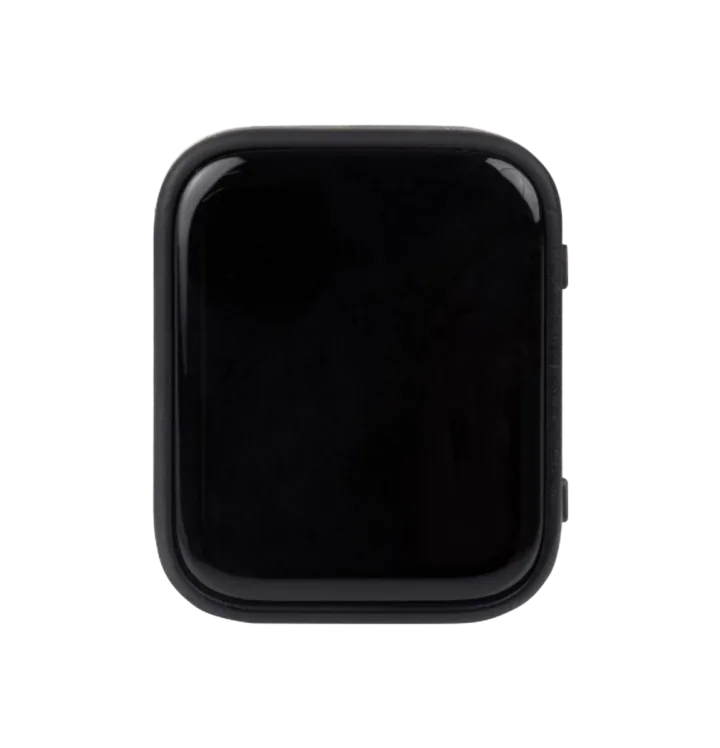
It runs on three Waveshare boards: the 1.8-inch original, the round 1.75-inch pendant, where the tank fills the whole circle like a little fishbowl, and the 2.06-inch watch, a tall tank you can wear. Same fish, same shop, same saves on all three. From 0.3 on a tank updates itself over Wi-Fi, so the cable is only for the first install.
| The 1.8 | The pendant | The watch |
|---|---|---|
 |
 |
 |

Contents
- The numbers
- How it's put together
- What the fish do
- The living tank
- Try it: PC simulator
- Try it: firmware in QEMU
- Install from your browser
- Run it on real hardware
- Train your own
- Layout
- Documentation
- Status
The numbers
| Teacher | Student (what ships) | |
|---|---|---|
| Model | gemma4:26b | pocket-tank 14.3M (dim 384, 8 layers, 8 heads) |
| Parameters | ~26,000,000,000 | 14,300,000, about 1,818× fewer |
| Size | ~18 GB (Q4_K_M) | 57 MB fp32 → 7.56 MB 4-bit |
| Vocabulary | ~262K tokens | 54 tokens (a closed schema lexicon) |
| Runs on | A desktop GPU | ESP32-S3, from flash, no network |
| Agreement | 72% picks the teacher's goal (the teacher agrees with itself 82%) |
On the real board a decision takes about 3.7 s at 12 tokens per second, with the tank rendering at 25 to 30 fps alongside it on the other core. Trained on 51,613 teacher-labeled situations. Every measured number, learning curve, and the methodology: docs/stats.md.
How it's put together
Three layers, strictly separated, all in common/ and compiled unchanged
into both the simulator and the firmware:
- Reflex layer (
tank.c). Physics, steering, schooling, touch gestures, feeding, the hunger economy, vegetation and algae. Runs every frame and never blocks on the model. - LLM advisor (
llm/). A llama2.c-style 4-bit inference engine, a word-level tokenizer, and one shared state encoder. Fish are re-asked only when their situation meaningfully changes, so four to six fish share one brain without anyone starving for a turn. The model runs on the second core of the ESP32-S3 with SIMD dot products and quantized activations in internal SRAM; the weights are memory-mapped from flash and never copied. - Progression (
progression.c). The long game: growth, arrivals, trait drift, milestones, habits, persistence. Everything survives a power cut.
One deliberate rule: the model owns its decisions. There are no fallback heuristics second-guessing it. If the model picks a goal, the fish commits. Uncertainty shows up as visible hesitation, not a silent override. The reflex layer only ever performs what the model chose, or stages presentations (begging, courtship, greeting) that the model's own state has earned.
What the fish do
Seven goals, from the browser prototype this project distills from:
seek_food, follow_friend, inspect_reef, visit_bubbles, explore,
rest, dart_play. (An eighth, flee_shadow, answered a roaming shadow
that was removed from the tank in September 2026; the token stays in the
vocabulary and the model was never taught to say it.) Each fish has five
drives (hunger, energy, stress, curiosity, boredom), three personality
traits (bold, sociable, lazy), a trust score toward you, and a life stage.
All of it is in the state line, so a bold fish and a shy one answer the same
situation differently, and the model was taught by example rather than by
rules.
Boredom is what keeps the tank moving. A fish that has been at the same pastime for about a minute goes stale, and the model was taught that a bored fish moves on, usually to explore a part of the tank it hasn't seen in a while; a fresh fish keeps doing what it was doing. Before this the fish would park at the bubble column, or follow each other in circles, for as long as you cared to watch. Boredom never outranks hunger, and a bored fish at night still rests.
The model samples its own distribution instead of always taking the top
answer. That restores the variety the teacher had and costs nothing on
survival: a starving fish picks seek_food 89% of the time at minimum across
every personality. When the top two choices are close, the fish pauses for a
moment before committing.
Fish turn the way real ones do. A fish whose way lies behind it commits to turning round instead of flip-flopping: it glances back first, then its head swings through a head-on view, the body shortening toward the glass and the tail following a beat behind, and it pulls away. Its body stays near level as it rises and sinks.

Tap a fish for its stats card, its name at the top. Needs, traits, and trust are revealed as the fish shows that side of itself, so a new fish's card is mostly blank. The MORE button at its foot (or a tap anywhere on the card) opens the milestones page, where the SETTINGS and UPGRADES buttons live.
The living tank
Everything below is detected from what actually happens in the tank, never scripted, and it is all persisted.
Growing up. A new tank starts with two fry. Feed them and over days they grow through juvenile, adult, and elder. A fry is plain; its markings come in with its first growth spurt. Adults get a dorsal crest; elders get bigger and settle down. Nothing announces it. Fish grow with time, lit or not, and at a quarter speed while the tank sleeps; a stage reached in the night is the morning's surprise.
Arrivals. Take good care of the pair and the tank earns more fish, up to five, one at a time. Each arrival has conditions (trust, feedings, a fish grown up, a hold-approach) and the tank tells you when it's close: the two most trusting adults dive into the sea grass and circle low through it. Once every condition is met, the pair goes down into the grass within half a minute and courts, and a few seconds into the dance there's a fry between them, light on or off. Put the tank to sleep before that and the fry is there when it wakes. A bed has to be tall enough to hide in before courtship starts or a fry can be born.
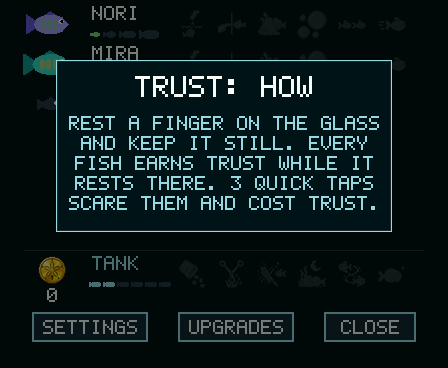
Trust. Hold a finger on the glass for three seconds and the fish that trust you come over from anywhere in the tank, the most trusting first and fastest. Rap three times and nearby fish scatter and stay spooked. Calm holds earn trust, startles cost it, and the model reads trust as part of every decision, so a fish that trusts you acts differently in every situation.
Hunger. A meal lasts five or six minutes awake. Left alone, the tank drops a pellet only when someone is really hungry, so an untended tank hovers between fed and peckish. Wake it after hours asleep and the school is ravenous: they gather just under the surface where you usually feed them, darting back and forth, and go into a frenzy when the pellets land. The tank holds off feeding itself while they beg, so the first meal is yours.
Upkeep. The sea grass keeps growing, every frond on its own, right up to the surface. A sideways stroke that starts on the grass cuts exactly the fronds it crosses at the height of your finger; a sweep along the floor mows a bed down to nubs. Algae films the glass over hours and a drag across it squeegees it clean. Fish like cover: grass calms them, and only a tank truly smothered by two beds at the ceiling stresses them.
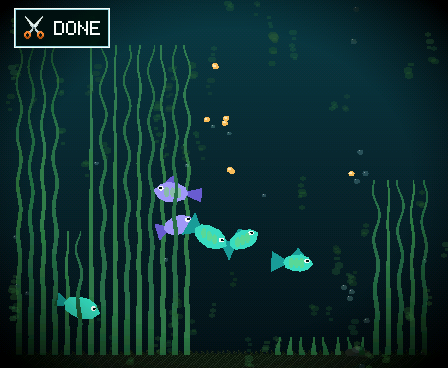
The sponge and the scissors. One stroke can wipe and trim at once, and sometimes you only want one. Tap a fish and look under its card: two small tools. Pick the sponge and your strokes only wipe algae and leave the grass alone; pick the scissors and they only trim. While a tool is in your hand the glass takes its strokes and nothing else: no feeding, no cards, no light, no moving a decoration. A DONE chip sits top left: tap it to put the tool back, or leave it and it goes back by itself after two minutes.

Milestones. Tap MORE on the open stats card for the milestones page: a row per fish with its sprite at its real size, its name and a growth strip, then a badge for each first it has chosen to do: first meal from you, first hold-approach, first reef, first bubbles, first follow, first dart. The tank's row below tracks the population and the firsts you share: first feeding, first trimming, first glass cleaning, first full night's sleep, first play session, the tank changed someone. A locked badge is the same picture as a gray silhouette; one earned since you last looked wears a ring. Tap a badge to read it: a small panel with arrows at its top corners that step through the rest of the group without going back to the page (a fish's six badges, the tank's six, the fry's gates, or the fish themselves from a fish's name); tap anywhere else to dismiss. At the foot of the page: SETTINGS, UPGRADES (the shop) and CLOSE. The shop's and the settings page's own CLOSE bring you back here, not out to the tank.
The next fry. While the tank can still grow, a NEW FRY row sits under the last fish: what the next arrival needs, as badges that light up when met, with a filling bar under each one still owed. The list is read from the same rule that decides a birth, so it is never wrong: at two fish it is trust, meals and a calm hold; later the youngest must grow up, and the counts rise; and always clean glass and some grass, because no fry is conceived in a dirty tank (film on more than 15% of the pane closes the gate, and its bar fills as you wipe). Tap a badge for the plain words and where it stands ("ALL FISH MUST HAVE TRUST OF AT LEAST 6 OUT OF 10 / LOWEST NOW 4.1"), and HOW? for a tip on how to get there. Tap the name for the tally. When every step is done, the parents court in the grass and the fry is born within the minute.
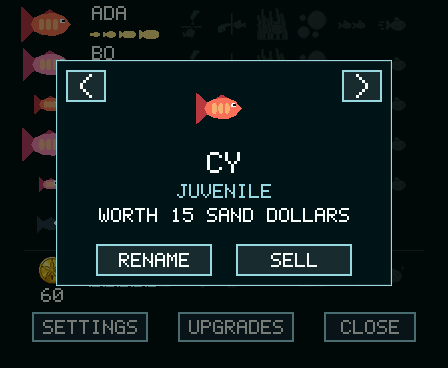
Rename or sell a fish. On the milestones page, tap a fish's name to open its card. RENAME brings back the letter wheel. SELL, tapped twice, trades the fish for sand dollars, and older fish are worth more: 5 for a fry, 15 for a juvenile, 30 for an adult, 60 for an elder. A tank keeps at least two fish, and after a sale the next fry waits for 12 more meals.
More badges, and the school at a glance. Each fish can earn first rest in the seagrass. The tank can earn a school of ten shrimp, and the reef badge now belongs to the tank: buy the reef cluster and the fish swim over to visit it. When the tank's row of badges is full, an arrow (or a swipe along the row) shows its next page. Tap the tank's fish count to see every fish in its own colors, with an outline for each open place.



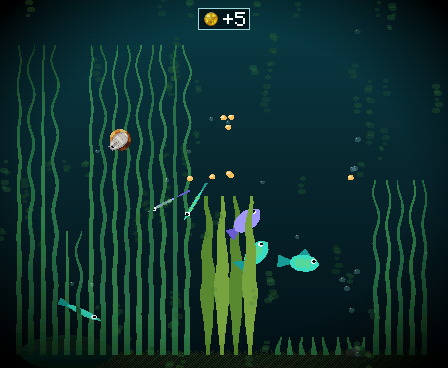
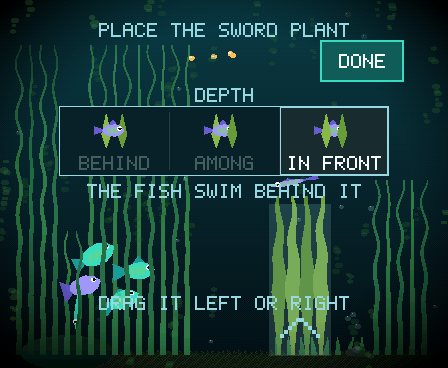
Sand dollars. Caring for the tank earns points, and the shop spends them on things for the tank. A meal the fish eat from your hand pays 2; a fish growing up pays 5, 10 and 25 for juvenile, adult and elder; a fry born 20; a fish that comes to trust you completely 15; every hundred algae colonies you wipe away pay 25, and so does every 250 cm of grass you cut, again and again. Nothing is ever needed and nothing is lost: a tank with no sand dollars is exactly the tank there was before. The coin on the milestones page's TANK row shows your balance, and it (or the UPGRADES button) opens the shop: a row per item with its price, UNLOCK when you can afford it, IN TANK once you own it, and HOW TO EARN for the list. Three things to buy so far. The sword plant (40) is a fourth bed of broad leaves on the open floor, trimmed and grown and counted as cover like the grass. The snail (80) grazes the glass clean cell by cell, crawling flat across the pane with its head leading, and walks the floor upright when there is nothing to eat, in front of a piece you placed IN FRONT or behind it as it pleases; it keeps working while the tank sleeps, so the glass is thinner in the morning. It is drawn the way the fish, the grass and the castle are, from a little geometry rather than a sprite, lit from the upper left and tinted by the water of its row, and it moves like a snail: waves run along its foot, its eye stalks sway, its shell rocks with the crawl. Tap the snail for its card: a ring around it and a tally of the spots of algae it has grazed clean so far, night shifts included. The model sees neither: they reach the fish the way your own chores do, through cover and the film. Dollars earned while you watch show as a small "+N" over the water.
Placing what you buy. A plant is yours to put down. Right after you unlock it the shop closes and a placement page comes up over the live water, the same gesture as placing the bubble column: drag it left or right along the floor and it follows your finger. A DEPTH bar sets where it stands among the fish, and instead of words to decode it shows three small pictures of your own first fish with two leaves, swimming over them, through them, or behind them: BEHIND, AMONG or IN FRONT. The tank redraws as you choose, a line under the bar says what to watch for, and DONE keeps it. If you change your mind later, the plant's row in the shop has a MOVE button that opens the same page again. The snail is not for placing; it goes wherever the algae is.
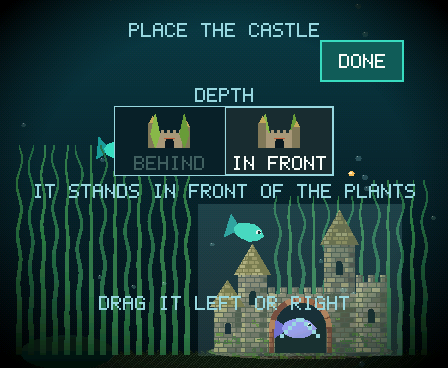
The castle. The third thing in the shop (150) is a stone castle with a swim-through arch: two pointed towers, a crenellated wall, a taller rear tower, a brick arch and moss creeping up from a rubble base. It is not a sprite. Like the fish and the grass it is drawn from a little geometry every time the scene is built, its stone a brick pattern from a position hash, lit from the upper left and tinted with the water of each row, so it sits in the tank instead of on it. Its placement page has the same drag and a DEPTH bar of two choices that mean the plant layer: BEHIND puts it behind the grass and the fish, a ruin in the weeds; IN FRONT stands it in front of the grass, which stops at its walls, and the fish swim through the arch, tucked behind the jambs as they pass. The fish do not know it is there. They find the arch by chance, which is most of the charm.
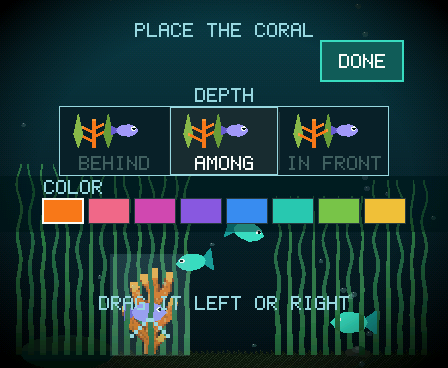
The coral. The fourth thing in the shop (100) is a branching coral, drawn from a little skeleton of rounded branches on a chunky pixel grid: a dark rim on the shaded side, a lit edge toward the light, pale tips, and a speckled body in whatever colour you give it. Its placement page has the drag, a DEPTH bar of two choices (BEHIND or IN FRONT, like the castle's), and a COLOR row of eight swatches; the coral on the floor wears the pick as you tap, and the shop's MOVE button brings the page back whenever you want a change. It also grows, and slowly, which nothing else in the tank does: you buy a young but established fan, the trunk and its two low branches, and over about seventeen days, awake or asleep, the rest of the branches reach out one by one until the fan is complete. It tops out about a quarter of the way up the glass and stays there. Then, over the following week, a crown of nine thin tentacles sprouts from the tip and sways on the tank clock. It is anchored: its base sits down in the pebbles and a low hump of the floor's own stones is heaped round it, so the trunk grows out of the floor instead of standing on it.
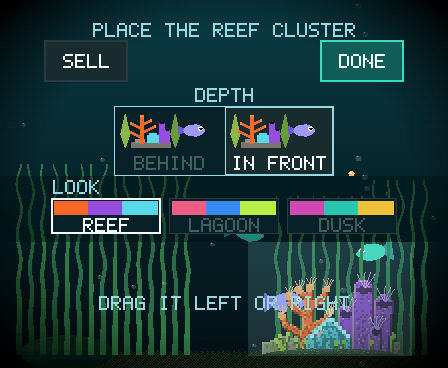
The reef cluster. The fifth thing in the shop, and the dearest (240), lives on the shop's second page: the header's arrows flip to it. It is a whole mature reef on a pile of stones, drawn the same procedural way from Strato's cluster art: a branching coral to the left, four tube sponges with dark mouths, a lobed brain coral in front, green weed between the stones, about twice the coral's footprint. You buy it big, at 85% of its full size, because a keeper buying a coral wants something to look at on day one; over two weeks it fills out to full size, and over the two weeks after that it blooms, up to forty-eight thin tentacles appearing one at a time round the tube mouths, the coral's tips and the brain's top, every one swaying. Its placement page has the drag, the two depths, and a LOOK row of three tiles instead of a colour: REEF is the art's orange, purple and cyan; LAGOON is pink, blue and lime; DUSK is magenta, teal and gold. It sits in a hump of stones like the coral.
The shrimp school. The sixth thing in the shop (180), on the second page beside the reef. Four cherry shrimp arrive as a loose school, drawn by code pixel by pixel like everything else that swims, and turning the same way the fish do. They keep to the foot of the grass most of the time, wander out onto the sand, and now and then drift slowly up a bed to the top of its canopy. They are the tank's cleanup crew: a pellet that sinks below the top of the grass is theirs, still falling or resting on the floor (pellets now rest there fifteen seconds before they dissolve), and the school crowds in to peck it clean. Every ten pellets they eat brings another shrimp, up to ten, never two within fifteen minutes. With more than half the glass covered in algae they refuse food: they keep to the grass and turn away from pellets, so the school stops growing until you wipe the glass (it never shrinks). Tap the school for its card: how many, the pellets they have eaten, and ten pips toward the next shrimp. Three quick taps on them scare them like the fish: they flick away tail first and regroup.
The sea urchin. The seventh thing in the shop (120). It lives on the sand and nibbles the tallest grass down a little at a time. It never cuts the grass short and it leaves the sword plant alone, so there is still trimming for you to do. Tap it for its card: how much grass it has eaten so far, and whether it is grazing or resting.
The night shift. The snail and the urchin keep working while the tank sleeps. A tank with a snail wakes up with about a third less algae on the glass, and a tank with an urchin wakes up to shorter grass. Helpers take the edge off a long sleep; they never take the chores away.
Selling back, and the short way to a piece. Tap and hold a still finger on any decoration in the tank and its placement page opens right there, with MOVE, DEPTH and, in the top-left corner, SELL. The same SELL sits next to MOVE in the shop's modal for anything you own. A sale needs two taps: the first arms the button and shows the refund, the second sells. You get 20% of the price back, the piece leaves the tank, and it is in the shop again at full price. The snail and the shrimp are not for sale; they are permanent residents.











The light. Two quick taps on the glass turn the tank light off and on; in the dark the fish rest and the palette dims. The first time a double-tap turns the light off, a small LIGHTS OUT notice says what happened and how to turn it back on, once per tank. The settings page has a LIGHTS OUT row that can hand the light to the tank instead: step it from DOUBLE-TAP to a time, 5 seconds up to 30 minutes. The tank knows when it is being handled (the motion sensor, or a touch) and goes dark by itself after that long still, so a tank left on the desk is asleep until you pick it up. Six hours of device sleep in one stretch earns the tank its first full night's sleep.
Feeding is yours if you want it. The tank drops a pellet now and then when someone is hungry, so nobody goes without. AUTO FEED on the settings page turns that off: then every meal is one you gave. Nobody dies of it, but a fish left starving in a lit tank slowly loses trust, and feeding it stops the loss.

The battery. A small battery sits top right whenever a fish's card is open, and stays up by itself when the charge runs low. On the cable a lightning bolt stands beside it, and while it charges a bright band runs through the fill, so you never have to tell two colors apart to know it is charging. Plug the tank in and the battery shows itself for a few seconds to say it noticed. Tap it for the battery page: the charge, whether it is charging, about how long it will last (or how long until it is full), how long ago it was unplugged, the screen-on time since, and how long a full charge lasts. The tank learns those times from its own battery as you use it.
Updates over Wi-Fi. The settings page has an UPDATES button. Tap CHECK FOR UPDATES and the tank pauses, turns its radio on and looks for a newer release. The first time, it lists the networks it can see; pick yours and type the password on the glass. If there is a new version it downloads it, checks it and restarts into it, and your fish are right where you left them. Below about 20% battery it asks you to plug in first. If an update ever goes wrong, the tank goes back to the version it had. The radio is only on during a check: the tank itself still runs with no network at all. On the watch, settings also has a SCREEN row: NORMAL, or TURNED if you wear it with the buttons toward your elbow. The original and the pendant turn their picture over by themselves when you turn the tank over; the ROTATION button on the settings page (a padlock in a turning arrow) locks the picture the way up it is.


Habits and continuity. The tank remembers where you feed it and greets the light coming on. A real-time clock tells it how long it was off, so a tank left dark for a day wakes hungry. One key does all of it: a short press on PWR puts the tank to sleep - it saves and the screen goes dark - and a press wakes it. Press again within twenty minutes and the tank simply resumes where it was, on a tap; after that it powers itself down to the board's deepest state (tens of microamps, months on the shelf), and the next press wakes it with a one-second boot, the fish having lived through the time away: hunger up, energy back, the grass and the algae grown, a long night ending in begging at the surface. One thing to know about that deepest sleep: the only chip still awake is the power-management chip, and its rule is that the key must be held for about an eighth of a second before it turns the board on - a quick tap does nothing. Press it like you mean it. The tank decides how deep it sleeps; you never do. Holding PWR powers it off at once. Hold BOOT and tap the glass to reset the tank. Flip the device and the screen follows.
First run. A new tank, whether a fresh install or a reset, opens with a short setup over the live water. A welcome page; then you place the bubble column, dragging it left or right across the tank while the bubbles and the airstone follow your finger; then each of the two fry in turn: the fish being introduced swims a slow loop front and center with a ring around it while you name it on an arcade-style letter wheel (touch a slot, drag up or down to spin its letter, or tap the chevrons above and below it), then you pick its body color from eight swatches and watch the fry wear it. Its accent stays a question mark: a fry has no markings yet, and they come in as it grows. A page of care tips finishes the tour. The light stays on throughout, and the column, the names and the colors you chose are saved with the tank.

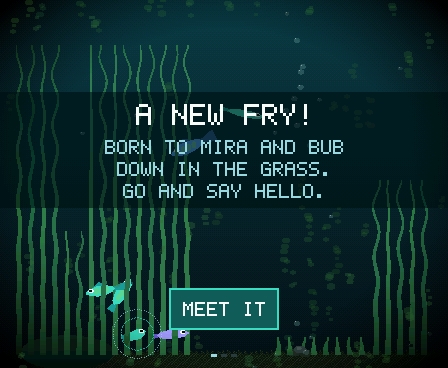
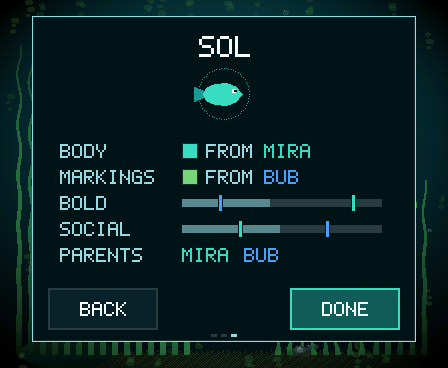
A birth. Every arrival is an event. The fry hatches low in the nursery grass wearing its family's colors, the body of one parent and the markings of the other, and the tank stops to introduce it. A new fry! rings the newcomer wherever it is and names its parents; the next page is the same letter wheel, so you name it; the last page shows the fry on its own, as it is now, with what it inherited: whose body, whose markings, and how bold and sociable it is on bars marked with each parent's own value. Its markings, like any fry's, come in as it grows. The welcome is saved with the tank until you finish it, so a fry born while you were away is waiting for you when you come back.

Starting over. Hold BOOT and tap the glass: a Reset tank? prompt appears over the water with a NO and a YES. YES wipes the save and two new fry take the tank, with the first-run setup to name them; NO, a sleep, or twenty seconds of silence keep everything.
Try it: PC simulator
The simulator runs the exact same common/ code inside an LVGL + SDL2
window, with the shipped model as the brain. Needs SDL2 and LVGL v9 (cloned
in-tree):
git clone https://github.com/mediacutlet/pocket-tank.git
cd pocket-tank
git clone --depth 1 --branch v9.2.2 https://github.com/lvgl/lvgl.git sim/lvgl
brew install sdl2        # macOS; apt install libsdl2-dev on Linux
cd sim && make && ./fishsim
On macOS the Makefile targets x86_64 by default to match an Intel Homebrew
SDL2; use make ARCH= for a native build. On Linux it builds for the host.
The trained model
(model/out/model_q4.bin + tokenizer.bin) ships in the repo, so the LLM
brain works out of the box.
In the window, the mouse is your finger: tap the water surface or drag down from the top edge to feed, click a fish for its stats card (the shrimp for theirs), click the card (or its MORE button) for milestones, hold the button to rest a finger on the glass, three quick clicks to startle, two to toggle the light, drag across the glass to wipe algae, and stroke sideways through a bed to trim it. Keys: F feed at the mouse, N light, A auto light, H handle the tank (moving the mouse over the window counts too), L switch between the rule stub and the LLM brain, U overlays, M milestones, 4 the shop, D fifty sand dollars to try it, W the shrimp school (again adds one), X the reset prompt, S the first-run setup (or drops a birth's pages), R force an arrival (the birth flow opens), Z jump through seven hours of sleep, G grow the grass and algae now, V volume, B the low-battery notice, P plug or unplug a pretend battery (click the battery for its page), Q quit.
Flags: --fresh starts a new random tank, --fast N runs tended time N×
faster so you can watch fish grow up, --greedy disables sampling,
--narrate prints every decision as it's made, --battery N starts the
pretend battery at N%, --snapshot <prefix> writes
PPM frames of the tank, card, milestones page, the shop, the placement
page, the castle (in front, behind, its page), the battery in each state
and its page, reset prompt, the setup pages, and the three pages of a birth.
Headless checks, all of which run in CI-style without a window:
--selftest (reflex layer), --selftest-llm [min] (the real model),
--selftest-pop (arrivals, inherited looks, saves, the setup and birth flows), --selftest-sleep (sleep metabolism,
the deep-sleep wake, and ravenous begging), --selftest-hunger (the hunger economy),
--selftest-tend (grass, algae, trust holds), --selftest-shop (sand
dollars, the shop, the plant, the snail), --selftest-battery (the battery
page's numbers, and the bolt only on the cable), and --bench (render cost).
make check from sim/ runs every selftest.
Try it: firmware in QEMU
The ESP-IDF v5.4 app boots in Espressif's QEMU with the real hardware configuration (octal 8 MB PSRAM) and the model partition populated:
cd firmware && ./run_qemu.sh
You'll watch an emulated ESP32-S3 memory-map the 7.56 MB model from flash and start making decisions, about 2.3 s each in emulation. The display and touch ports are stubs in the QEMU overlay; decisions go to the log.
Install from your browser
The easy way onto a board: https://pocketank.com/install/. Plug the Waveshare board into your computer, open the page in Chrome or Edge, pick your board (the 1.8, the pendant or the watch), click Install Pocket Tank, pick the port, and watch the bar fill. Then the page asks for your Wi-Fi: the tank's screen stays dark while it lists the networks it can see, you pick yours and type the password, and the tank connects to check it before it starts. That is what lets it update itself later; you can skip it and set it up on the tank instead. About 8 MB goes over in a minute or two, the board reboots on its own, and two fry are waiting.
After that, updates come over Wi-Fi. 0.3 is the last release that needs the cable: a tank on 0.2 installs it from the page once, and from then on CHECK FOR UPDATES on the settings page does the rest. Each board fetches only its own image, every image is signed, and a tank refuses one that is not signed by this project or was built for another board. docs/OTA.md has the design.
Updating by cable is the same click. The installer never erases the board: it
rewrites the app and the model, and the tank's save lives in a part of the
flash (NVS at 0x9000) that none of the four parts cover, so your fish,
their names, trust, history, badges, sand dollars and decorations carry on.
Every version loads the saves of every earlier one (the save only ever grows
at the tail, and the one field that went in mid-struct is slid into place on
load). To start over, hold BOOT and tap the glass for the Reset tank?
prompt; the page also has an "erase and install fresh" button for a board
that won't get that far. The settings page shows the release at its foot,
small and dim ("V0.3.3 ALPHA", then the build id), so you can tell what
you run. It is the same mechanism ESPHome and Home
Assistant use (ESP Web Tools),
running entirely in the browser over Web Serial.
To host your own copy, tools/make_installer.py turns a firmware build plus
the shipped model into one static folder (installer/dist/: the page, a
manifest with the four parts and their flash offsets, the binaries, and the
vendored flasher). Any HTTPS static host will do, GitHub Pages included;
installer/README.md has the details.
Run it on real hardware
Three Waveshare boards are supported, all ESP32-S3R8 with 16 MB flash and 8 MB PSRAM, an AMOLED, capacitive touch, an IMU and a PMIC:
| Board | Glass | Build |
|---|---|---|
| ESP32-S3-Touch-AMOLED-1.8 (V1 and V2, auto-detected) | 368×448, shown as a 448×368 tank | the default |
| ESP32-S3-Touch-AMOLED-1.75C, the pendant | 466 px circle | sdkconfig.round |
| ESP32-S3-Touch-AMOLED-2.06, the watch | 410×502, portrait | sdkconfig.watch |
Each board's touch panel is calibrated in its touch port, so a tap lands where the finger is. docs/BOARDS.md has what the three share and where they differ; each board's own traps are in its doc. The browser installer above is the no-toolchain path; this is the developer one.
. ~/esp/esp-idf/export.sh
cd firmware && idf.py build
idf.py -p /dev/cu.usbmodem* flash
esptool.py --chip esp32s3 -p /dev/cu.usbmodem* write_flash 0x290000 ../model/out/model_q4.bin
The other two boards build from the same tree on top of their own fragment, each in its own build directory:
idf.py -B build-round -DSDKCONFIG=build-round/sdkconfig "-DSDKCONFIG_DEFAULTS=sdkconfig.defaults;sdkconfig.round" build
idf.py -B build-watch -DSDKCONFIG=build-watch/sdkconfig "-DSDKCONFIG_DEFAULTS=sdkconfig.defaults;sdkconfig.watch" build
Every build is signed, so the first build needs a key: tools/ota_key.sh
makes one for you in firmware/keys/ (never committed). A tank you flash
with your own key takes over-the-air updates only from images signed with
that key, not from this project's releases; the browser installer is the
way onto the release channel.
The model lives in its own 8 MB raw partition and only needs flashing once. docs/bringup.md is the step-by-step checklist with pass signals for each stage, and docs/memory_budget.md explains where every kilobyte goes. The boot log prints a per-stage frame profile and per-decision inference timings, so performance work is measurable without instruments.
Other boards. This repo supports those three boards, to keep the project small while it is young. Two community ports run the tank elsewhere. They are not built or tested here, and they may lag behind this repo:
- knoopx ported it to the Waveshare ESP32-P4-WIFI6-Touch-LCD-4B (4-inch 720×720 MIPI-DSI panel, GT911 touch, ES8311 audio) in their fork. It needs ESP-IDF 5.5. Pull request #5 has the details.
- lmoiseichuk ported it to the 2.8-inch ES3C28P "cheap yellow display" (ESP32-S3, 320×240 ILI9341 IPS panel, FT6336 touch, ES8311 audio), with every page laid out for the smaller screen, in their fork. Pull request #10 has the details.
Train your own
The whole distillation pipeline is here. model/gen_traces.py runs the
headless tank against any Ollama-served teacher and logs state→goal pairs;
train_tokenizer.py, train.py, and export_q4.py take it from JSONL to a
flashable 4-bit binary; eval.py measures agreement with the teacher on
fresh situations. It builds on a clone of
karpathy/llama2.c in
model/llama2.c/.
Step-by-step commands: docs/pipeline.md. Two things the project learned the hard way, both documented there and in docs/stats.md: the teacher prompt is the DNA of the whole dataset (one sentence moved a goal from 45% of labels to 14%), and a seven-minute prompt check before an overnight run is always worth it.
Layout
common/— everything shared verbatim by sim and firmware:tank.c(reflex layer, the snail),render.c(RGB565 software renderer, stats card, milestones page, the shop, the reset prompt and its pixel font),progression.c(the long game, the sand dollars and persistence),icons.c(baked pixel art),audio.c(the sound mixer),notice.c(the milestone and low-battery announcements),update.c(the update pages and their flow),llm/(4-bit engine, word tokenizer, the shared encoder)sim/— the LVGL + SDL2 simulator, its persistence port, and the self-testsfirmware/— ESP-IDF app: display, touch, battery, IMU, RTC and audio ports for the three Waveshare boards, the on-device advisor scheduler, update mode and its Wi-Fi port, the QEMU harness, and the partition tablemodel/— the frozen state/goal schema, trace generation, training, evaluation, probes, and the 4-bit exportinstaller/— the browser installer page and the vendored ESP Web Tools bundle;tools/make_installer.pyassembles the upload foldertools/— the icon baker, the sound bank builder, the installer assembler, the release manifest maker, the touch calibration fitter, the three-board picture sheet, and a serial bench clientassets/icons/— the pixel-art source for the stats card, the badges, the shop and the snailassets/sounds/— the cues (16 kHz mono) and their levels
Documentation
- docs/stats.md — every measured number, dated
- docs/pipeline.md — teacher to flashable binary
- model/schema.md — the state encoding and goal output
- docs/progression.md — the progression contract: growth, hunger, trust, upkeep, sleep, breeding
- docs/progression-next.md — the design and the evidence behind it
- docs/retrain-v3.md — the schema v3 retrain runbook
- docs/retrain-v4.md — the schema v4 (boredom) retrain runbook and its numbers
- docs/DEVICE.md — what is in flight on the device, and the flash rule
- docs/BOARDS.md — the three boards: what is shared, where one may differ, how a release keeps each to its own image
- docs/board-amoled-1.75c.md — the pendant's bring-up notes
- docs/board-amoled-2.06-watch.md — the watch's bring-up notes
- docs/OTA.md — updates over Wi-Fi: the partition table, update mode, signing, the manifest
- docs/AUDIO.md — the sound design: the cues, the asset pipeline, the power rules
- docs/memory_budget.md — flash, PSRAM, and SRAM plan
- docs/bringup.md — hardware bring-up checklist
Status
- ✅ Model: schema v4 (boredom, no shadow), 14.3M student, 4-bit export, evaluated
- ✅ Simulator: the full tank with progression, self-tests, snapshots
- ✅ Firmware: running on the real board at 25 to 30 fps and 3.7 s per decision, with touch, auto-rotation, a battery gauge and log (tap the battery for its page; on the cable it wears a bolt), and one key for sleep and wake (a 20 min nap window, then the board powers itself off to tens of microamps; from there a held press wakes it)
- ✅ The living tank: growth, arrivals with courtship, trust, the hunger economy, upkeep chores, milestones, the reset prompt, the first-run setup (place the bubbles, a letter wheel to name each fry, a body color to pick), births announced and named with a family page, a sleep that lives through the night at the next boot, fish that get bored and go exploring
- ✅ Sound: the board's own little speaker plays cues for what you do (a feed, the light, a trim, a card) and for the fish (eating, a spook, a fish coming to your finger), plus a welcome, a birth fanfare and milestone chimes with an on-screen announcement; the codec is only powered while the tank is in your hands, and a low-battery notice keeps the gauge on screen until it is charged; a settings page (from the milestones page) for brightness and volume, with a mute
- ✅ The light follows the hand: an optional idle rule (the motion sensor and touch) puts a tank left on the desk to sleep; the double-tap by default
- ✅ Sand dollars: care earns points, the shop spends them; a sword plant, an algae-grazing snail and a swim-through castle to start; what you buy you place yourself, where along the floor and whether it stands behind, among or in front of the fish
- ✅ Browser installer: one click from Chrome or Edge, at pocketank.com/install, with a board to pick; a cable update is the same click and never erases a tank
- ✅ v0.2.0 (alpha), the first numbered release: fish that turn like fish, the fish's name on its card, a shrimp school that eats what falls and multiplies, and a fry's welcome that comes before its badges
- ✅ v0.3 (alpha): two more boards (the round pendant and the watch), updates over Wi-Fi with signed, per-board images, a sea urchin that keeps the grass down, a snail that cleans overnight, a sponge and scissors, and fish you can rename or sell
- 🚧 Next: more to unlock: new fish species, more plants, corals, and more tank maintenance critters
- 🚧 Next: more achievements and milestones
The video series
This repo is the companion to a YouTube series documenting the build: distilling the model, designing the schema, squeezing inference into PSRAM, first boot on real glass, and the tank growing into a pet.
▶ Watch: https://youtu.be/C2z7x47xxdM
License
MIT, see LICENSE. model/llama2.c/ and sim/lvgl/ are cloned
separately and carry their own MIT licenses.