
Pioneer CDJ & XDJ Emulator
Original firmware. Emulated hardware.
Pioneer DJ players on your computer, from the CDJ-2000 to the NXS2 and XDJ family.
Supported players · Quick start · Keyboard · Virtual deck · Mods · How it works
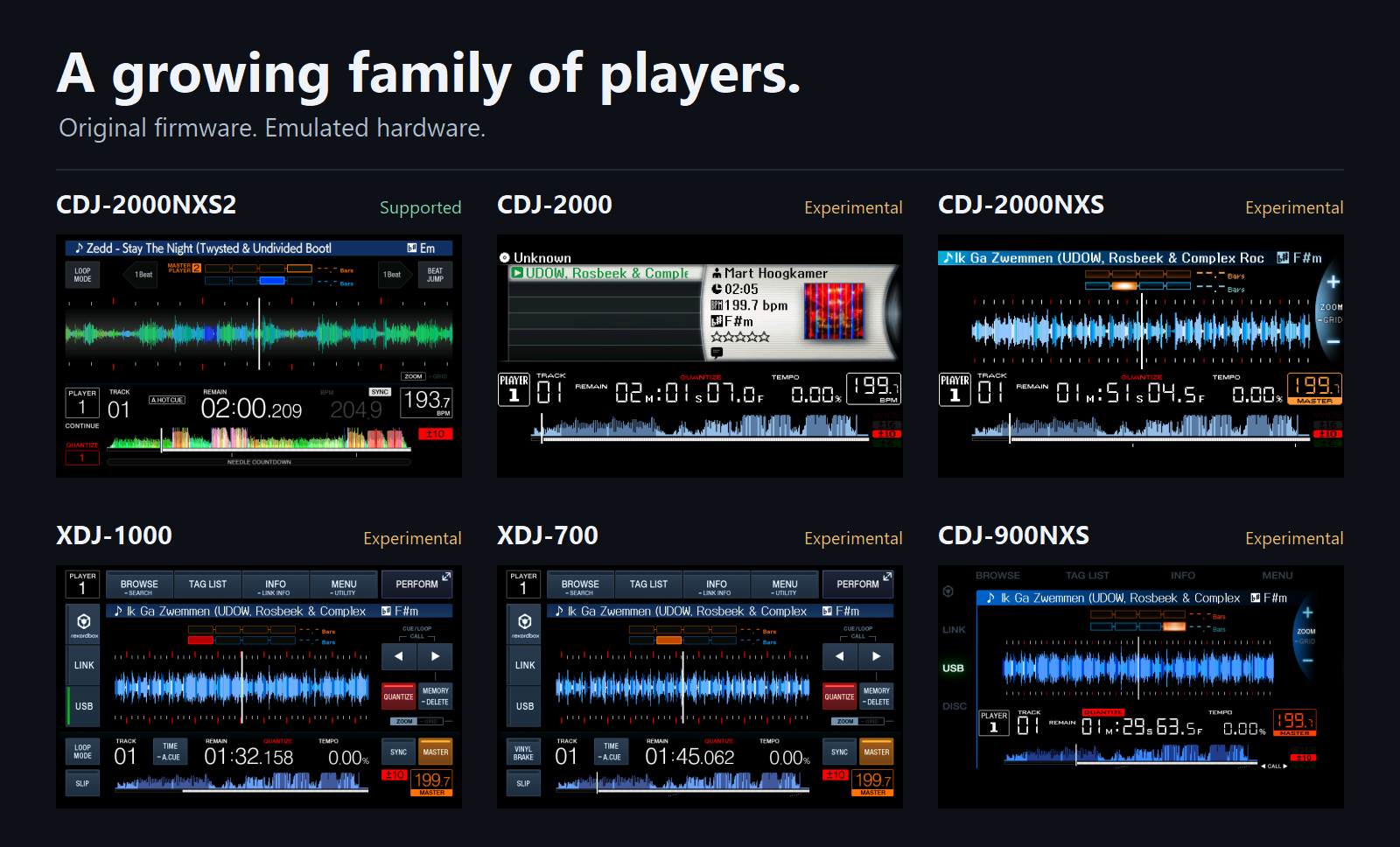
Actual emulator captures from development builds. Select the image for a closer look.
The CDJ-2000NXS2 boots, mounts a virtual USB stick, and loads and plays tracks from it. The waveform scrolls, the time counts down, and the sound you hear is computed by the player's own DSP program on an emulated DSP. Start two and they find each other on an emulated Pro DJ Link network, where MASTER and SYNC work between them. Plug in a MIDI controller and it plays them, or use the virtual deck.
Seven older players have experimental emulation, with further models in development. The status table separates usable features from ongoing work.
Features
These are the CDJ-2000NXS2's; the older players are covered under Supported players.
| 🎛️ The real firmware | All three processors of the player run its own code: MAIN, the display board and the audio DSP. |
| 🔊 The DSP's own sound | A C66x emulator with a JIT runs the DSP program MAIN uploads at boot; the audio you hear is its output. |
| 📈 Load and play | A track from the stick loads and plays; the waveform and playhead move, the time counts down. |
| 🔗 Pro DJ Link | Two decks take their own addresses from a small DHCP server, announce themselves, and MASTER and SYNC work between them. |
| 🎚️ Any MIDI controller | A profile of what the controller sends plus a mapping to CDJ keys. A Roland DJ-202 mapping is included, with its LEDs mirroring the player's lamps. |
| 🌀 Jog and touch | The jog bends the DSP's playback speed through the firmware's own jog engine; a click in the window is a touch on the screen. |
| 🧪 Built for modding | Trace any firmware address, watch memory, change it while it runs, call firmware functions, script every input. |
Screenshots
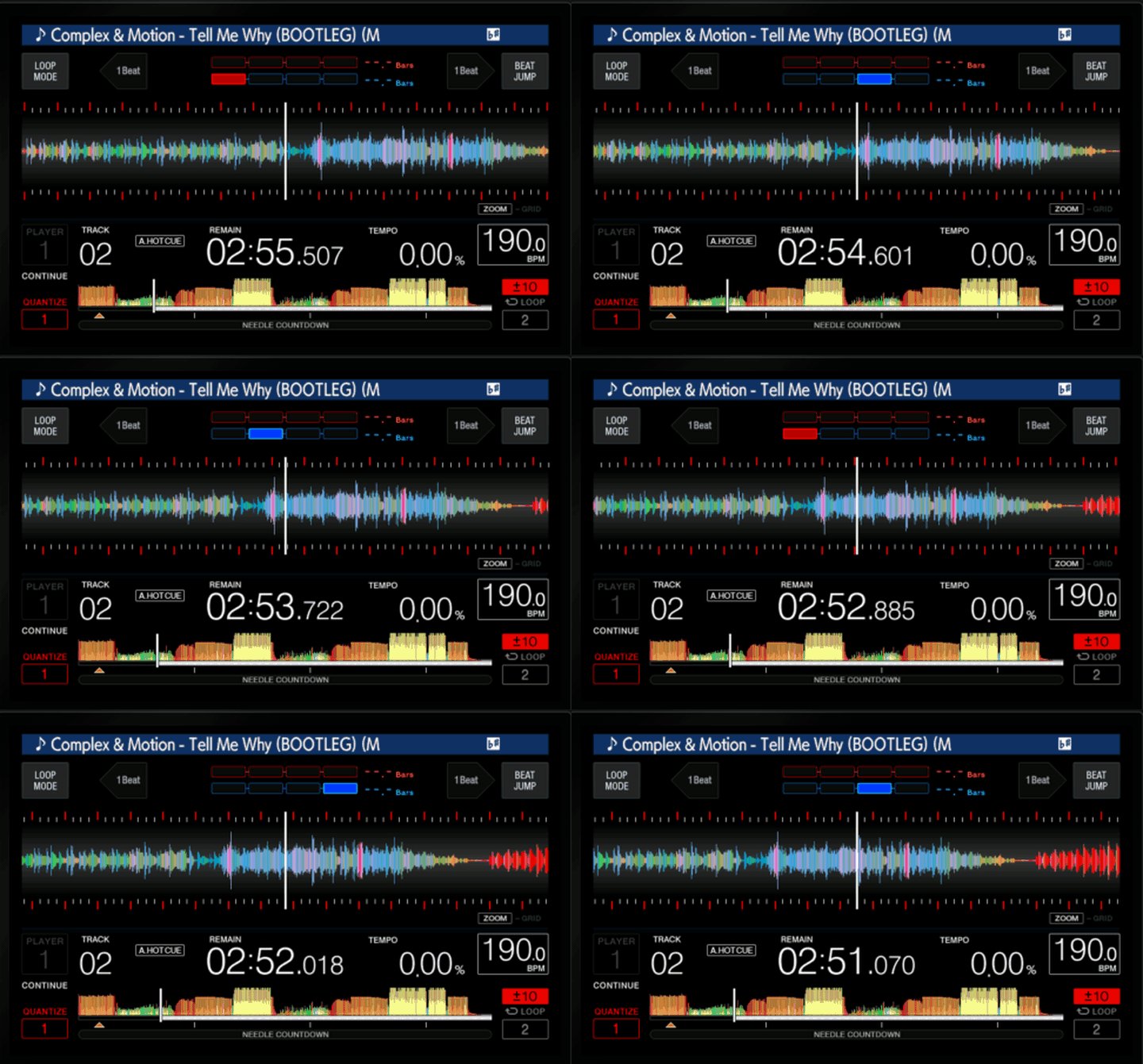
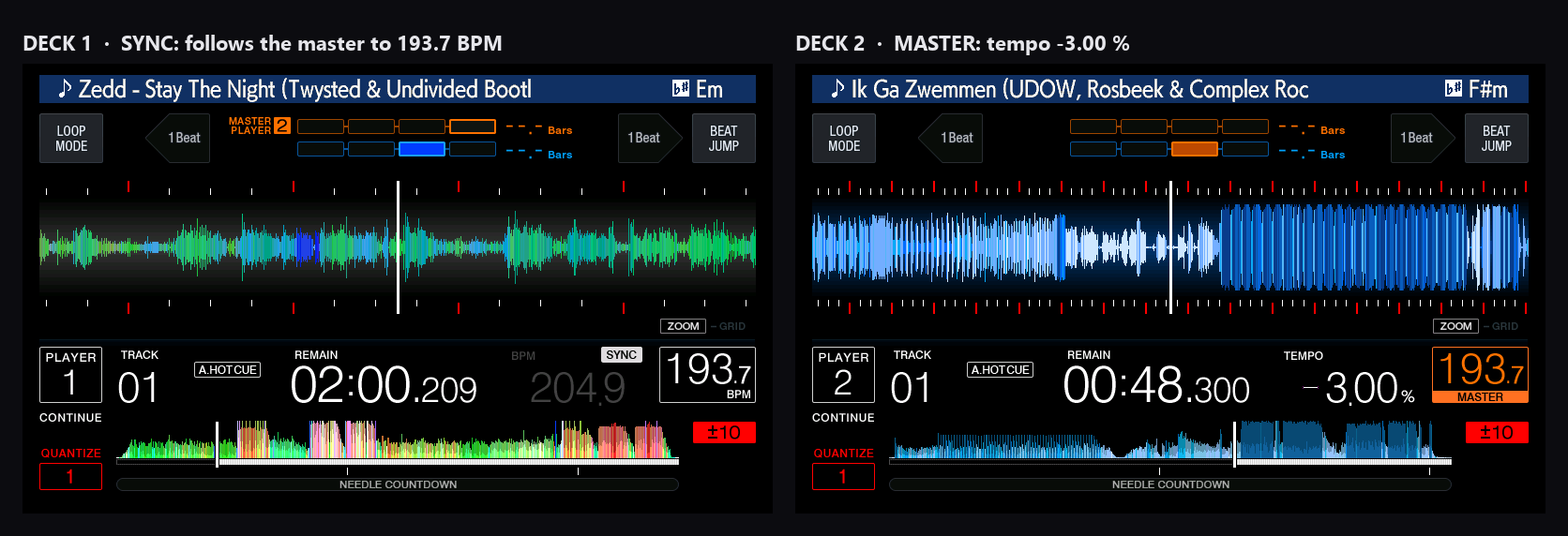
More Pro DJ Link screens
 Deck 2 tracks the master's beat over Pro DJ Link |
 MASTER TEMPO and SYNC, colour waveform |
 Browsing the other player's USB over the link |
 ...and playing a track loaded from it |
Supported players
The CDJ-2000NXS2 is the fully supported player; the older models are
experimental. Sound is on by default (NOSOUND=1 turns it off). Screenshots
show the firmware interface, not a claim of feature parity.
| player | status | what works |
|---|---|---|
| CDJ-2000NXS2 | ✅ Fully supported | Plays tracks from USB in real time with sound. Pro DJ Link, MIDI controllers and mods. |
| XDJ-1000MK2 | 🧪 Experimental | Loads and plays from USB in real time with the DSP module setup builds. PLAY, CUE and touch work. |
| XDJ-700 | 🧪 Experimental | Loads and plays from USB in real time with the DSP module setup builds. Touch works. |
| XDJ-1000 | 🧪 Experimental | Loads and plays from USB in real time with the DSP module setup builds. PLAY, CUE, tempo, jog and touch work. |
| CDJ-900NXS | 🧪 Experimental | Loads and plays from USB in real time with the DSP module setup builds. |
| CDJ-2000NXS | 🧪 Experimental | Loads and plays from USB in real time with the DSP module setup builds. PLAY, CUE, tempo and jog work. |
| CDJ-900 | 🧪 Experimental | Loads and plays from USB; its display shows the overview, playhead and time. |
| CDJ-2000 | 🧪 Experimental | Loads and plays from USB in real time with the DSP module setup builds. PLAY, CUE, tempo and jog work. |
Feature matrix per player
✅ works, measured ⚠️ partly, see the note ❌ does not work ➖ the player does not have it · not tested yet
| CDJ-2000NXS2 | XDJ-1000MK2 | XDJ-700 | XDJ-1000 | CDJ-900NXS | CDJ-2000NXS | CDJ-900 | CDJ-2000 | |
|---|---|---|---|---|---|---|---|---|
| Media | ||||||||
| USB | ✅ | ✅ | ✅ | ✅ | ✅ | ✅ | ✅ | ✅ |
| Playback | ||||||||
| Sound | ✅ | ✅ | ✅ | ✅ | ✅ | ✅ | ❌ | ✅ |
| Real time with the setup DSP module | ✅ | ✅ | ✅ | ✅ | ✅ | ✅ | · | ✅ |
| Display | ||||||||
| Waveform / overview | ✅ | ✅ | ✅ | ✅ | ✅ | ✅ | ✅ | ✅ |
| Tempo and BPM readout | ✅ | ✅ | ✅ | ✅ | ✅ | ✅ | ✅ | ✅ |
| Transport | ||||||||
| PLAY / pause | ✅ | ✅ | ⚠️1 | ✅ | ⚠️1 | ✅ | ✅ | ✅ |
| CUE | ✅ | ✅ | · | ✅ | · | ✅ | · | ✅ |
| Tempo | ||||||||
| Tempo fader | ✅ | · | · | ✅ | · | ✅ | · | ✅ |
| MASTER TEMPO | ⚠️2 | · | · | · | · | · | · | · |
| Jog | ||||||||
| Pitch bend | ✅ | · | · | ✅ | · | ✅ | · | ✅ |
| Vinyl / scratch | ⚠️3 | · | · | · | · | · | · | · |
| Needle search | ✅ | · | · | · | ➖ | · | ➖ | · |
| Performance | ||||||||
| Hot cues | ✅ | · | · | · | ➖ | · | ➖ | · |
| Loops | ⚠️4 | · | · | · | · | · | · | · |
| Beat jump | · | · | · | · | ➖ | ➖ | ➖ | ➖ |
| Slip | ⚠️5 | · | · | · | · | · | · | ➖ |
| Interface | ||||||||
| Touch screen | ✅ | ✅ | ✅ | ✅ | ➖ | ➖ | ➖ | ➖ |
| Pro DJ Link | ||||||||
| Link with other players | ✅ | ❌6 | ❌6 | ❌6 | ❌6 | ⚠️7 | ❌6 | ❌6 |
Firmware: CDJ-2000NXS2 1.87, XDJ-1000MK2 1.45, XDJ-700 1.15, XDJ-1000 1.13, CDJ-900NXS 1.31, CDJ-2000NXS 1.44, CDJ-900 4.32, CDJ-2000 4.33.
- Only one run so far.
- Sound can drop out after switching it on.
- VINYL scratching not tested yet.
- Loops engage in only some runs.
- The slipped playback is not checked yet.
- Only one deck can be started so far.
- Announces itself; browsing not checked yet.
Everything below describes the CDJ-2000NXS2 unless it says otherwise.
Nothing from Pioneer DJ is included
This repository distributes no firmware, no ROM or flash images, no fonts, no artwork files and no manuals or schematics. Everything here was written for this project. To run it you supply your own copy of the public firmware update file for the player, which the setup unpacks on your machine, into a folder that is never committed.
The screenshots in this README show the emulated firmware's own interface, running in this emulator, for illustration.
This project is not affiliated with, endorsed by or supported by Pioneer DJ or AlphaTheta. Pioneer DJ, CDJ, rekordbox and PRO DJ LINK are trademarks of their respective owners.
Quick start
You will need a recent multi-core CPU (see Limits), about 3 GB of
disk for the build trees and the DSP module, Python 3.11 or newer, the update
file for your player, and your own music. For the CDJ-2000NXS2 that is
C2KNXS2.UPD version 1.87; every address in the model is for that version.
1. Get a shell for your system (only your own line applies):
| system | what to do first |
|---|---|
| Windows | Install MSYS2 and open the MSYS2 MINGW64 shell. setup.sh tells you which packages to add. |
| Linux (native or WSL) | Nothing. Any shell will do; setup.sh prints the apt command for anything missing. |
| macOS (Apple silicon or Intel) | Install the Xcode Command Line Tools and Homebrew, then the build tools and a newer bash (macOS's own is 3.2; the scripts find Homebrew's by themselves): xcode-select --install then brew install bash ninja meson pkgconf glib pixman python |
2. Clone and run setup (the same on every system):
git clone https://github.com/Stijn-Jacobs/cdj-nxs2-qemu.git cdj-nxs2
cd cdj-nxs2
./setup.sh
setup.sh walks you through seven steps. Every one is safe to re-run and is
skipped when it is already done:
- Prerequisites: checks compilers, libraries and Python packages, and
prints the exact
pacman,aptorbrewcommand for whatever is missing. - Build: fetches QEMU 9.1.0, applies this project's patches and builds
the MAIN emulator, the display-board emulator and the DSP library, with a
progress line per phase and full logs in
logs/(10–40 minutes). - Firmware: asks for your update file (
C2KNXS2.UPDfor the CDJ-2000NXS2) and turns it into the images the emulator boots, checking each against a known SHA-256. - USB stick: either a folder of your own music exported by rekordbox
(the folder that holds
PIONEER/), or a plain folder of music files (MP3, FLAC, AAC/M4A, WAV, AIFF, ALAC), which baken analyses instead, so no rekordbox is needed. Either way, a disk image is built from the result. - DSP module: asks whether to build the DSP module now
(about 20-40 minutes, about 2 GB of free disk while it runs; the default is
yes).
--skip-dsp, or answering no, leaves it for later. - Your setup: one deck or two, Pro DJ Link, sound, a MIDI controller;
saved to
cdj.conf. - Mods: small on/off tweaks to how the deck behaves. Take the defaults in one answer or choose each (see Mods); saved alongside your setup.
3. Play:
./start.sh # Ctrl-C stops everythingThe deck window opens and the CDJ-2000NXS2 boots to its screen. Click the window,
press U for the USB stick, ↓ to a track, Enter to load it and Space to
play (every key: Keyboard). Click the screen to touch it.
Updating: git pull, then ./start.sh as usual. The emulator is compiled,
so when a pull changed its code start.sh notices and offers to rebuild
(./build.sh main display does the same by hand). A pull that changed the DSP
module's generator also needs the module built again (see DSP module).
On macOS
- The deck window is QEMU's native Cocoa window and the sound goes to the
default output through Core Audio; neither needs anything from
Homebrew.
GUI_DISPLAY=sdlandAUDIODEV=...choose others, as elsewhere. - Pro DJ Link runs over multicast on your network interface. The first time, macOS may ask whether your terminal may find devices on the local network: allow it, or the two decks will not see each other.
- The DSP module compiles with Apple's clang (
gccon macOS is clang), and its profile-guided build uses clang's own with Xcode'sllvm-profdata. - Python packages go into
.venv/in this folder, since Homebrew's Python refusespip installoutside a virtual environment; setup offers the exact command. QEMU 9.1's configure needsdistlib, which currentpipno longer carries, so the build makes itself a small venv with it in the build tree. - Over
ssh, with no desktop session, the decks run without a window.
Setup and start options
./setup.sh --dry-run            show every step and command, change nothing
./setup.sh --reconfigure        ask the "your setup" and "mods" questions again
./setup.sh --yes                never ask; take the defaults and the options below
./setup.sh --skip-build         leave the build out (a build tree you made yourself)
./setup.sh --rebuild            build even when the emulators are already built
./setup.sh --skip-dsp           leave the DSP module out (./start.sh says how to build it later)
  --model <id>                  the player (see Other players); asked when not given
  --firmware <file>             your update file for that player (re-installs the images)
  --music <folder>              the rekordbox USB export to image
  --tracks <folder>             a plain folder of music to image instead, analysed by baken
  --decks 1|2   --name <deck name>   --djlink on|off   --audio on|off
  --controller none|<profile>|learn  --relay-port <port>
  --build-dir <dir>             where the two QEMU build trees go

./start.sh                      start what cdj.conf describes
./start.sh --model <id>         start that player
./start.sh --app | --no-app     the virtual deck app, or the plain window
./start.sh --service | --no-service   boot into SERVICE MODE or not
./start.sh stop                 stop a running rig from another shell
./start.sh --dry-run            show what would be started
./build.sh [source|patches|main|display|dsp]   one build phase at a time
Other players
The XDJ-1000MK2, XDJ-700, XDJ-1000, CDJ-900NXS, CDJ-2000NXS, CDJ-900 and
CDJ-2000 start from the same two commands with --model; plain ./setup.sh
also asks which player you want (Enter keeps the CDJ-2000NXS2). Pass the
update file as --firmware:
--model |
update file | firmware |
|---|---|---|
xdj1000mk2 |
XDJ1KMK2.UPD |
1.45 |
xdj700 |
XDJ700.UPD |
1.15 |
xdj1000 |
XDJ1000.UPD |
1.13 |
cdj900nxs |
C900NXS.UPD |
1.31 |
cdj2000nxs |
C2KNXS.UPD |
1.44 |
cdj900 |
C900GUI.UPD, C900DRIV.UPD, C900MAIN.UPD, C900PANL.UPD |
4.32 |
cdj2000 |
C2KGUI.UPD, C2KDRIV.UPD, C2KMAIN.UPD, C2KPANL.UPD |
4.33 |
./setup.sh --model cdj2000 --firmware path/to/C2KGUI.UPD   # the other three files beside it
./start.sh --model cdj2000
Setup stores the player in cdj.conf, so ./start.sh alone starts it from
then on. An older player gets the build, firmware and USB steps and opens one
window with your stick; a second deck, Pro DJ Link, MIDI controllers, mods and
the virtual deck app are CDJ-2000NXS2 features and are skipped. The CDJ-2000,
CDJ-2000NXS, XDJ-1000, XDJ-1000MK2, XDJ-700 and CDJ-900NXS also get the DSP
module step. Which players exist is
whatever has a profile in models/.
Not every key is mapped on the older players yet. On the XDJ-700, XDJ-1000 and
CDJ-900NXS only U (USB), Enter (the select knob's push) and Space
(PLAY) are: U and seven Enters load the first track. The CDJ-900 also has
↑ / ↓, , (TRACK back), [ / ] (SEARCH), B, T, I, M, L and
D; U and four Enters load the first track. C (CUE) and Esc (BACK)
are mapped, but the emulated CDJ-900 does not react to them yet.
Keyboard
No controller needed: click a deck's window and play it from the keyboard. Each window drives its own deck. The mouse is the touch screen.
| key | does | key | does |
|---|---|---|---|
Space |
PLAY/PAUSE | C |
CUE (held, as on the deck) |
↑ / ↓ |
turn the browse knob | PgUp / PgDn |
ten rows at a time |
Enter / → |
push the knob: open a folder, load a track | Esc / ← / Backspace |
BACK |
, / . |
TRACK previous / next | [ / ] |
SEARCH back / forward (held) |
- / = |
nudge slower / faster while held (Shift for more) |
Q / W / E |
LOOP IN / OUT / RELOOP |
B |
BROWSE | M |
MENU (UTILITY) |
U / L / R / D |
USB / LINK / REKORDBOX / DISC source | T / I |
TAG LIST / INFO |
S |
SYNC | A |
MASTER |
K |
MASTER TEMPO | P |
TEMPO RANGE |
V |
SLIP | Z |
REVERSE |
J |
JOG MODE |
The virtual deck app
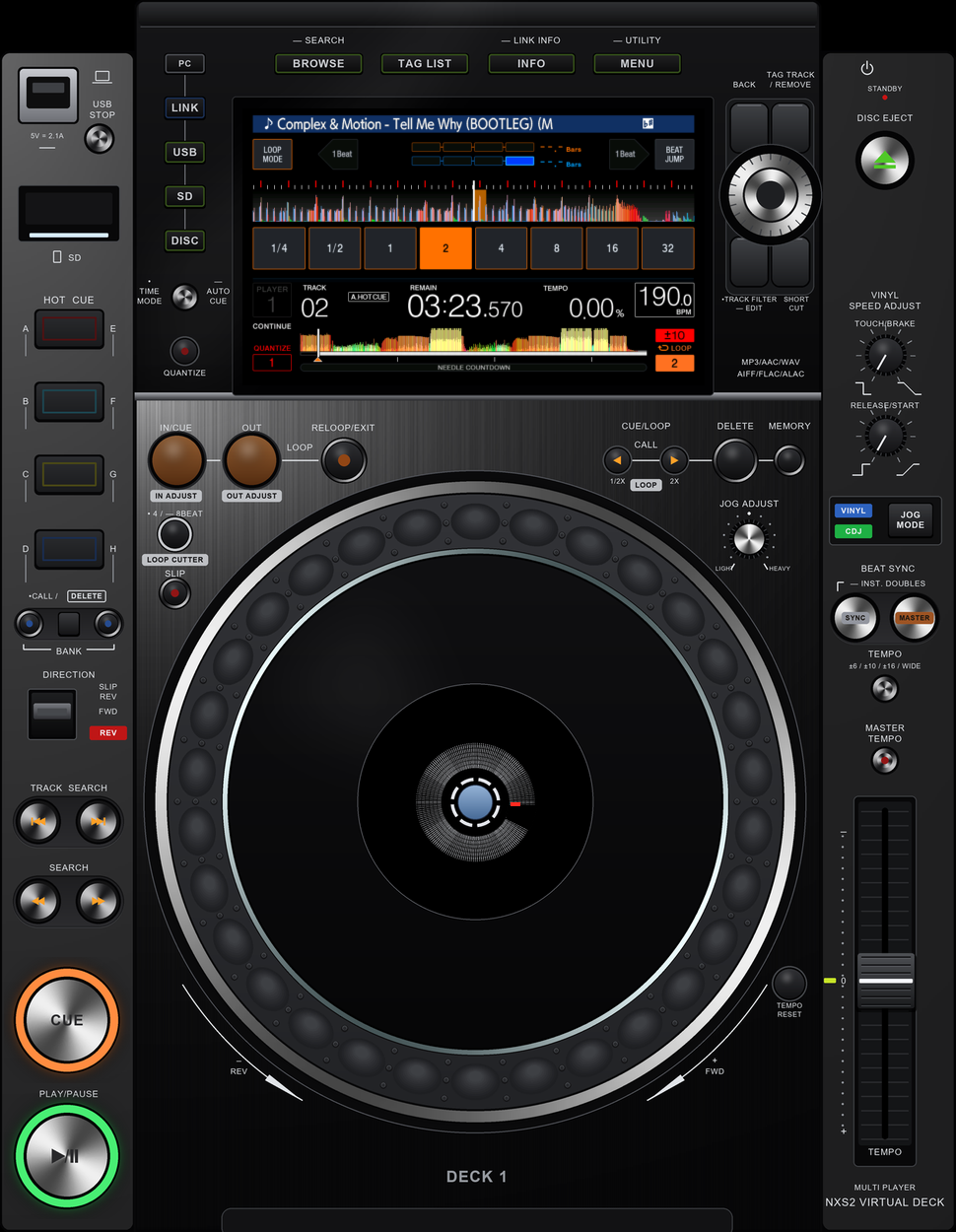
A full player drawn around the emulated screen instead of a bare window: source and browse keys, the rotary selector, hot cue pads, the loop section, CUE and PLAY, a jog with its centre display, the tempo fader. Everything on it is drawn by the app itself; no photo, logo or artwork of the real unit is used.
./start.sh --app # or CDJ_APP=1 in cdj.conf; --no-app for the plain windowWith two decks both stand side by side in one window. Closing the window, or Ctrl-C, stops the decks.
Mouse and keyboard
| you do | the deck gets |
|---|---|
| click a key | the key, held for as long as the mouse button is |
| drag the jog round | the platter turning: the rim bends the track, the top plate is touch-sensitive |
| mouse wheel over the jog | a nudge |
| wheel over (or drag) the rotary selector, click its centre | turn, push |
| drag the tempo fader | the tempo slider |
| click the screen | a touch |
| type | the keyboard map, to the deck under the mouse |
F2 |
the screen beside the face at full size, on/off |
F3, or right-click the screen |
the screen in a window of its own (resizable, F11 full screen) |
Lamps
The lamps are the deck's own: PLAY, CUE, SLIP, MASTER TEMPO and the jog ring light and blink from MAIN's panel-lamp frame, and the jog's centre display turns with the firmware's own pointer. Keys whose report bit is decoded from the firmware but not yet tried on a running deck carry a small amber ring; keys with no known report bit (hot cues, BANK, QUANTIZE, TRACK FILTER, SHORT CUT, the vinyl speed knobs, the needle strip) are drawn but do nothing. Hovering a control says which is which in the status line.
A bigger screen
The NXS2's 7-inch screen is a small part of a tall deck, so a face that fits
a monitor shows it at about half size. F3 opens a deck's screen in a
window of its own at any size (F11 there for full screen); F2 docks it
beside the face at its own 800 x 480 instead. The default is the decks
alone (--screen face|dock|window|auto, or CDJ_APP_SCREEN).
Stuck on "Waiting for the screen"
The screen comes from each deck's display board, a QEMU of its own. After
45 seconds without it the status strip says why, and the terminal prints the
end of that board's log (bridge-gui-show1.log in /tmp, or the system's
temp folder on Windows). logs/app.log records every attempt the app made
to reach each screen. Those two files are what to send with a bug report.
The emulator itself prints little; CDJ_REPORT=1 brings back its exit reports
for diagnostics.
How it is built
Pillow draws the face and pygame-ce (SDL) puts it on screen; both are in
requirements.txt, which ./setup.sh installs into .venv/. The window is
laid out in points and drawn in the display's own pixels, so on a Retina Mac
or a scaled Windows display the face is drawn at 2x (or whatever the
display's density is) rather than stretched. The face is drawn once per
window size with anti-aliasing and every lamp is a small pre-drawn image, so
a lamp or the jog costs almost nothing per frame and the time goes to the
screen: about 4 ms for an 800 x 480 frame at 2x on an Apple-silicon Mac, with
the window shown at the display's refresh rate (120 Hz there). The app talks
to the deck three ways:
- the screen comes from a frame file the display board writes whenever
its picture changes (
CDJ_GUI_FRAME_FILE, checked up to 120 times a second), so every frame the firmware draws is shown: with thehigh_fpsmod about 70 a second while zoomed in on a playing track. QEMU's VNC server, the portable alternative, stops at 33 updates a second and is kept only as the fallback for an older build; - the touch screen and the keyboard go over that VNC server (loopback only, one port per deck from 5921, or the next free one: the launcher tells the app which), straight into the display board's own touch and key handlers, exactly as with the plain window;
- the drawn controls and the lamps go through the controller relay, the
same path and the same key table (
midi/cdj_actions.py) as a MIDI controller, which can stay connected alongside.
MIDI controllers
Using one: plug the controller in before ./setup.sh. Setup recognises a
controller it has a profile for (or offers to learn a new one) and saves your
choice, and from then on ./start.sh starts the bridge together with the decks.
With two decks the controller's left side plays deck 1 and its right side deck 2.
The bridge's own output is in logs/bridge.log. On Windows it runs on a normal
Windows Python (python.org or the Microsoft Store) with mido and
python-rtmidi installed, because MSYS2's Python cannot open MIDI devices; setup
finds it and prints the one pip command it needs if the packages are missing.
On macOS the packages go into this folder's .venv/ (setup prints that command
too), and the bridge reaches the controller through Core MIDI.
Any controller works as a profile (what the hardware sends,
midi/controllers/<name>.json) plus a mapping (which CDJ key each control
presses, midi/mappings/<name>.json). The Roland DJ-202 ships with both. For
another controller:
python midi/learn.py new                          # name it, move each control, name each one
python midi/learn.py map --controller <name>      # bind controls to CDJ actions
python midi/bridge.py --controller <name> --dry-run
Every key of the player's front panel can be mapped, including ones nothing
binds yet. ./setup.sh --reconfigure offers the same walk-through. Details,
the mapping format and the full action catalogue: midi/README.md.
Pro DJ Link
Setup asks for one deck or two (--decks 1|2, or CDJ_DECKS=2 in cdj.conf).
Two decks find each other over an emulated Pro DJ Link network, and MASTER and
SYNC light up between them, same as the real players.
Connecting rekordbox and Ableton Live on this PC
Setup, start command and troubleshooting
The decks' usual Pro DJ Link network is QEMU's multicast segment, which no program on your PC can join. On Windows the deck can instead sit on a virtual network adapter of your PC, and then:
- rekordbox on the PC is a Pro DJ Link peer of the deck. In Export mode they see each other, the deck browses the rekordbox library (the deck's REKORDBOX / LINK source) and loads and plays tracks from it.
- Ableton Live (12 tested) shows
1 Linkat the deck's BPM, and follows the deck's tempo, with theableton_linkmod on. rekordbox in Performance mode also lists the deck as a Link peer and syncs to it.
One-time setup. The adapter is the TAP-Windows6 driver that ships with OpenVPN (the "TAP Virtual Ethernet Adapter" component is enough). Install OpenVPN, then from an elevated PowerShell:
powershell -ExecutionPolicy Bypass -File scripts\net\tap_setup.ps1
It creates an adapter named CDJ-Link with its tapctl.exe (expected in
C:\Program Files\OpenVPN\bin; pass -TapCtl <path> if OpenVPN lives
elsewhere) and gives it the address 192.168.50.1/24. It also caps the
adapter's MTU at 1500, adds a fixed ARP entry for the deck (192.168.50.10),
and opens one firewall rule on that adapter for UDP 67 (DHCP), 20808 (Ableton
Link) and 50000-50002 (Pro DJ Link). It is safe to run again, and starting a
deck afterwards needs no admin rights.
Start the deck on it (one deck; the rig's own DHCP server gives it
192.168.50.10):
DJLINK=tap:CDJ-Link bash scripts/run/rig.sh show
# with the ableton_link mod:
DJLINK=tap:CDJ-Link CDJ_MAIN_ABLETONLINK=1 CDJ_MAIN_ABLETONLINKPONG=1 bash scripts/run/rig.sh show
In rekordbox, switch to Export mode (the deck does not show up in
Performance mode for browsing). Once the deck has booted it appears in the
player list. On the deck press L (LINK) or R (REKORDBOX) for the source,
browse the library and load a track as from a USB stick.
In Ableton Live, turn on Preferences > Link/Tempo/MIDI > Show Link
Toggle, then press LINK in the transport. With the mod on, the toggle shows
1 Link and Live's tempo follows the deck's.
If it does not work:
E-8309on the deck when you load from rekordbox: the adapter's MTU is not capped at 1500. TAP-Windows reports 65500, so Windows sends rekordbox's NFS replies as single oversized frames, which the deck drops. Runtap_setup.ps1again, ornetsh interface ipv4 set subinterface "CDJ-Link" mtu=1500 store=persistent.- rekordbox does not see the deck: rekordbox is in Performance mode, or it
is sending on another adapter. Switch to Export mode; if the deck still does
not appear, check that
CDJ-Linkis the adapter rekordbox's network settings use. - The launcher says there is no adapter of that name, or that it has no address: the setup has not run, or the adapter was renamed.
- One deck only, and Windows only. A TAP adapter carries a single deck
(
NDECKS=1), andDJLINK=tap:is refused on other systems.
Mods
Small on/off tweaks to how the deck behaves, each with its own default,
listed in mods/mods.conf:
| mod | what it does | default |
|---|---|---|
high_fps |
Draw the zoomed-in waveform about twice as often (~70 fps instead of ~33). | on |
live_clock |
Repaint the REMAIN clock every frame instead of about three times a second. | on |
three_band |
Draw the centre waveform and the overview as three bands (low blue, mid amber, high white), CDJ-3000 style, from the track's own 3-band data (.2EX). | off |
phrase |
Draw a coloured phrase band along the bottom of the overview strip, CDJ-3000 style, from the track's own phrase analysis in its .EXT file; tracks without it get no band. |
off |
osc |
Send the deck's beats, state and load/play/stop/cue/loop events as OSC messages on UDP broadcast port 50010, for lighting desks and scripts. | off |
usb_midi |
Send MIDI Start, Stop, Continue and Timing Clock over the rear USB-B port, so a DAW or drum machine follows the deck. | off |
ableton_link |
Join Ableton Link as a peer: Live or any Link app on the deck's network follows its tempo and beat. | off |
tcnet |
Act as a TCNet Master node, broadcasting the deck's play position, track length, beat in the bar and play state on UDP 60000/60001 and answering Metrics (BPM, speed) and MetaData requests on UDP 65023, so ShowKontrol, Resolume or other TCNet receivers can follow it. | off |
Each mod has a page of its own: its knobs, what it patches, and what has and has
not been verified. osc needs a relay on the emulator
(python3 scripts/net/osc_relay.py, see its page); ableton_link is reached
through a TAP adapter.
./setup.sh shows the defaults (step 7) and either takes them or asks about
each one, and saves your answers to cdj.conf; ./setup.sh --reconfigure
asks again. You can also edit cdj.conf directly,
or override any of them for one run with the environment, e.g.
CDJ_GUI_FRAME_MS=0 ./start.sh (a caller's own environment always wins over
cdj.conf).
SERVICE MODE is a separate boot option, not a mod: it changes what the deck boots into, not how it behaves once it is up.
Patching a real firmware update
three_band, phrase, osc, usb_midi and ableton_link are firmware code
patches, not emulator knobs: the launcher applies the display ones to a copy of
the display image at boot (mods/patch_gui.py) and the MAIN ones to a copy of
the MAIN image (mods/patch_main.py), the same code a real update would carry.
mods/patch_update.py makes the same patches to a real Pioneer .UPD file, so
they end up on an actual player instead of a copy this emulator throws away on
exit; each mod's page gives its command, for example:
python mods/patch_update.py C2KNXS2.UPD C2KNXS2-link.UPD ableton_link
MAIN has no scatter-load table of its own: it runs in place, so a mod's routine goes straight into a run of erased flash inside its own address space rather than being copied out to RAM the way a display patch is.
Only a mod that is an actual firmware code patch is offered this way. An
emulator-only knob such as high_fps or live_clock has nothing to write into
a real update, and does not appear. python mods/patch_update.py --list shows
what is available and which firmware version it was verified against; a
mismatched version is refused unless you pass --force-version.
Combining mods. Name as many as you like in one command, e.g.
python mods/patch_update.py C2KNXS2.UPD out.UPD three_band osc ableton_link.
Each name brings every patch its row in mods/mods.conf needs. All routines
of one image are placed in a single pass into one free area, so they cannot
overlap, and mods that hook the same spot in the firmware share it: the spot
is replaced once by a stub that runs the original code and then each mod in
turn. The launcher combines the mods you switched on the same way.
This is untested on real hardware. The container repacking and the LZSS
re-encoding have been checked against the real update file byte for byte, and
the patched image has been checked against patch_gui.py's/patch_main.py's
own output (see tests/), but nobody has flashed a patched update into an
actual player. Flashing a modified firmware update is entirely at your own
risk. Keep the original file, and expect that a mistake here could mean a
trip through service mode's recovery path, or worse.
Service mode
./start.sh --service # or CDJ_SERVICE=1 in cdj.conf; --no-service overrides itThis is the service manual's own diagnostic screen: on real hardware you get it by holding TEMPO RANGE and MEMORY while powering the unit on, until the Pioneer logo clears, and this flag does exactly that at boot. The screen lists BUTTON, JOG, ENCODER, NEEDLE, SLIDER VOLUME, JOG TOUCH VOLUME and JOG RELEASE VOLUME; press or move a control and its own row lights up, so it is a live test of every input rather than the player screen.
Both keys release once the logo clears, so nothing stays held down and the rest of the deck is otherwise normal.
By default every run boots from a shared, throwaway flash image, so nothing you
change in SERVICE MODE (or anywhere else) survives past Ctrl-C. With
PERSIST=1 a deck keeps its own flash image between runs
(extract/flash-<tag>.bin), the same as a real unit's memory: a setting
changed in SERVICE MODE on a persistent deck stays changed.
The DSP module
A deck keeps up with real time only with a native module of the DSP program's
hot code. None is shipped, because it would be derived from Pioneer's code;
setup builds it from your own firmware (step 5) and installs it into
~/c14gen/. A headless deck plays a track for 30 seconds, the DSP's hot code is
compiled to a native module from what it ran, and a second 30-second play with
that module collects the profile-guided counts for the final build. It uses 6
compile jobs (less on an idle machine). With the module, playback holds real
time from the first seconds after a load.
The module is installed with a stamp naming what it was built from: the
generator version, the DSP core's interface, the firmware and the player.
./start.sh compares the stamp with the current code. After a git pull that
changed the generator or the core's interface it does not load the module and
shows a banner that it needs building again (./setup.sh rebuilds it); the
deck runs far below real time until then. If you skipped step 5, the banner
says how to build the module.
Mods do not affect it: they patch the MAIN and display firmware, never the DSP
program the module is built from, so turning a mod on or off later needs no
rebuild. To compare without the module, start with MODULE=none ./start.sh
(the DSP's hot code is then compiled as it plays).
Limits
- Speed depends on your CPU. One deck runs in real time on a fast desktop. Two decks need roughly twice that, and on a busy or modest machine they fall behind real time (the audio then has gaps).
- MASTER TEMPO is heavy. It makes the DSP program do far more work per sample, and it is currently the most demanding thing you can ask of the emulator.
- Only firmware v1.87 is supported for the CDJ-2000NXS2.
- Work in progress. The older players are experimental (see Supported players). On the NXS2 the USB stick is the only medium so far. Some panel keys are decoded by the firmware but have not been tried here; the controller tools say so when you bind one.
How it works
A CDJ-2000NXS2 is three computers in one box, and all three run here (the older players are built the same way, from their own parts):
| chip | job in the player | here |
|---|---|---|
| Renesas SH7724 (SH-4A) | MAIN: transport, file system, rekordbox database, Pro DJ Link, the front panel | QEMU's SH-4 with a board model written for this project (hw/cdj/) |
| Renesas SH7269 (SH-2A) | the display processor: draws the 7-inch screen from what MAIN sends it | a second, big-endian QEMU with its own board model (hw/cdj/boards/nxs2/sh7269gui.c) and a window on your desktop |
| TI TMS320C6655 (C66x) | the DSP: decodes the track, time-stretches it, produces the audio | a C66x core written for this project (hw/cdj/c6x/), running the program MAIN uploads to it at boot |
flowchart LR
    subgraph deck1["Deck 1"]
        direction LR
        MAIN1["MAIN<br/>SH7724 (SH-4A)"] <-- "SPI link" --> GUI1["Display<br/>SH7269 (SH-2A)"]
        MAIN1 <-- "host port / McBSP" --> DSP1["DSP<br/>C66x"]
        DSP1 --> AUDIO1(["🔊 audio"])
        GUI1 --> WIN1(["🖥️ window"])
    end
    subgraph deck2["Deck 2"]
        direction LR
        MAIN2["MAIN<br/>SH7724 (SH-4A)"] <-- "SPI link" --> GUI2["Display<br/>SH7269 (SH-2A)"]
        MAIN2 <-- "host port / McBSP" --> DSP2["DSP<br/>C66x"]
    end
    MAIN1 <-- "Pro DJ Link (emulated Ethernet)" --> MAIN2
    CTRL(["🎛️ MIDI controller"]) --> BRIDGE["midi/bridge.py"] -- TCP --> RELAY["midi_relay.py"] -- "panel report" --> MAIN1
    RELAY -- "panel report" --> MAIN2
The CDJ-2000 and CDJ-2000NXS have a board model of their own
(hw/cdj/boards/cdj2000/): an SH7763 MAIN, a Blackfin BF531 display
processor, and a DSP behind a host port (a C6727 on the CDJ-2000, a C6747 on
the CDJ-2000NXS). The XDJ-700, XDJ-1000 and CDJ-900NXS share the NXS2's
SH7724 MAIN, which draws their screen itself, with a C6747 DSP
(hw/cdj/boards/xdj1000/). The launcher starts each older player in one
window (see Other players).
None of the three knows it is emulated. MAIN talks to the display processor over the same SPI link, to the DSP over the same host port and McBSP audio bus, and reads its front panel through the same report from the panel microcontroller as on the real board. The models were written device by device, from what the firmware actually touches.
How it was done. By reverse engineering, under QEMU, one blocked boot at a time. The firmware update was unpacked (its container, the LZSS packing of the MAIN and display images, the resource archives), and the boards were modelled wherever the firmware stopped: interrupt controllers, DMA, I²C, the USB host controller, the Ethernet MAC, the SPI link between the two processors, the DSP's boot path and command protocol. The firmware turned out to be its own best documentation: it logs to an internal ring, it names its tasks, its keys and its errors, and a trace hook at any firmware address plus a memory watch said the rest.
The NXS2's DSP needed the most work. There is no usable C66x emulator, so this
project has its own: a VLIW core that issues up to eight instructions a cycle,
with the SoC peripherals the program uses. Interpreted, it is far too slow for
real-time audio, so a JIT compiles the hot parts of the DSP program to
native code (hw/cdj/c6x/tools/); the DSP module is that
code, built ahead of time. The instruction decode tables come from GNU binutils.
A platform for modding the firmware
Running the firmware is the first step; changing what a player does is the next, and this is built for it. The emulator makes the whole machine observable and every part of it adjustable, without touching a real deck:
| 🔍 Watch it think | CDJ_FWLOG prints the firmware's own internal log; CDJ_FWTRACE=<address>,... prints the registers each time execution passes an address; CDJ_MWATCH=<address> reports which instruction changed a memory word; QEMU's monitor dumps memory and the screen while it runs. |
| ✏️ Change it while it runs | CDJ_MPOKE holds memory at a value, CDJ_PPOKE writes one when a chosen instruction executes, and CDJ_PCALL2 calls any firmware function from inside a running task. |
| 🕹️ Drive it from outside | Every front-panel key, the jog, the pots and the touch screen are one datagram away (scripts/run/panel_key.py, midi/bridge.py), so input can be scripted, remapped or generated. |
| 🔁 Replay the DSP | The DSP core can record its execution and replay it deterministically, so a change to the audio path can be tested against a recording. |
From here, new behaviour is a question of finding the right code and writing the right change: remapping controls, adding features to the deck, studying the Pro DJ Link protocol from a player that speaks it natively, or experimenting with the audio chain. Keep what you derive from the firmware on your own machine: the update file, and anything built from it, is Pioneer's.
Booting from the flash
MAIN_BOOT=flash ./start.sh
By default MAIN starts with its firmware already unpacked into memory
(extract/main_unpacked.bin), past the point where the player's own
bootloader hands over. With MAIN_BOOT=flash it starts the way the real unit
does: from the reset vector, in Pioneer's bootloader. The firmware update's
MAIN section carries that bootloader, an emergency updater and the packed MAIN
image, at the flash addresses the player's own updater writes them to, and
./setup.sh --firmware lays them into extract/flash.bin the same way. The
bootloader sets up the clocks and memory, checks the image's checksum, unpacks
it and starts it; a damaged image starts the emergency updater instead, as on
the real player. It adds about two seconds to MAIN's start.
A flash.bin made by an older setup holds no bootloader; MAIN then refuses to
start and says so. Run ./setup.sh --firmware <C2KNXS2.UPD> again to rebuild it.
Starting from a saved deck
Booting a deck and loading a track takes minutes on the older players and longer on the NXS2; a test or a change to the firmware's later stages should not pay that every time. A deck can be saved while it runs and started from that moment:
SNAPSHOT=loaded ./start.sh --model xdj1000 # or idle, the settled screenThe first start boots as usual, drives the deck to the point (the model
profile's MODEL_IDLE_S and MODEL_LOAD_STEPS) and saves it; every later
start restores it at once. Saves live in /tmp/cdj-snap/, one folder per
combination of QEMU build, firmware, USB image and MAIN_ARGS, so a rebuild or
a new stick starts a fresh save by itself; delete the folder to forget them.
A save only comes back into the machine that wrote it, so a device that gains
state needs that state in its VMStateDescription before saves of it restore
correctly. The USB image is not part of a save: the stick is attached as a
read-only-in-practice snapshot and comes back as the original file.
scripts/test/quick.sh snap is the same thing as a test: with the deck table
of deck_smoke.py it restores each deck's loaded point and checks that the
playhead moves (deck_smoke.py --snapshot). The first run saves the points,
so it takes as long as decks2; after that a deck takes a minute and a half.
📁 Repository layout
| path | what it is |
|---|---|
setup.sh, start.sh |
the guided setup and the everyday start |
launcher/ |
what setup.sh, start.sh and the scripts in scripts/run/ do (python -m launcher), and what the portable program runs |
packaging/ |
the portable program: package.py builds it for this OS, release.sh builds everything and then packages; a GitHub release runs that for Windows, macOS and Linux |
build.sh |
the build step underneath setup (./build.sh main, display, …) |
hw/cdj/common/ |
what every board shares: the boot (DRAM, NOR flash, image, reset vector), the SH-4 core blocks and the board descriptor (cdj_common.h) |
hw/cdj/boards/nxs2/ |
the CDJ-2000NXS2: its MAIN board, one file per device, and the display board (sh7269gui.c); diag/ holds the diagnostic hooks, standin/ historical models that are off by default |
hw/cdj/boards/cdj2000/ |
the CDJ-2000 and CDJ-2000NXS: MAIN board (Renesas SH7763), Blackfin display and C6727 / C6747 DSP models, experimental |
hw/cdj/boards/cdj900/ and hw/cdj/m16c/ |
the CDJ-900: the CDJ-2000's MAIN board with its M16C display micro (core, SoC and the display model), experimental |
hw/cdj/boards/xdj1000/ |
the XDJ-700, XDJ-1000 and CDJ-900NXS: their SH7724 MAIN board with its LCD controller and graphics blocks, experimental |
mods/ |
the mods registry and the display- and MAIN-firmware patches behind them |
models/ |
one profile per player, read by the firmware and launch scripts (see models/README.md) |
hw/cdj/c6x/ |
the C66x DSP core, its SoC peripherals, the JIT generator (tools/) and unit tests |
patches/ |
the changes to QEMU 9.1.0 itself |
scripts/build/ |
the QEMU builds (Linux, macOS and MSYS2), the board installer and the DSP module build |
scripts/firmware/ |
unpacking and verifying the update file |
scripts/media/ |
the USB stick image builder; collection_xml.py and bpm_estimate.py turn a plain folder of music into the XML baken reads for the other USB step |
scripts/run/ |
the run chain behind the launchers, the panel and monitor sockets, the controller relay and the run reports |
scripts/net/ |
the Pro DJ Link segment: DHCP server, capture, capture scorer, and tap_setup.ps1 for the TAP adapter |
midi/ |
the MIDI controller bridge, controller profiles, mappings and the learn tool |
app/ |
the virtual deck app: the drawn player around the emulated screen |
tests/, scripts/test/ |
the offline unit tests (python -m pytest tests, no firmware needed) and the quick check: scripts/test/quick.sh runs them beside a replay of DSP recordings and a headless boot of each deck to its first stable screen (deck_smoke.py), in a couple of minutes |
docs/img/ |
the screenshots on this page |
The board sources are copied into the QEMU tree on every build; edit them here,
never in qemu-src/.
Licence
This project's own files are licensed under the GNU General Public License,
version 2 or (at your option) any later version (GPL-2.0-or-later); the
full text is in LICENSE, and each file carries an
SPDX-License-Identifier line.
Third-party files and binaries
- The C66x instruction decode tables in
hw/cdj/c6x/binutils/are copied from GNU binutils and licensed GPL-3.0-or-later. They are compiled into the MAIN emulator, so a binary built from this tree is distributed under GPL-3.0-or-later terms. hw/cdj/boards/nxs2/standin/minimp3.his minimp3, released into the public domain (CC0).
QEMU itself is GPL-2.0-or-later overall, with a few GPL-2.0-only files; if you distribute a binary, check how those parts combine with GPL-3.0. This note describes the files' licences; it is not legal advice.
Credits
QEMU, which this machine plugs into; GNU binutils, for the TI C6x opcode tables; minimp3; baken (MIT), which writes the USB export for the folder-of-music setup step.