

knife
Find the bug, not just the binary. A reverse engineer's toolkit in Rust.
Parse, triage, disassemble, and audit PE, ELF, Mach-O, and WebAssembly from one small binary. Static only: it reads the bytes on disk and never runs the target.

Why
Five tools become one: headers, strings and IOCs, imports, entropy,
disassembly — plus the step they all leave to you. Most tools tell you a binary
imports memcpy. knife reads the call sites and tells you which one takes
its length from a subtraction:
$ knife sec 7z.dll
  [-] stack cookies (/GS)  disabled   no __security_cookie in the load config
      linear stack overflows reach the saved return address unchecked
  [-] CFG                  disabled   GUARD_CF clear
  WEAK   exposure score 7 · 3 of 6 mitigations missing or weakened

$ knife audit 7z.dll
  § AUDIT (145 FINDINGS)
  [-] copy-underflow   memcpy  sub_1000a6b4     @ 0x1000a72a
      copy length computed by subtraction (integer underflow to a huge size?)
Those addresses are real functions in a stripped C++ parser that most
disassemblers never recover: knife seeds function discovery from the PE
exception directory (7z.dll: 87 → 6472 functions) and ranks dangerous calls
by the argument provenance that reaches them. Same story on a Linux daemon or
a macOS dylib.
Install
# from crates.io (installs the `knife` command)
cargo install reknife

# prebuilt binary, no toolchain needed (cargo-binstall)
cargo binstall reknife

# latest from git
cargo install --git https://github.com/bl4ckr0ss3/knife
Or grab a prebuilt archive from the
Releases page and drop knife
on your PATH.
If your shell cannot find knife after installing, ~/.cargo/bin is not on
your PATH yet: restart the shell (or source ~/.cargo/env on Unix), then
knife --version.
To update an installed release:
knife update --check   # check the latest stable GitHub release
knife update           # verify, back up, and replace this executable
The updater requires curl and a writable installation directory. It verifies
GitHub's SHA-256 asset digest, rejects downgrades, and prints the previous
executable's backup path. Restart running Knife sessions after updating.
knife update --check --json provides a machine-readable version check.
Unsupported prebuilt platforms can use cargo install reknife --locked --force.
The TUI
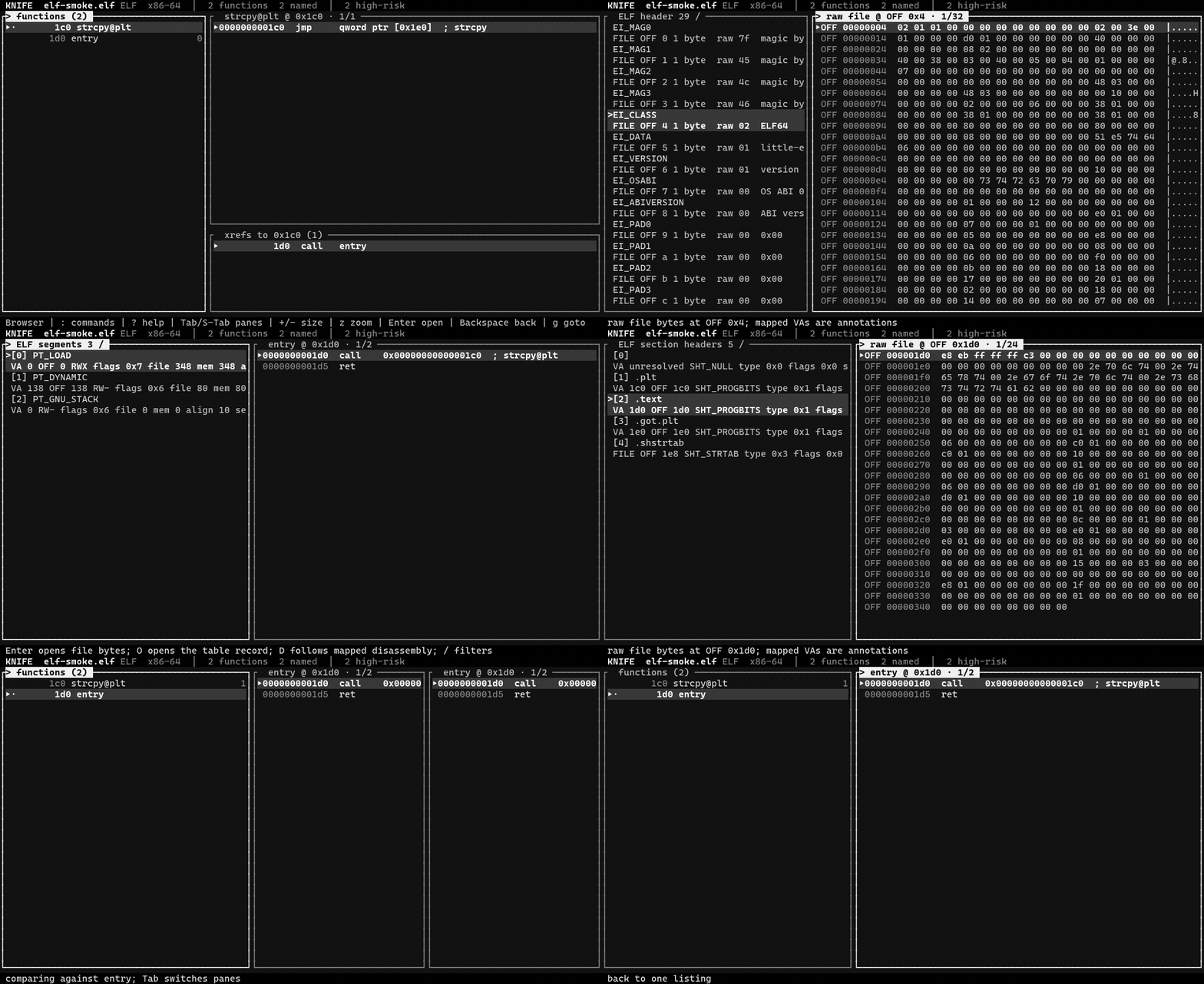
knife tui FILE opens a monochrome debugger-style workspace: function list,
listing, cross-references. Bare knife opens a file explorer instead —
directories first, PE/ELF/Mach-O badges sniffed from the magic bytes, /
filters, Enter opens the workspace, and quitting the workspace returns to the
explorer (knife tui without a file and knife <dir> do the same).
? shows scrollable help (↑/↓, Page Up/Down, Home/End; Esc or ?
closes it), and : opens command mode. The essentials:
| key | does |
|---|---|
↵ |
open a function, follow the call under the cursor, or jump to a xref |
⌫ |
back |
Tab / Shift+Tab |
focus the next / previous pane, skipping empty xrefs |
+ / - |
grow / shrink the focused pane |
z |
maximize the focused pane; press again to restore |
Ctrl+← / Ctrl+→, Ctrl+Tab, F6 |
move between analysis and the investigation desk |
g |
goto a symbol; va:0x.. static VA, off:0x.. file offset |
/ |
filter the function list, or search the listing |
d / f |
pseudocode / spatial CFG view |
s |
cycle functions, attack surface, driver summary, types |
n / c |
name / note whatever the cursor is on |
b |
bookmark |
Commands worth knowing: :split clones the listing into a second column and
:compare FUNC pins a function there — Tab walks between the columns, and
each keeps its own cursor, view mode and history; :only collapses back.
:reload re-reads the target from disk on a background worker; pane layout
and annotations survive, a failed reload keeps the old session.
:xrefs, :callers, :callees, :imports, :exports, :strings,
:sections, :bookmarks, :history open filterable catalogs. On ELF targets,
:headers, :segments, and :section-headers expose the actual on-disk
records. Enter opens file-backed bytes, O opens the table record, and D
follows a mapped static address into disassembly. File offsets are always
labelled OFF; Knife does not pretend header bytes are virtual addresses.
:focus references or :xrefs opens the reference pane even when it is empty.
Tab completes commands, Up/Down recalls them.
Your names, notes, bookmarks, patches, types and prototypes save immediately
to a SHA-256-keyed database shared with the CLI — quitting is not a save step.
The database follows the binary, not the path; --db PATH relocates it and
KNIFE_NO_CACHE=1 forces a fresh analysis. The
milestone plan tracks what is stabilized
and what is next.
Commands
One tool, many jobs, which is the point of a Swiss-army knife:
| command | what you get |
|---|---|
knife FILE |
full triage: verdict, hashes, sections, mitigations, capabilities, IOCs, artifacts, entry disasm |
knife sec FILE |
exploit mitigations, and what each missing one buys an attacker |
knife sinks FILE [--class C] [--all] |
dangerous-API call sites, grouped by bug class |
knife audit FILE [--reachable] |
sink call sites whose arguments look exploitable |
knife xrefs FILE TARGET |
what references a function, import, or address |
knife xrefs FILE --str TEXT |
what references the strings matching TEXT |
knife paths FILE TARGET [--from F] |
call chains that reach a sink from entry points and exports |
knife graph FILE [--from FUNC] [--reachable] [--dot] |
whole-program call graph, optionally rooted or Graphviz-ready |
knife graph FILE --func FUNC [--dot] |
one function's control-flow graph as text, JSON, or DOT |
knife tui FILE |
interactive: functions, listing, xrefs, split comparison, naming and notes |
knife mcp [--file F] |
Model Context Protocol server over stdio (tools for agents) |
knife name FILE ADDR NAME |
name an address; every later command uses it |
knife note FILE ADDR TEXT |
annotate an address; shows up in the disassembly |
knife field FILE --type TYPE OFFSET NAME [--data-type CTYPE] |
define a reusable, optionally typed structure field |
knife type FILE --func FUNC BASE TYPE |
bind a pseudocode base to a user type |
knife var FILE --func FUNC BASE NAME |
persistently rename a recovered pseudocode variable |
knife proto FILE --func FUNC --returns TYPE [--param TYPE ...] |
set an exact persistent function prototype |
knife patch FILE [--vaddr ADDR | --off OFFSET] --bytes HEX |
stage binary edits without modifying the input file |
knife patch FILE [--vaddr ADDR | --off OFFSET] --clear [--len N] |
restore a staged patch run or byte range |
knife patch FILE --export PATH [--force] |
atomically write a patched copy of the binary |
knife typelib FILE --export PATH |
export reusable layouts for other binaries |
knife typelib FILE --import PATH [--replace] |
merge or explicitly replace imported layouts |
knife db FILE |
everything you have stored for this binary |
knife funcs FILE [--by-refs] |
recover functions via control-flow analysis |
knife dis FILE --func NAME |
disassemble a whole function with labels and xrefs |
knife dis FILE [--vaddr X | --off Y] [--count N] |
linear disassembly (x86/x64, AArch64) |
knife pseudo FILE --func NAME |
pseudocode view: lifted statements, calls with arguments |
knife headers FILE |
ELF file header, raw e_ident plus decoded labels |
knife segments FILE |
ELF program headers and mapped section indices |
knife sections FILE |
sections/segments with per-section entropy bars |
knife imports FILE |
imported libs and functions, suspicious APIs flagged |
knife exports FILE |
exported symbols |
knife caps FILE |
capabilities inferred from the symbol surface |
knife strings FILE --min N |
ASCII and UTF-16 strings |
knife iocs FILE |
URLs, IPs, domains, emails, wallets, reg keys, paths, defanged |
knife hashes FILE |
MD5 / SHA-1 / SHA-256 and imphash |
knife drv FILE [--reachable] |
kernel-driver / BYOVD analysis: identity, devices, IRP dispatch, IOCTLs, kernel primitives, signing, loldrivers matches |
knife scan FILE |
crypto constants, packer markers, embedded formats |
knife artifact FILE [--limit N] |
bounded 7-Zip/firmware package inventory without extraction or execution |
knife ihex FILE |
validate Intel HEX checksums and report firmware load regions and entry points |
knife map FILE |
whole-file entropy sparkline, packed regions flagged |
knife hex FILE --off O --len L |
hex dump |
knife ls FILE |
archive (.a/.lib) members |
knife completions SHELL |
shell completion script (bash, zsh, fish, powershell, elvish) |
knife diff A B |
compare two binaries' functions, imports, sections; exit 1 on any change |
Add --json to any analysis command for machine-readable output. knife FILE
is shorthand for knife info FILE.
For vulnerability research
Triage asks whether a binary is hostile. Research asks where it can be broken, and four commands answer that:
knife sec — what am I up against. Reads the real mitigations, not the
flags: a PE with DYNAMIC_BASE set but no .reloc still loads at its
preferred base, a GUARD_CF flag with an empty guard table checks nothing.
Each finding carries its consequence.
knife sinks — where the surface is. Matches the binary against a
catalogue grouped by the mistake each API enables — unbounded copies, format
strings, input-sized stack allocation, command execution — then resolves every
hit to concrete call sites: addresses in named functions, not an import list.
On kernel32.dll that is 327 call sites across 17 APIs; statically linked
targets work the same way.
knife audit — which ones look actually wrong. For each catalogued call
it recovers where the interesting argument came from (a bounded backward
data-flow walk) and keeps only the sites whose provenance matches a bug
pattern: a memcpy length computed by subtraction, an allocation sized by a
multiply, a printf format loaded from memory. Ranked, named, and honest
about paths: when dangerous arithmetic reaches a sink on only some paths, the
finding says so. x86/x64.
knife xrefs / knife paths — what reaches what. Who references a
function, import, address, or string; and the shortest call chains from entry
points and exports down to a sink. Empty results do not establish
unreachability — indirect dispatch is outside this direct graph.
knife sec ./target                       # what am I up against
knife sinks ./target --class memory      # where could the bug be
knife audit ./target --reachable         # which sites look actually exploitable
knife xrefs ./target --str "/tmp/"       # who builds that path
knife paths ./target system              # can anything reach it
knife graph exports the recovered edges as a deterministic artifact —
whole-program call graph, a forward-reachable subgraph, or one function's CFG —
as text, JSON, or DOT:
knife graph driver.sys --reachable
knife graph driver.sys --func DispatchDeviceControl --dot > ioctl-cfg.dot
dot -Tsvg ioctl-cfg.dot -o ioctl-cfg.svg
Worked example on a real, shipped binary:
finding CVE-2017-11882 with knife — sec shows
the Equation Editor has no mitigations, audit flags the font-name copy, and
dis confirms it is an lstrcpy of attacker data into a stack buffer.
What you worked out. Everything above is recomputable from the bytes; what
you understood is not. knife name and knife note write it down, and every
later command reads it back. Naming an address tells the engine there is a
function there — how you make progress on a stripped binary.
knife name ./target 0x4017a0 parse_record      # sub_4017a0 is now parse_record
knife note ./target 0x4017c4 "len from packet" # shows up beside the instruction
knife funcs ./target | grep parse_record       # and in every other command
Agents
knife mcp serves every analysis above over the
Model Context Protocol, so an agent drives
the same engine the command line does: recover functions, read pseudocode,
rank the dangerous call sites, and write names, notes and prototypes into the
database. Bind a binary once (knife mcp --file PATH or the
open tool) and nothing after it needs a path. Being static, the server
cannot run the sample it is reading — which is what makes it safe to hand an
agent a piece of malware.
Firmware and package investigations can begin target-free with
artifact_inventory {"path":"/absolute/package.spk"}. It invokes an optional
caller-installed 7z/7za (or KNIFE_7Z) using a fixed read-only listing,
returns exact package identity and paginated member metadata, classifies absolute
and parent-traversal paths, preserves reported symbolic/hard-link targets, and
does not extract members. Open a selected contained executable separately for
native analysis.
claude mcp add knife -- knife mcp
Full tool table and per-client setup: docs/MCP.md.
Use your existing agent through MCP; Knife itself needs no model account. The external-agent workflow describes investigations with evidence and explicit unknowns. Reproduce analysis operations from a terminal with structured JSON:
knife query sample.exe trace_string_usage --args '{"query":"password","limit":5}'
knife query sample.exe explain_function --args '{"selector":"main"}'
The built-in investigation desk opens beside the
listing. Press i to chat through local Ollama, OpenRouter, OpenAI, or another
OpenAI-compatible endpoint; the agent can call Knife's bounded analysis tools
and save its evidence into the project ledger. Press S to choose a provider
and model from the setup sidebar (or type an exact model ID). Knife remembers
provider/model preferences in its user config and stores hosted API keys only
in the operating-system credential vault; keys remain masked and never enter
the project ledger. No provider is contacted until you submit a message.
Use Ctrl+Right, Ctrl+Tab, or terminal-friendly F6 to focus the desk, then z to
maximize its chat and evidence panes; z restores the side-by-side layout.
Ctrl+Left returns to analysis without discarding the conversation.
The conversation labels replies with the configured model's readable name
(for example GLM5.3 Flash) and uses restrained role and evidence colors to
separate analyst input, model output, observations, inferences, and limits.
Kernel drivers & BYOVD
knife drv FILE is the driver half of the audit. A .sys parses,
disassembles, and decompiles like any other target; this pass turns the
generic surface into the questions a driver review actually asks:
| what | where |
|---|---|
native-subsystem identity + DriverEntry |
driver header line |
\Device\ / \DosDevices\ names and their xrefs |
devices list |
IRP_MJ_* dispatch handlers |
"irp dispatch" |
IOCTL codes decoded as CTL_CODE, METHOD_NEITHER flagged |
"ioctl surface" |
| kernel primitives with call sites: physical-memory maps, arbitrary R/W, driver loaders, registry/process, callbacks | "kernel primitives" |
| Authenticode signers + SHA-1 thumbprints | "signing" |
| SHA-256 match against a bundled loldrivers.io snapshot (2000+ samples) | "known vulnerable driver" |
knife drv ./sus.sys                 # the whole picture
knife drv ./sus.sys --reachable     # primitives user mode can actually drive
In the TUI the driver pane is navigable like the sinks: s cycles to it,
↵ jumps to a call site or device, w toggles reachable-only, 3 gates on
severity, / filters. The kernel API catalogue feeds knife sinks and
knife audit too.
What makes it more than objdump
-
Cross-format, one model. goblin parses PE/ELF/Mach-O into a single neutral model; every command works on every format. WebAssembly modules are parsed by knife itself (goblin has no wasm parser): the full section table, imports grouped by module, exports, custom sections including the
producerstoolchain fingerprint and the decodednamesection, function-body locations, and aknife watlisting of any function body — all without a wasm lifter, so code views refuse while every byte and data view works. -
A real analysis engine. Recursive-descent disassembly seeded from the entry point and every named symbol, jump-table resolution, basic blocks, CFG, xref counting. On
kernel32.dll: 2605 functions, 1515 named. -
It finds code control flow cannot reach. Function discovery from the PE exception directory and ELF
.eh_frame_hdr— the 87 → 6472 jump above. Chained unwind entries are continuations, not functions, and are skipped. -
Imports resolve to names.
.plt/GOT andjmp [IAT]thunks are followed, so call sites readcall strcpy@pltinstead of an anonymoussub_. -
A decompiler engine.
knife pseudolifts to an IR, propagates expressions across blocks, eliminates dead stores, rebuildsif/else,whileandswitchfrom dominators, and reads the stack frame as named locals and arguments. The CVE-2017-11882 overflow comes out as the single linelstrcpyA(&var_28, arg_8 + 0x1c);. Conservative types with interprocedural argument and return propagation; anything the lifter does not model prints verbatim, so the limits stay visible. -
User types that stick. Reusable structure layouts, typed fields, scoped bindings, exact prototypes, variable aliases — editable in the TUI and the CLI, portable between binaries via
knife typelib:knife field sample.exe --type CONTEXT 0x18 length --data-type size_t knife type sample.exe --func parse_packet rcx CONTEXT knife proto sample.exe --func parse_packet --returns bool --param "CONTEXT *" knife typelib driver-a.sys --export kernel-types.json knife typelib driver-b.sys --import kernel-types.json
-
A safe patch workspace. Staged bytes are analysis facts: the original file is never touched, analysis runs on the staged image, and
--exportwrites a patched copy atomically.knife patch sample.exe --vaddr 0x401234 --bytes "31 c0 90" knife dis sample.exe --func verify # analyzes staged bytes knife patch sample.exe --export sample-patched.exe
-
Constant scanning built in.
knife scanfingerprints AES S-boxes (generated, not stored), SHA/MD5/CRC32 constants, packer markers, and embedded formats. -
Transparent triage. The verdict (
CLEAN/LOW RISK/SUSPICIOUS/MALICIOUS) is an additive score where every point is a named signal. Concealment and anomaly weigh above raw capability — a system DLL legitimately exports powerful APIs. It shows what a binary can do and how it is built, and leaves intent to you.
Examples
# busiest functions, then read the hot one
knife funcs sample.exe --by-refs
knife dis sample.exe --func sub_401240

# what crypto is this stripped blob doing?
knife scan blob.bin

# pull defanged network indicators as JSON
knife iocs sample.exe --json | jq '.[] | select(.kind=="url").value'
Build from source
cargo build --release        # target/release/knife
cargo test
Needs Rust 1.88 or newer (2021 edition). No system libraries beyond the platform default; the whole tool, terminal interface included, is pure Rust.
Community
Questions, triage walkthroughs, and release announcements happen on Discord: join the server.
Contributing
Issues and pull requests are welcome. Please run cargo fmt, cargo clippy,
and cargo test before opening a PR; CI enforces all three across Linux,
macOS, and Windows. See CONTRIBUTING.md.
License
MIT. See LICENSE.