

Ocean Drive
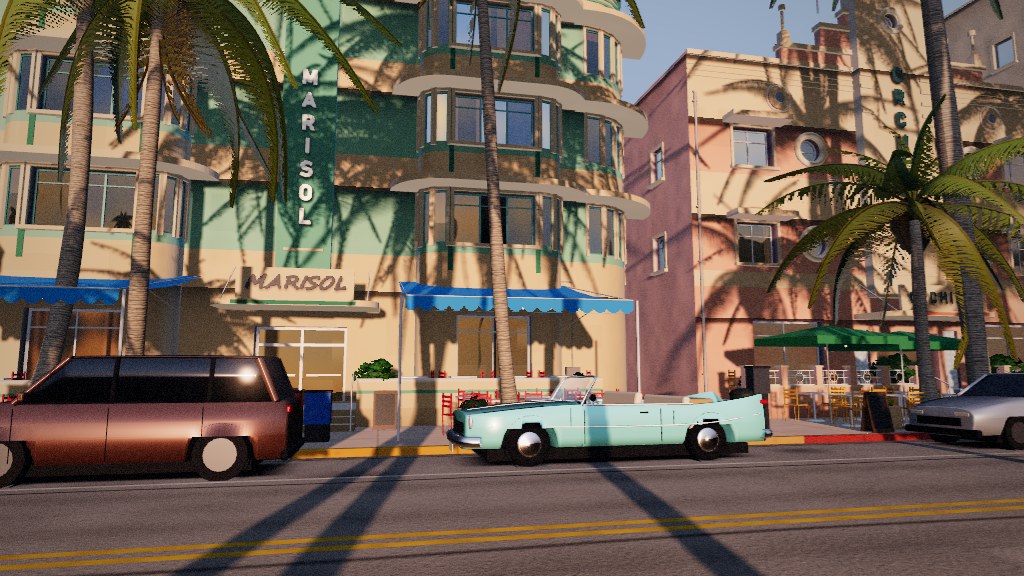
A first-person walk along Ocean Drive in Miami Beach at sunrise, built in Three.js. The sun is a hand's width above the Atlantic, the pastel Art Deco hotels are lit gold, and the palms throw shadows the length of the street. You can walk the sidewalk past the cafés, cross to the park, climb a lifeguard tower and go down to the water, where the swash runs in around your feet. Or get into any car on the street, a parked one or a stopped one in the traffic, and drive it anywhere: down the drive, over the park lawn, down the seawall ramps onto the sand and into the surf. It is a sandbox, not a crime game: no weapons, no fighting, and a borrowed car's driver gets out and waves.
The hotels, the palms, the sand, the ocean, the sky, the signs and every sound are generated in code at load time. The only files the scene loads are the cars, modelled in Blender for this project, the people and their animations from Mixamo, and two Poly Haven CC0 normal maps for the car interiors (see CHANGELOG.md for the provenance). The hotels are invented: there is no real name or brand anywhere in the scene.

Walk it: https://starknightt.github.io/ocean-drive/
The brief it was built from: PROMPT.md. One page, unedited, with a list at the end of where the scene went beyond it.
It runs best on a desktop GPU in a Chromium-based browser, and it was built and measured on an RTX 4060. It also runs on laptops and phones, on a lower quality tier.
Running it locally
git clone https://github.com/StarKnightt/ocean-drive.git
cd ocean-drive
npm install
npm run dev        # http://localhost:5173
npm run build      # production build into dist/
The only runtime dependency is three (0.186). The build uses a relative base, so dist/ works
from any sub-path; every push to main deploys it to GitHub Pages through
.github/workflows/deploy.yml.
The Playwright scripts in tools/ need the dev server running: shots.mjs captures the five
fixed critic cameras, walk-test.mjs walks the route from the sidewalk to the water,
ride-test.mjs and vehicle-sim-test.mjs check the bike, the ATV and the convertible (car-ride-test.mjs
runs the convertible's enter / drive / exit flow in Node; traffic-sim-test.mjs and
traffic-visual-test.mjs check the traffic in Node), and mobile-test.mjs runs
the touch controls on an emulated phone.
Controls
| Action | Keyboard and mouse | Touch |
|---|---|---|
| Start | Click (locks the pointer; the sound starts on the same click) | Tap (goes fullscreen where the browser allows it) |
| Look | Mouse | Drag anywhere off the joystick |
| Walk | W A S D, Shift to walk faster | Left-thumb joystick |
| Jump | Space | Jump button |
| Get in / out | E (or F): the beach cruiser, the lifeguard ATV, the convertible, any parked car, or a stopped traffic car at its driver's door (the driver gets out and waves) | Ride / Enter button |
| Throttle, brake / reverse, steer | W S A D, Shift for a little more throttle | Joystick |
| Handbrake | Space: held with the wheel turned, the tail steps out | Jump button, held |
| Driver's view / chase camera | C (or V) | Camera button |
| Horn | H | |
| Car radio: Off, Bossa at Dawn, Sunrise Synth, Clave Café | Q | Radio button |
| Minimap | N hides / shows it, Shift+N north up / heading up | |
| Fast travel: 1 beach, 2 your car, 3 hotel sidewalk, 4 promenade, 5 11 ST, 6 café, 7 convertible, 8 ATV, 9 tower lookout, 0 start (2, 3, 5 and 7 bring the car you are driving) | 1–0 | Pin button, top right |
| Back to the nearest road (stuck, bogged in the sand, stalled in the surf) | R (or Backspace) | |
| Mute | M | Mute button |
| Release the pointer | Esc |
The key hints show small at the bottom left for a few seconds after you get in, then fade.
The last car you got out of stays where you left it, across reloads (localStorage
ocean-drive.car); the minimap marks it with a small lozenge.
| URL option | Effect |
|---|---|
quality=low|medium|high |
Pins a quality tier instead of detecting one |
dynres=0 |
Turns dynamic resolution off |
hud=1 |
Shows the frame-rate readout |
nofs=1 |
Does not go fullscreen on the starting tap |
openworld=0 |
The road-only rules: cars stay on the road, the ATV on the beach, no parked car to enter |
units=kmh |
The driving speedometer in km/h |
prof |
Per-section main-thread timings in window.__prof() |

What is in it
- About 22,400 lines of hand-written JavaScript across 57 files in
src/. - A district 680 m long, from z −340 to +340, with six cross streets, the park, the promenade and the beach. The brief asked for one block.
- About forty procedural Art Deco hotels: curved bays, eyebrow slabs over the windows, porthole windows, pylon signs, stepped parapets, recessed windows that reflect the sky, café patios with umbrellas and awnings, and weathering streaked down the stucco. The names are invented: MARISOL, ORCHIDEA, BELLA MAR, CORALINE, SEAGROVE and so on.
- About 160 palms of three species, coconut, royal and sabal, with fronds that sway in the wind and leaflet shadows cut from the same alpha as the leaves.
- A weathered street with lane markings, crosswalks, Deco lamps and signs, parked cars and a 1950s convertible at the curb.
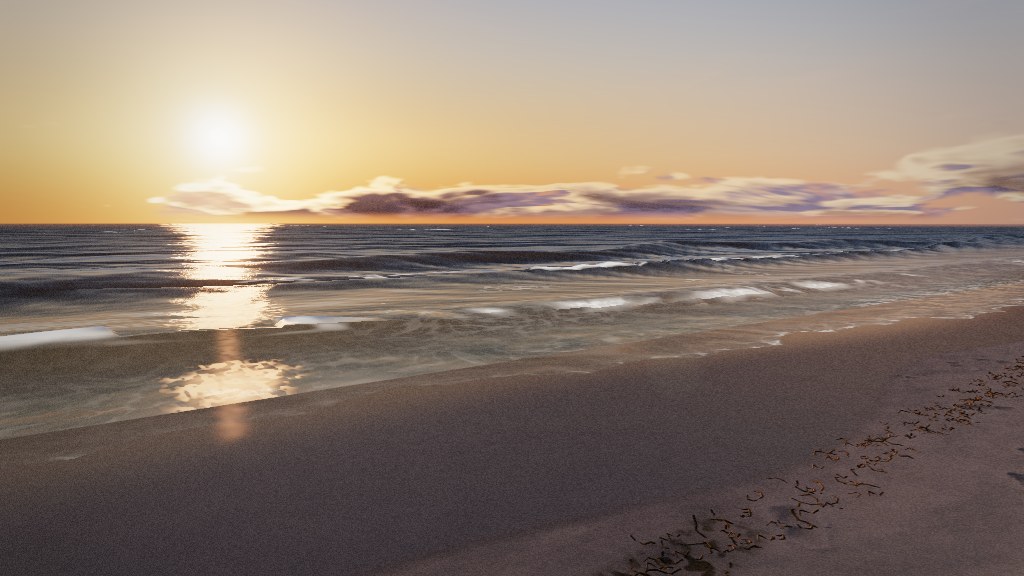
- A beach with footprints pressed into the sand, a wrack line of seaweed, a wet-sand sheen, breakers, lace foam and swash that washes around your feet. Three lifeguard towers, all climbable.
- An ocean with a glitter path under the sun and turquoise shallows.
- People: a crowd of Mixamo characters walking, jogging and skating the sidewalks and the promenade, sitting at the cafés and on the benches, a beach walker on the wet sand and a seated driver in every traffic car. They step out of a car's way and turn their heads to one coming at them.
- Birds: pelicans in a line over the water, gulls that flee when you walk at them, sanderlings chasing the surf, grackles on the patios, a frigatebird and cormorants.
- Cars modelled in Blender (
blender/): the two-tone 1950s convertible and seven modern bodies, with cockpits you can sit in. A beach cruiser to ride, a lifeguard ATV and the convertible to drive (V8 synthesized live), and every other car too. - Traffic: a few cars cruising the drive at 20–30 km/h, keeping their distance, stopping for
anyone on a crosswalk, for the 11 ST signal (which cycles) and for you in the lane, with
brake lights, positional engines and a horn when blocked. They brake for where you will be,
beep when you cut in, edge round things at the lane edge and pass a car left standing in the
lane. None in the
?shotharness frames. - Open world: any parked or stopped traffic car to take (its driver swings the door open, gets out and walks off), the park lawn, the seawall ramps, soft sand you can bog in and surf that can drown the engine, with the car pressed into the sand and the water, gold-backlit spray, thrown sand, ruts and patchy skid marks. Sidewalk bins and news boxes you can knock over, road-closed barricades and cones at the ends, dents on the modern cars, parked classics in the curb rows, the last car you left saved across reloads, a minimap and a three-station generative car radio.
How it works
Sky and light
The sky is a physically inspired scattering model evaluated for a sun a few degrees above the horizon, with a deck of clouds whose sun-facing edges go gold and whose undersides go violet. The sun is warm and the shadows are cool, lit by the same sky. Aerial haze thickens with distance, so the far end of the street goes soft and warm the way a humid Miami morning does.
Shadows are contact-hardening: sharp where a palm trunk meets the pavement, soft at the far end of its long shadow. The shadow camera follows the player through the whole district, snapped to whole shadow-map texels, so the edges do not shimmer as you walk.
Hotels, palms and the street
Every hotel is described by a short line of parameters (floors, style, colour scheme, window layout, eyebrow type, canopy, patio, portholes, parapet) and built from it in code, so the forty hotels share a vocabulary without repeating one another. The palms are built the same way from trunk and crown definitions per species. Beyond the near blocks a far level of detail takes over for the hotels and the palms.
Beach and ocean
The waves are on a schedule shared with the audio: each set of breakers is timed from the sound's clock, so the swash you see arriving at your feet is the swash you hear. Below the swash line the sand goes dark and reflective. The dry sand is baked with footprint-churned relief and its own shadows from the 7° sun, so the low light rakes across every footprint.

Sound
Nothing is recorded; everything is synthesized with the Web Audio API and placed in 3D with HRTF panning. The waves are a row of sources along the shore. The gulls call from birds you can see. The wind in the fronds follows how many palms are near. The car that passes is a car you can see, with its Doppler shift synced to its position. A generative bossa nova plays from one hotel patio and gets louder as you walk up to it. Footsteps change with the surface underfoot: pavement, grass, sand, wet sand, the wooden tower steps, and a splash in the swash. The bike and the ATV have their own freewheel and engine sounds.
The loader
The page opens on a sunrise title card. Its progress bar is not a timer: each build stage reports how far it has got, so the bar tracks the actual build of the scene.

Performance
About 200 fps on an RTX 4060 at the 1024×576 test resolution, measured along the whole district.
The quality tier is chosen on load (src/quality.js) from the GPU string, the WebGL limits, the
CPU core count and the memory. high is the reference look for a desktop with a discrete GPU,
medium is for integrated GPUs, laptops and tablets, and low is for phones. The tiers scale the
pixel ratio, the shadow map (8192, 4096 or 2048 texels), MSAA or FXAA, bloom, the detail in the
ocean and the sand, the far level of detail and the number of audio voices.
On top of the tier, dynamic resolution steps the render scale down, to 0.6 at least, when frames run slow, and back up after a long calm stretch. A scale that had to be abandoned is not retried for a while, and for longer each time, so it never oscillates.
Limitations
- The critic never passed it. The brief said to stop when a critic could find nothing that looked fake, and that never happened. See below.
- Browsers. Built and tested in Chromium (Chrome, Edge). Firefox and Safari are untested.
- Phones. The
lowtier runs, but it is a reduced version of the scene: smaller shadow maps, less detail in the sand and the ocean, fewer sounds.

How it was built
It was built overnight in Cursor by AI agents, from the brief in PROMPT.md. An orchestrator ran a long-running builder agent through each system in order, sky and lighting, hotels, palms, street and car, beach and ocean, then sound, walking and the full scene, with a separate sound agent working alongside. After each pass a fresh critic agent that had never read the code screenshotted five fixed cameras and compared them side by side with real sunrise photographs of Ocean Drive and Miami Beach, listing everything that looked fake. The builder fixed the list and the critic looked again.
The rounds per system were: sky and lighting 6, hotels 3, palms 2, street and car 1, beach and ocean 1, and the full scene 3, the last of them against the live site.
Honest version: the critic never gave a clean pass. In the later rounds it started contradicting its own earlier findings, so the physics of a low sun and the reference photographs were used as the tie-breakers rather than the latest list.
The next day more agents extended it at the user's request: the loader, the quality tiers and touch controls, the people, the birds, the extended district, the bike and the ATV, and a round of fixes. The skills used were cloudai-x/threejs-skills, dgreenheck/webgpu-claude-skill, majidmanzarpour/threejs-game-skills and find-skills.
Layout
src/
  main.js        boot, render loop, dynamic resolution, input
  sky.js         sunrise sky, clouds, sun
  quality.js     quality tiers
  renderer/      post chain: bloom, anti-aliasing, grade
  world/         layout, hotels, palms, street, cars (GLB), traffic, crowd (Mixamo), exiting
                 drivers, beach, ocean, surf, birds, knockable props, world edges, lod
  vehicles/      bike, ATV and cars: simulation, chase camera, skids, spray, dents
  player/        walker (collisions, surfaces, jump) and touch controls
  ui/            driving HUD, minimap, radio card
  audio/         synthesis, spatial audio, waves, gulls, wind, car, music, radio, footsteps, vehicles
  textures/      procedural noise
blender/         the car models: Python build scripts and cars.blend
public/models/   the car and people GLBs
tools/           Playwright capture and test harnesses
Licence
MIT. See LICENSE.