

sping
A modern ping for humans. Terminal-native, real-time connectivity monitor that doesn't just measure packets — it interprets network context.

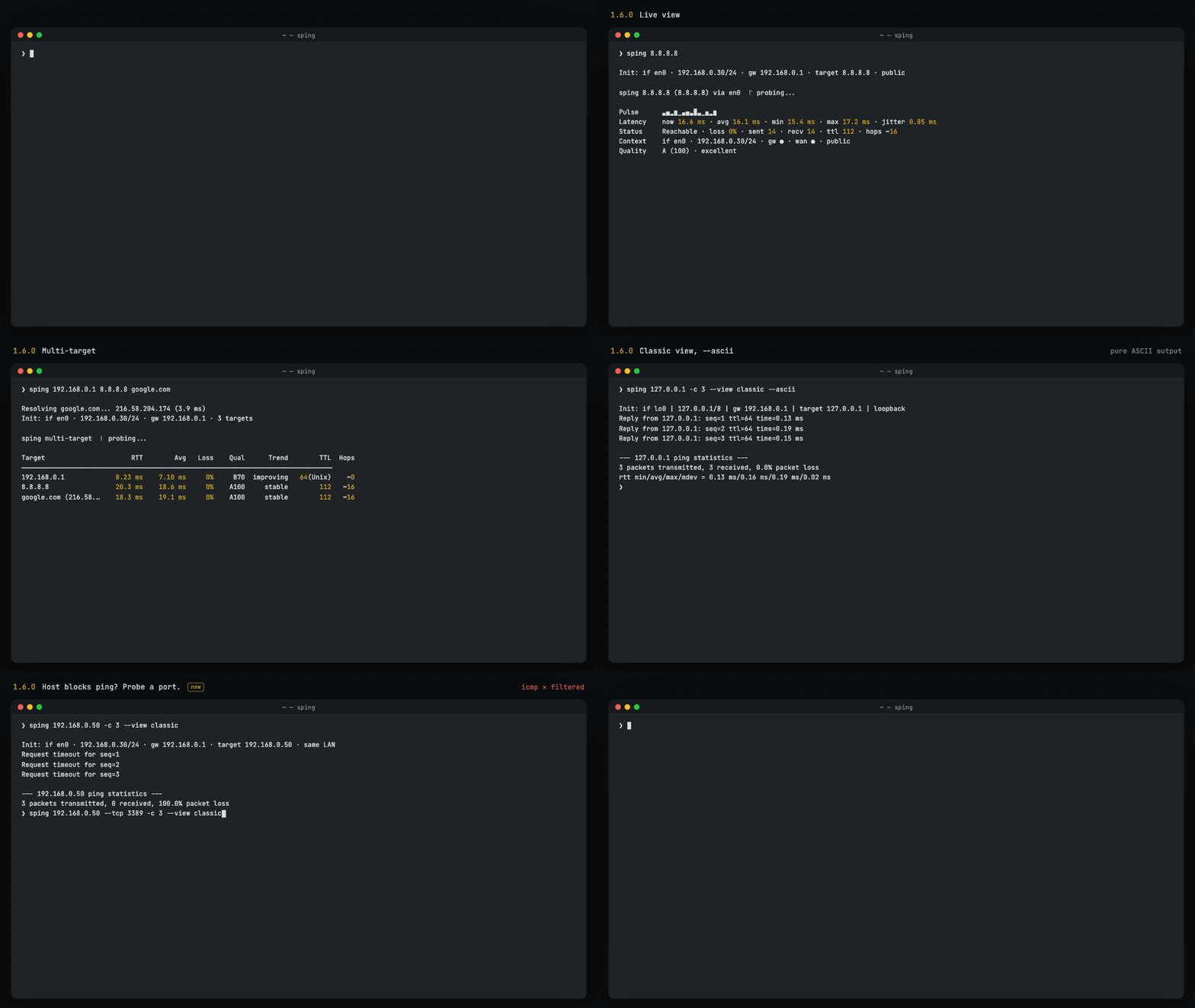
Status: functional and in active use, with a frozen JSON contract. Linux, macOS and Windows; x86_64, aarch64 and armv7 (Raspberry Pi).
Answers three questions at once:
- Does the target respond? — RTT, TTL, jitter, loss, quality score, trend
- Do I have network from this interface? — gateway reachable, WAN reachable
- What type of problem is it? — correlated diagnostics, automatic
sping google.com (216.58.204.174) via eth0  ⠙ probing...

Pulse      █▇▆█▁▃█▄
Latency    now 13.8 ms · avg 13.9 ms · min 13.6 ms · max 14.1 ms · jitter 0.19 ms · dns 18.5 ms
Status     Reachable · loss 0% · sent 8 · recv 8 · ttl 112 · hops ~16
Context    if eth0 · 192.168.1.100/24 · gw ● · wan ● · public
Quality    A (100) · excellent
What's new in 1.6.0
- TCP connect probe (
--tcp PORT): times the TCP handshake where ICMP is filtered or not allowed. An open port and a refused one both answer; see TCP connect. - The diagnosis as data: JSON lines carry
diagnosis, the findings as stable codes with their evidence, and in single-target mode thegatewayandwanstate they come from (see JSON_CONTRACT.md). - Clearer wording: the quality grades are named
excellent,good,fairandpoor; the TTL's OS hint appears only while the TTL is still an initial value; a loopback target isloopback. - Steadier scoring: the grade and the jitter warning read the same 20 probes, changes under 0.1 ms are noise, and lost probes count in the trend.
- Static Linux binaries (musl) for x86_64 and aarch64: Alpine and systems older than glibc 2.34 included.
- Homebrew:
brew install LambdaBytes/tap/sping; every release also goes to crates.io. - Fixes:
127.0.0.1gets its loopback interface with/8on Linux, macOS and Windows; on macOS the gateway and the interfaces are found under cron too.
Every change, version by version: CHANGELOG.md.
Multi-target dashboard
sping 192.168.1.1 8.8.8.8 google.com
Target                      RTT        Avg   Loss    Qual      Trend        TTL  Hops
───────────────────────────────────────────────────────────────────────────────
192.168.1.1             0.31 ms    0.30 ms     0%    A100     stable   64(Unix)    ~0
8.8.8.8                 13.6 ms    13.6 ms     0%    A100     stable        112   ~16
google.com (216.58.…    13.7 ms    13.6 ms     0%    A100     stable        112   ~16
Install
| Method | Command | Platforms | Man page and completions |
|---|---|---|---|
| Homebrew | brew install LambdaBytes/tap/sping |
macOS | yes |
| crates.io | cargo install sping |
Linux, macOS, Windows, with Rust 1.88+ | no |
| Pre-built binary | from the Releases page | Linux, macOS, Windows | no |
| Debian / Ubuntu package | .deb from the Releases page |
Debian 12, Ubuntu 22.04, Raspberry Pi OS (Bookworm) or later | yes |
| From source | cargo build --release |
Linux, macOS, Windows, with Rust 1.88+ | no |
Homebrew
From v1.6.0 on. Builds from source and installs the binary, the man page and the shell completions:
brew install LambdaBytes/tap/sping
From crates.io
Requires Rust 1.88+. Installs the binary only (no man page or shell completions):
cargo install sping
Pre-built binaries
Download from the Releases page:
| Platform | Asset |
|---|---|
| Linux x86_64 | sping-vX.Y.Z-linux-x86_64 |
| Linux aarch64 | sping-vX.Y.Z-linux-aarch64 |
| Linux x86_64, static | sping-vX.Y.Z-linux-x86_64-musl |
| Linux aarch64, static | sping-vX.Y.Z-linux-aarch64-musl |
| Windows x86_64 | sping-vX.Y.Z-windows-x86_64.exe |
| macOS Apple Silicon | sping-vX.Y.Z-macos-arm64 |
| Debian/Ubuntu amd64 | sping_X.Y.Z-1_amd64.deb |
| Debian/Ubuntu arm64 | sping_X.Y.Z-1_arm64.deb |
The Linux binaries and packages need glibc 2.34 or newer: Debian 12, Ubuntu
22.04, Raspberry Pi OS (Bookworm) or later. The -musl binaries are static
and run on any Linux of their architecture, Alpine and older systems
included.
Verify with SHA256SUMS from the same release. From v1.5.5 on, every file of
a GitHub release also has a build provenance attestation, which tells the
commit and the workflow run that produced it:
gh attestation verify sping-vX.Y.Z-linux-x86_64 --repo LambdaBytes/sping
Debian / Ubuntu (.deb)
sudo dpkg -i sping_1.6.0-1_amd64.deb # or _arm64.deb on aarch64The package installs:
- binary at
/usr/bin/sping - man page (
man sping) - shell completions for bash, zsh and fish
- docs under
/usr/share/doc/sping/
macOS binary
From v1.5.5 on, the macOS binary of a release is signed with a Developer ID and notarized by Apple, so it runs once it is made executable:
chmod +x sping-vX.Y.Z-macos-arm64
./sping-vX.Y.Z-macos-arm64 8.8.8.8
macOS refuses an earlier, unsigned binary until its quarantine attribute is
removed: xattr -d com.apple.quarantine sping-vX.Y.Z-macos-arm64.
From source
Requires Rust 1.88+ (edition 2024 + let-chains).
git clone https://github.com/LambdaBytes/sping.git
cd sping
cargo build --release
# Binary at ./target/release/sping
Usage
# Single target — compact view (default)
sping 8.8.8.8

# Multiple targets — dashboard table
sping 192.168.1.1 1.1.1.1 api.example.com

# Hostname
sping google.com

# Fast probing (200ms interval)
sping 8.8.8.8 -i 200

# Bind to an interface (Linux) / a source IP (Linux, macOS)
sping 8.8.8.8 -I eth0
sping 8.8.8.8 -S 192.168.1.100

# Another WAN reference for the gateway/WAN check (default 1.1.1.1)
sping 8.8.8.8 --wan-probe 9.9.9.9

# Ping-style flags: count, timeout, payload size, TTL, quiet, family
sping 8.8.8.8 -c 5                # stop after 5 probes (any view)
sping 8.8.8.8 -W 1                # 1s per-probe timeout
sping 8.8.8.8 -s 120              # 120-byte payload
sping 8.8.8.8 -t 10               # outgoing TTL / hop limit
sping 8.8.8.8 -c 10 -q --view classic  # quiet: summary only
sping example.com -4              # force IPv4 (-6 for IPv6)
sping fe80::1%eth0                # IPv6 link-local: the zone is required

# TCP connect instead of ICMP (see "TCP connect" below)
sping example.com --tcp 443
sping 192.168.1.1 10.0.0.5 --tcp 22   # every target, the same port

# ASCII-only output: automatic on non-UTF-8 locales and on the legacy
# Windows console (SPING_ASCII=0 forces Unicode); NO_COLOR honored
sping 8.8.8.8 --ascii

# List interfaces
sping --list-interfaces

# Debug mode
sping --debug 8.8.8.8
Exit codes are ping-compatible: 0 replies received, 1 no replies, 2 error.
Batch mode
Probe a list of targets from a file:
# Create a hosts file (one target per line, # comments allowed)
cat > hosts.txt << EOF
8.8.8.8
1.1.1.1
google.com
192.168.1.20
EOF

# Summary to stdout (10 probes per host)
sping --batch hosts.txt -c 10

# JSON output
sping --batch hosts.txt -c 20 --view json

# Save to file
sping --batch hosts.txt -c 10 -o results.txt

# JSON to file
sping --batch hosts.txt -c 10 -o results.json --view json

# Fast interval
sping --batch hosts.txt -c 50 -i 200
Output (summary):
8.8.8.8                  10/10  0%  avg 13.6 ms  min 13.6 ms  max 13.7 ms  jitter 0.05 ms  ttl 112 hops ~16  A(100) stable
1.1.1.1                  10/10  0%  avg 20.0 ms  min 19.9 ms  max 20.1 ms  jitter 0.08 ms  ttl 52 hops ~12  A(100) stable
All targets are probed in parallel. Full diagnostics (quality, trend, spikes) included.
Views
sping 8.8.8.8                    # compact (default) — fixed TUI
sping 8.8.8.8 --view extended    # compact + RTT dist + echo path
sping 8.8.8.8 --view classic     # traditional ping scrolling
sping 8.8.8.8 --view json        # NDJSON for scripting
sping 8.8.8.8 --view json | jq '{rtt: .rtt_last, ttl: .ttl, quality: .quality}'
TCP connect
--tcp PORT times the TCP handshake with the port instead of sending ICMP
echoes. It needs no ICMP permission and gets through networks that filter
ICMP; it works in every mode (single target, multi-target, batch) and view.
- An open port (
Connected to) and a refused one (Refused by) are both answers: something replied, with its time. A refusal may come from the target or from a device on the way (a firewall can refuse for it), so it shows the path works, not that the service is up. The summary counts them:10 connects, 10 answered (3 refused), 0.0% loss. - No answer before
-Wis a loss; a local failure (no route, for example) is an error, as a failed ICMP send. - On Windows each probe sends a single SYN, never retransmitted: Windows
otherwise retries after a refusal and reports it only after about 2 s.
Windows waits for the answer to that SYN about 3 s at most, so a
-Wabove 3 s ends there. -Wis the connect timeout,-tthe TTL / hop limit,-4/-6the family;-Sbinds the source address on every platform, Windows included;-Ibehaves as with ICMP.-sdoes not apply and is rejected.- A source address that cannot be bound is an error (exit code
2). - TCP has no TTL to read: there is no
ttl, OS hint or hop estimate. The views show the port (tcp/443) and how the last connect ended: the compact and extended views say it in Events (TCP 443 connected · 21 ms,TCP 443 refused · host or firewall answered,TCP 443 timeout · no answer), the table and batch lines asopen,refused,timeoutorerror; JSON addsprobe,port,refusedandtcp_state(see JSON_CONTRACT.md). - The gateway and WAN probes of the compact and extended views stay ICMP.
- One new connection per probe, closed normally (no reset): each one
established leaves a
TIME_WAITentry on this host, as any short connection does.
ICMP permissions
sping works without admin/sudo on all platforms. On Linux it uses unprivileged
DGRAM ICMP sockets (the net.ipv4.ping_group_range sysctl, which covers all
users by default on Debian and most distributions), and falls back to a RAW
socket only when DGRAM is denied.
If DGRAM ICMP is restricted, widen the allowed group range:
sudo sysctl -w net.ipv4.ping_group_range='0 2147483647'Two features require CAP_NET_RAW (the RAW fallback and interface binding with
-I/--interface). Grant it to the binary without running as root:
sudo setcap cap_net_raw+ep /usr/bin/sping
Features
Measurement
- ICMP echo over IPv4 and IPv6 with its own implementation on each platform,
no admin rights needed, and a TCP connect probe (
--tcp PORT) where ICMP is filtered - Quality score A–D (excellent, good, fair, poor; 0–100) over the last 20 probes, with a trend (stable/improving/degrading) that counts lost probes
- Spike detection with adaptive threshold and cooldown
- Outage timer with recovery events
- RTT, jitter, loss and
mdev; RTT distribution p50/p95/p99, range and spikes (extended view); kernel receive timestamps on Linux - TTL + hop count:
ttl 116 · hops ~12; an OS hint only while the TTL is still an initial value (ttl 64 (Unix-like),128 (Windows),255 (network)): past a router the TTL no longer says who answered
Network context and diagnosis
- Network context of each target: interface, source address and prefix, default gateway and target class (same LAN, routed internal, public, default gateway, link-local, loopback)
- GW/WAN auxiliary probes with hysteresis (3 fails → offline, 2 ok →
online); the WAN reference is
1.1.1.1or--wan-probe IP - Diagnostic correlation: "target unreachable · internet still OK", "gateway unreachable · local network issue likely"; in JSON as stable codes with their evidence
- While monitoring, hostnames are resolved again every 60 s: when the address leaves the DNS answer, sping moves to another one of the same family. In single-target mode the context is detected again every 15 s
- IPv6 link-local targets with their zone (
fe80::1%eth0)
Views and modes
- Five views: compact (default), extended (adds the RTT distribution and the echo path), classic (ping-style), JSON and the multi-target table; the compact and extended views fall back to classic when the output is not a terminal
- The pulse bar of the recent probes, scaled to their own RTT range, with losses marked and spikes in color
- Multi-target dashboard and batch mode from a file (summary or JSON, to stdout or a file)
- JSON output — stable NDJSON format, with the diagnosis as codes and the gateway/WAN state it comes from, see JSON_CONTRACT.md
- Ping-style flags (
-c,-W,-s,-t,-q,-4/-6,-i,-I,-S) and ping-compatible exit codes - ASCII output (
--ascii, automatic on non-UTF-8 locales and on the legacy Windows console) andNO_COLOR - Monitoring stops cleanly on Ctrl+C and on SIGTERM (Unix) and prints the
final summary (every view but JSON); the classic, JSON and batch output
handle a closed pipe (
sping … | head) - Debug mode —
--debugorSPING_LOG=debug
Distribution
- Binaries for Linux x86_64 and aarch64 (glibc 2.34+, and static with musl),
macOS arm64 and Windows x86_64;
.debpackages with the man page and the shell completions; Homebrew and crates.io - On GitHub releases: the macOS binary signed and notarized, and a build provenance attestation for every file
Platforms
| Feature | Linux | macOS | Windows |
|---|---|---|---|
| IPv4 ICMP | DGRAM socket | DGRAM socket | IcmpSendEcho |
| IPv6 | ICMPv6 DGRAM | ICMPv6 DGRAM | Icmp6SendEcho2 |
| TTL / hop limit | recvmsg | IP header (IPv4), recvmsg (IPv6) | API (IPv4 only) |
| Gateway detection | /proc/net/route | /sbin/route |
route print |
| Interface detection | /proc/net/route, if_inet6 | /sbin/ifconfig |
GetAdaptersAddresses |
-I interface |
SO_BINDTODEVICE | accepted, no effect | warning, unbound |
-S source |
bind() | bind() | OS routes (TCP: bind()) |
| TCP connect | socket2 | socket2 | socket2 (Winsock) |
| Admin required | No | No | No |
| All views | full | full | full |
Architecture
Own ICMP implementation per platform. No third-party ping libraries.
- Linux:
socket2DGRAM (RAW fallback) +libcrecvmsg for TTL / hop limit - macOS:
socket2DGRAM + IP header parsing for the IPv4 TTL, recvmsg for the IPv6 hop limit - Windows:
IcmpSendEcho/Icmp6SendEcho2FFI fromiphlpapi.dll - TCP connect (
--tcp):socket2on every platform, one connection per probe
Async Tokio runtime, watch channels, single-writer renderer at 10 FPS.
Supported architectures
x86_64, aarch64 and armv7 (armhf) are compile-checked; aarch64/armv7 cover
Raspberry Pi OS (64- and 32-bit). Release artifacts are produced for Linux
x86_64/aarch64 (glibc, and static with musl), macOS arm64 and Windows x86_64.
Known limitations
-I/--interfacebinds only on Linux: macOS accepts the flag but it has no effect, Windows prints a warning and probes unbound.-S/--sourceis ignored by ICMP on Windows, where the OS picks the route;--tcpbinds it.- The raw-socket fallback and
-IneedCAP_NET_RAW(see SECURITY.md); the unprivileged DGRAM path covers the common case. - Names go through the system resolver (5 s timeout) and are resolved again every 60 s while monitoring; sping does no reverse DNS and keeps no DNS cache of its own.
- The static
-muslbinaries resolve names with musl's own resolver:/etc/hostsand the servers in/etc/resolv.conf, without the system's NSS modules (mDNS.localnames, for example, do not resolve). - IPv6 replies carry a hop limit (
ttl) on Linux and macOS; on Windows it is not shown (0in JSON). Gateway detection and--list-interfacesare IPv4 only. - With
--tcp, the gateway and WAN probes stay ICMP: without ICMP permission they are disabled with a warning and show?. - An IPv6 link-local target needs its zone:
fe80::1%eth0, or the interface index (fe80::1%2), which is the only form Windows takes.
Roadmap
- Distribution packaging: AUR, Fedora/COPR, Debian/Raspberry Pi OS (work in
progress under
packaging/). - nixpkgs: the package is under review.
Performance
| Metric | Value |
|---|---|
| Binary | 1.6 MiB (stripped + LTO) |
| RAM | ~4 MB resident |
| CPU | < 1% at two probes per second |
| Code | ~10,800 lines Rust |
| Tests | 207 (177 unit + 30 E2E) |
License
MIT