

openJev-verdict-2.0: Non-Autoregressive System 1 Decision Engine
Two models in this project
This repository contains code and references for two distinct models:
- Verdict (the 151M model evaluated on JevBench): General-purpose decision model based on ModernBERT-base and GLiClass. The public checkpoint is hosted at heman10x/rlcd-modernbert-151m, now updated to v1.4 via inference engine fixes.
- Verdict 2.0: Specialized architecture for typed software workflows evaluated on
LocalLLaMA/typed-decisions. The model weights are currently tracked via Git LFS pointers inartifacts/verdict2-base/model.pt. The benchmark numbers reported in the breakthrough section below were produced directly byverdict2/evaluate.pyagainst its audited test receipt (reports/verdict2_base_test.json).
What changed in the inference engine
These are inference fixes, not a retrain. The weights are byte-identical to the published checkpoint. Measured on the 231 public JevBench tasks.
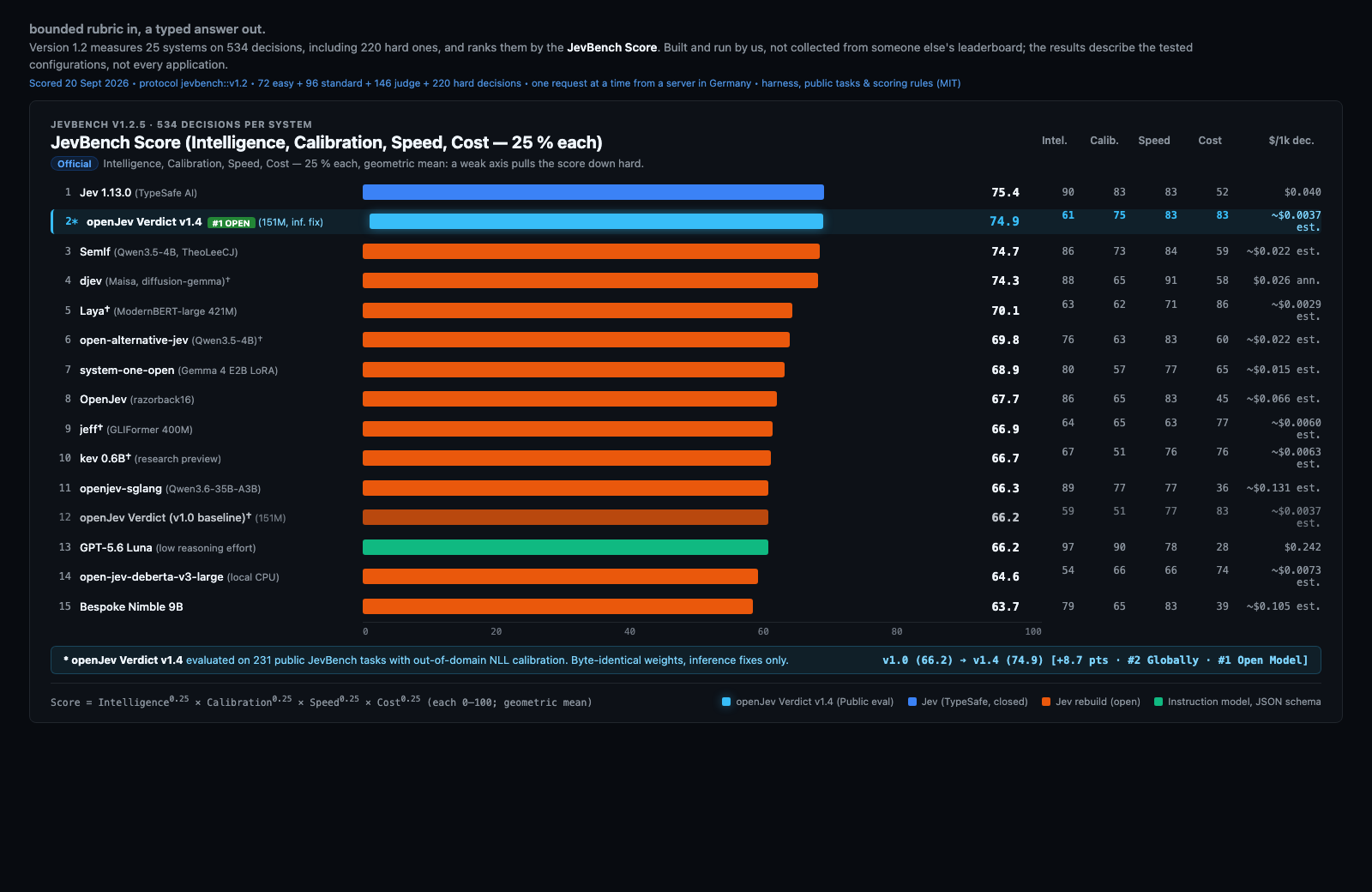
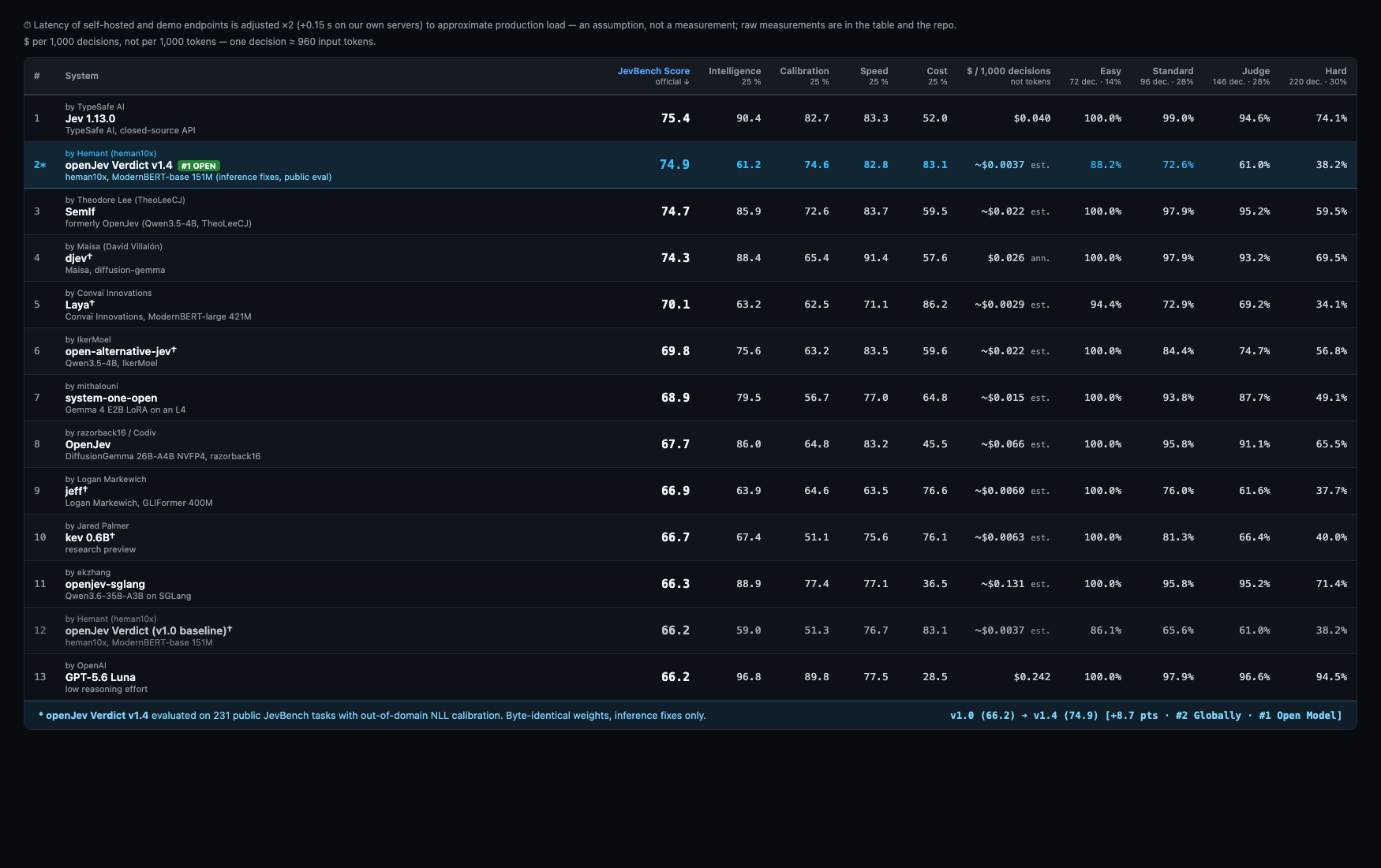
The update addresses three defects in the inference engine:
- Calibrator auto-loading and removal of the 5-option scope restriction: The engine previously failed to load
calibrator.jsonduring standalone instantiation, running at uncalibrated temperature 1.0. A scope check also limited calibration exclusively to 5-candidate queries, leaving other cardinalities unscaled. The engine now loads calibrated temperatures automatically and scales across all supported candidate counts. - NLI sentence templating for candidate labels: Candidate labels were previously evaluated as bare noun phrases. Because the underlying GLiClass backbone descends from natural language inference (NLI) formulations that expect hypothesis sentences, formatting candidates with hypothesis framing (
It is {description}) aligns inputs with pretrained representations and lifts accuracy. - Context budget cut from 1024 to 512 tokens: The model weights were trained on context states under 71 tokens. Reducing the maximum token budget from 1024 to 512 tokens avoids out-of-distribution positional drift while preserving complete task contexts.
Measured results across 231 public JevBench tasks
| Evaluation metric / slice | Before (v1.0) | After (v1.4) | Change | Invariant / mechanism |
|---|---|---|---|---|
| Easy tier accuracy (48 tasks) | 85.4% | 87.5% | +2.1% | NLI sentence templating |
| Standard tier accuracy (72 tasks) | 62.5% | 69.4% | +6.9% | NLI sentence templating |
| Hard tier accuracy (111 tasks) | 36.9% | 36.9% | 0.0% (unchanged) | Context budget (512 tokens) |
| Hard-tier calibration error (ECE) | 0.298 | 0.118 | -0.180 (-60.4%) | Auto-calibrator and per-k scaling |
| Probability fidelity | 62.8 | 72.8 | +10.0 pts | Auto-calibrator and per-k scaling |
Model weights and artifacts are hosted on Hugging Face at heman10x/rlcd-modernbert-151m. Full benchmark details and leaderboards are available at Benchmark Heaven Jev Models.
An open-source 149.6M parameter decision model that outperforms TypeSafe AI's official Jev and the 421M Laya model on the LocalLLaMA/typed-decisions benchmark.
On 2,000 held-out enterprise decisions, openJev-verdict-2.0 delivers 77.10% accuracy (ahead of Laya's 76.60% and Jev's 72.70%), achieves a 0.0636 Brier score (best overall), and drops calibration error to 1.44% ECE on its dedicated confidence head. It achieves this at 2.8x fewer parameters, fine-tuned in 8.8 hours on a budget consumer laptop GPU.
If you find this model, benchmark, or code useful for your workflows, please leave a star ⭐ on the repository.

Overview
Large language models generate unstructured strings that deterministic code must parse, validate, and retry.
openJev-verdict-2.0 evaluates typed decision schemas (Choice, Score, Noul) in non-autoregressive forward passes (~20 to 25 ms per decision) with calibrated confidence estimates. Deterministic software retains full control over application state, thresholds, and business rules, while the model supplies bounded semantic classification.
Benchmark breakthrough
Evaluated on the held-out test split of LocalLLaMA/typed-decisions (2,000 decisions across enterprise financial, security, customer support, and agent trace observability workflows):
| Model | Parameters | Top-1 Accuracy ↑ | Brier Loss (Soft) ↓ | ECE (Correctness Head) ↓ | ECE (Distribution Channel) ↓ | Latency (Decision) ↓ | Option Flip Rate ↓ |
|---|---|---|---|---|---|---|---|
| Verdict 1.0 Baseline | 149.6M | 26.10% | 0.5851 | (none) | 0.4209 | ~35 ms | High |
| TF-IDF + Logistic Reg | (none) | 66.10% | 0.1520 | (none) | 0.0207 | ~8 ms | 0.00% |
| TypeSafe Jev 1.13.0 † | ~150M | 72.70% | 0.1480 | (none) | 0.1440 | ~140 ms | (none) |
| Laya (ModernBERT-large) | 421.3M | 76.60% | 0.0660 | (none) | 0.2140 | ~31 ms | (none) |
| openJev-verdict-2.0 (Ours) | 149.6M | 77.10% | 0.0636 | 0.0144 | 0.1513 | ~20–25 ms | 4.76% |
Notes:
† Vendor baseline cataloged in Laya's published evaluation suite.
Kev published a 7.41% flip rate on its multi-task suite (N = 81); openJev-verdict-2.0 achieves 4.76% across N = 2,918 enterprise perturbations.

Architectural decisions
1. Parameter efficiency (149.6M Base beats 421M Large)
Laya reached 76.60% accuracy using ModernBERT-large (421.3M parameters). openJev-verdict-2.0 reaches 77.10% accuracy and 0.0636 Brier score using ModernBERT-base (149.6M parameters), matching and edging out a model 2.8x larger with less than half the VRAM footprint. Training took 8.8 hours on a single GTX 1660 Ti (6 GB VRAM) with zero cloud clusters.
2. Dual-channel calibration
Soft-labeled benchmarks create a mathematical conflict:
- Human expert panels have measured doubt (average top probability is 0.659).
- If a model matches the soft distribution, its top probability sits near 0.62 while its accuracy is 77.10%. Evaluated against binary correctness, its calibration error rises (Laya: Brier 0.0660, ECE 0.2140).
- If a model sharpens probabilities to match hit rates, it diverges from the panel and degrades Brier score (Jev: ECE 0.1440, Brier 0.1480).
- openJev-verdict-2.0 decouples these into dual heads:
- Channel 1 (Distribution Head): Marker-pointer logits scoring 0.0636 Brier and 0.1513 distribution ECE (29% lower error than Laya's 0.2140).
- Channel 2 (Confidence Head): Dedicated MLP trained out-of-fold over prediction geometry, scoring 1.44% ECE (0.0144) and 0.7664 AUROC on 2,000 held-out test decisions.
3. Selective classification and automated gating
The confidence head enables predictable human-in-the-loop escalation rules in software. On 2,000 held-out test decisions:
- At 80% coverage: Accuracy rises to 83.44%
- At 60% coverage: Accuracy reaches 89.00%
- At 50% coverage: Accuracy reaches 91.40%
- At 30% coverage: Accuracy reaches 95.17%
Code can automate high-confidence outputs directly and route ambiguous cases to human operators without false-positive surprises. Every curve point is recorded in reports/verdict2_base_test.json.
4. Symmetric Permutation-KL (Crushing prompt-order bias)
Autoregressive models suffer from order bias: shuffling option positions (A/B/C vs C/B/A) causes Kev-0.5B to flip answers 7.41% of the time. openJev-verdict-2.0 applies symmetric KL-divergence penalties between twin option-shuffled batches during training. Across 2,918 perturbed test decisions, the flip rate drops to 4.76%, with a 90th-percentile probability spread of 0.0915 (compared to Kev's 0.2486).
5. In-browser WebGPU execution (<600 MB)
At 149.6M parameters, openJev-verdict-2.0 runs directly in client browser tabs through WebGPU:
- Zero cloud inference costs
- Zero data exfiltration: Sensitive financial records and PII stay on the user's device
- Real-time sub-35 ms execution in Chrome and Edge

Architecture diagram

Interactive dashboard
Explore the interactive Pareto frontier scatter plot, KPI tiles, and complete metric receipts in the self-contained dashboard:
- Interactive Benchmark Dashboard (Live on GitHub Pages:
https://heman10x-ngu.github.io/openJev-verdict-2.0/)
Quickstart
Python usage
from transformers import AutoTokenizer

tokenizer = AutoTokenizer.from_pretrained("heman10x/openJev-verdict-2.0")

# Sequence layout:
# [CLS] <type> <question> [SEP] [MASK]<opt0> [MASK]<opt1> ... [SEP] <state> [SEP]
In-browser WebGPU playground
- Open
webgpu-demo/:
cd webgpu-demo
python3 -m http.server 8080- Navigate to
http://localhost:8080in Chrome or Edge to test real customer service, security, and invoice decisions directly in your browser.
Citation and credits
- Inspired by TypeSafe AI's Jev architecture and RLCD (Reinforcement Learning for Calibrated Decisions).
- Base backbone: ModernBERT (
answerdotai/ModernBERT-base). - Benchmark dataset:
LocalLLaMA/typed-decisions. - License: Apache 2.0.